

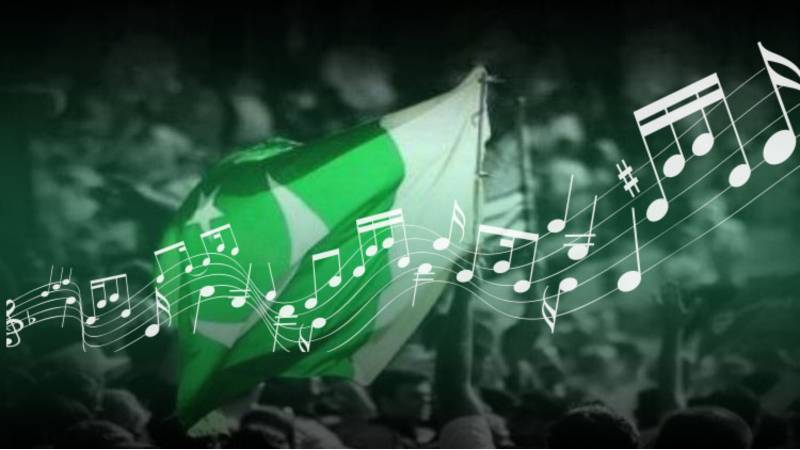
From the crackling sound of the radio in the 1960s to curated playlists on smartphones today, Pakistan’s national songs continue to stir the hearts of millions. Played across the country on Independence Day (14th August), Pakistan Resolution Day (23rd March), Defence Day (6th September), or in response to national tragedies such as the 1971 war or the APS school attack in 2014, these songs serve not only as melodies of pride but also as emotional narratives of national resilience, identity, and unity, concluded by the authors in their research work.
With voices like Mehdi Hassan’s resonant “Apni jaan nazar karoon, apni wafa pesh karoon” and Noor Jehan’s wartime ballad “Ae puttar hatan te nai wikday,” these compositions have long glorified the military’s valor and reinforced narratives of sacrifice. Many Pakistanis, regardless of age or background, feel a visceral emotional response to these anthems. One of the participants in our study, Zahra Fatima, recounts how her grandfather, though suffering from Alzheimer’s, responds with spirited chants of “Pakistan Zindabad!” when national songs play, a testament to their deep-seated imprint on the national psyche.
Beyond mere patriotism, national songs have historically played a crucial role in uniting the populace during moments of collective crisis. From the fall of Dhaka in 1971 to the APS tragedy in 2014, songs like “Is parcham ke saaye taley hum aik hain”, “Bara dushman bana phirta hai”, and “Mujhay dushman ke bachon ko parhana hai” transcended sectarian, ethnic, and political divides. They rallied the nation behind a single cause: unity, valour, and faith.
A democratic approach to national song composition could serve not only to unify but also to represent the diverse ways in which Pakistanis contribute to their country
These songs are not just musical compositions; they are emotional tools of nation-building. They narrate stories of heroism, reinforce collective memory, and offer solace and strength in turbulent times.
However, despite their emotional resonance, a growing number of voices have begun to question the limited thematic focus of Pakistan’s national songs. Most revolve around military sacrifice, war victories, or defense preparedness, such as the motivational anthem “Har ghari tayyar Kamran hain hum” reinforcing a singular image of heroism.
While honoring the military is important, this exclusivity appears to marginalise other forms of national service and sacrifice. Teachers, healthcare workers, farmers, scientists, artists are individuals who no doubt quietly shape the nation’s future, rarely find representation in the Pakistani national songs.
Asad, a participant in our study, critics contemporary national songs, while underscoring the commercial sheen and political messaging that sometimes dilute their emotional depth. “They’ve become flashy, commercial productions that lack soul,” he says. “The poetry is increasingly politicised, serving more as a polarised voice to manipulate like-minded individuals than inspiring them for social and cultural cohesion.”
This critique opens the door for an essential reimagination. What if national songs expand their thematic repertoire? What if we compose songs about the schoolteacher who educates in the remotest areas, the polio worker braving threats to immunize children, or the female entrepreneur breaking barriers in rural and remote areas of Pakistan?
A democratic approach to national song composition could serve not only to unify but also to represent the diverse ways in which Pakistanis contribute to their country. It would acknowledge that patriotism is not confined to the battlefield but lives equally in the hospital ward, the classroom discourses, fields of Balochistan, KPK, Punjab, and Sindh, and the mountains of Baltistan and Kashmir.
Pakistani national songs have been a powerful medium for glorifying valour and instilling patriotism. Yet, for them to continue fostering true social cohesion, they must evolve. We must broaden our definition of service and heroism and let our national songs to reflect the full spectrum of sacrifices made by the people of Pakistan, not just those in uniform.
In doing so, we will not only honour our armed forces but also empower the voices of everyday heroes, forging a more inclusive and enduring sense of national pride. This is a step towards national cohesion, stability, and strength.