

It was a silvery winter morning in Lahore. Soft, gentle sunshine spread all around me. It was a beautiful day—one that would stay with me because it marked a new turn in my life’s journey. The year was January 2000. Only a few months earlier, I had moved from Karachi to Lahore, after spending three years teaching at the Aga Khan University’s Institute for Educational Development (IED). By late 1999, I had arrived in Lahore, where winter had already set in, and I had been entrusted with establishing a Faculty of Social Sciences at a private university.
One day, while sitting in my office, I wondered why not spark a serious national debate on education through the newspapers, whose reach is so wide. Acting on that thought, I obtained Dawn’s email address and sent an article titled Holistic Approach to Education, written from a critical perspective. Two weeks passed with no response, and I concluded that the editor had shown no interest. The surge of writing inside me subsided, and I immersed myself in life’s bustle.
Three or four weeks later, a friend from Islamabad phoned to say my piece had appeared prominently in Dawn. Words cannot capture my feelings at that moment, but the story did not end there. That same evening, I received a long email from Zubeida Mustafa, then Dawn’s editor. Twenty-five years have passed, yet that message remains saved on my laptop—one of my life’s treasures.
In her email, Zubeida first apologised for the article’s delayed publication, explaining she had been out of Karachi. She praised the piece warmly, writing that—despite trying—she had been unable to cut a single line. “There are few writers,” she added, “who approach education with such a critical and analytical style. I would like you to write regularly for Dawn on this subject.”
Sitting in a coffee shop in Riyadh, it seemed the twenty-five years in her company were like winter sunlight: immensely precious, yet all too brief
Reading her generous words filled me with joyous astonishment. Why would the editor of Dawn encourage an unknown newcomer at such length? And what passion for education blazed in every line of her message! I later found both answers in Zubeida’s own life story. After completing her early schooling, she earned a degree in International Relations from Karachi University and then studied Economics at the London School of Economics (LSE). Those varied disciplines broadened her horizons. Returning to Karachi, she began work at a research institute until 1975, when she met the celebrated editor of Dawn, Ahmed Ali. His discerning eye recognised the hidden journalist within her and invited her to write for Dawn’s editorial pages. Embracing the challenge, Zubeida and Dawn became inseparable.
Over the years, she launched innovative pages and magazines on education, health, and books—giving voice to society’s marginalised groups and using journalism for social change. Believing education deserved more space, she dedicated an entire page to it in Dawn. It was there that my first article appeared, and at her urging, I began writing regularly for that page. Meeting deadlines became second nature, and most of my readers came from academia, much to Zubeida’s delight. Yet she was always seeking new horizons.
One day, she phoned with an idea: “Shahid, why don’t we start a series of articles, in simple language, aimed at students—pieces that enhance their study skills?” At her request, I wrote a twenty-two-part series titled Learning to Learn for Dawn.
Soon, another horizon beckoned. Zubeida decided the editorial pages should also carry a regular education column—and asked me to write it. I felt deeply honoured. My column appeared every other week for nearly nine years.
Not long afterwards, she called again, excitement in her voice: “Shahid, we’re launching a new magazine in Dawn devoted to books—Books and Authors. You will need to write weekly reviews.” The magazine emerged in full glory, and I wrote reviews during its early phase. After nine years with Dawn, I moved to The News editorial pages to write on education and language, and later began a weekly Urdu column for the newspaper Dunya.
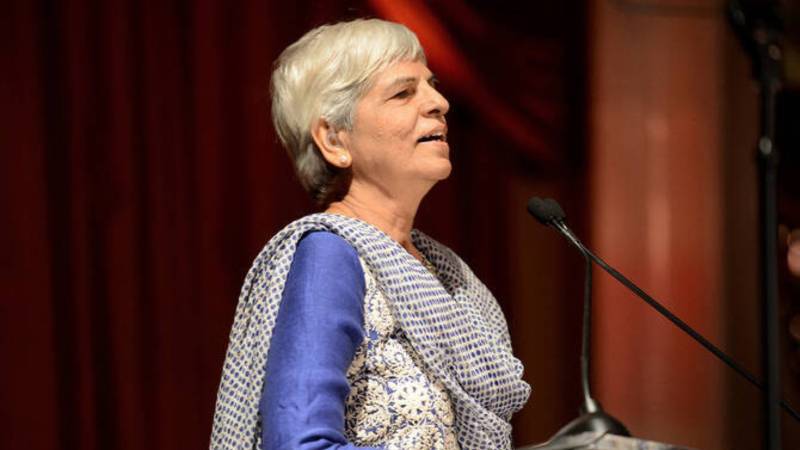
We spoke occasionally by phone or met at conferences. Then one day, she told me she was retiring, after thirty-four years with Dawn. Silver now threaded her black hair—a grace all its own. Her eyesight was dimming, yet her restless spirit remained. In retirement, she wrote her memoir, My Dawn Days, and produced the important education volume, Tyranny of Language. Despite ill health, she wrote until the end.
Recently, I travelled to Riyadh, Saudi Arabia. Sitting in a coffee shop, working on my laptop, I received news that my friend and mentor, Zubeida Mustafa, had left us forever. I leaned my head against the chair, closed my eyes, and remembered that silvery Lahore morning when I was introduced to Zubeida through her email. How enchanting it had been, the soft winter sun all around me. And now, sitting in a coffee shop in Riyadh, it seemed the twenty-five years in her company were like winter sunlight: immensely precious, yet all too brief. I scarcely realised how quickly the day had passed.