

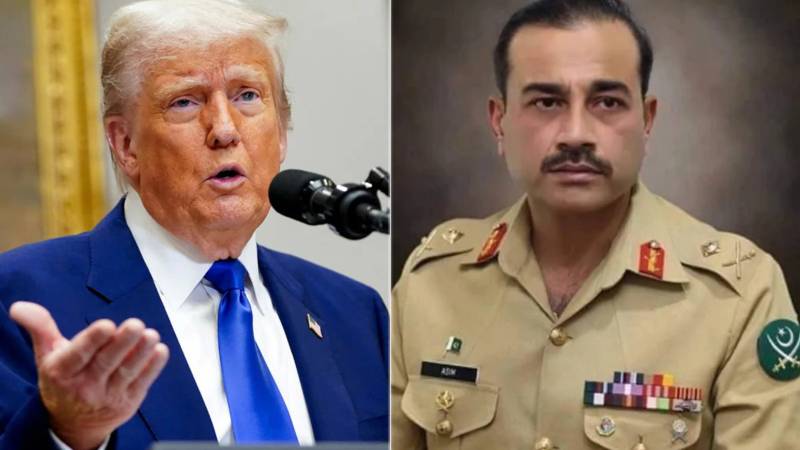
In diplomacy, setting matters as much as substance. So when Pakistan’s Chief of Army Staff, General Asim Munir, was welcomed to the White House—not just the Pentagon—it carried more than symbolic weight. It offered insight into how the United States navigates power structures in strategically complex states like Pakistan, and how Pakistan, in turn, presents itself in moments of global uncertainty.
Rather than sparking simplistic debates about civil-military imbalance, the visit deserves a more grounded interpretation: it reflected Washington’s pragmatic approach to influence, Islamabad’s evolving statecraft, and the reality that regional stability often relies on institutional effectiveness over protocol formality.
General Munir’s visit came at a moment of heightened global flux. From Europe to the Indo-Pacific, strategic fault lines are deepening, and global powers are recalibrating alliances, roles, and influence. In this context, Pakistan remains a strategically located country, with connections across South Asia, the Gulf, and Central Asia.
The Trump administration’s decision to engage General Munir at the highest diplomatic level signalled not only continuity in military-to-military ties, but also a desire to maintain direct dialogue with those capable of executing security policy with institutional backing. It was a realist move, grounded in the understanding that policy execution in Pakistan—particularly on security, counterterrorism, and regional coordination—often involves the military as a central actor.
Beyond bilateral matters, the meeting sent clear signals across the region. It reaffirmed Pakistan’s place in South Asia’s evolving security equation. The Army’s presence at this level of diplomacy indicated that Pakistan remains not just a stakeholder, but an enabler of regional stability or disruption, depending on the level of engagement.
The meeting reflected not only who holds sway in national security but also how power is read, assessed, and acted upon by global partners
For Washington, the optics served a purpose: reaffirming its willingness to work with established power centres while maintaining a stable security corridor in a volatile part of the world. For Pakistan, it was an opportunity to reinforce its strategic relevance at a time when global attention is increasingly fragmented.
Some observers see this as another example of the military’s outsized role in Pakistan’s foreign relations. But this reading may miss a broader point: Pakistan operates within a hybrid institutional framework, where civilian governments and military institutions share overlapping influence, particularly on matters of national security.
Whether one views this as a strength or a symptom of democratic asymmetry, it is the operating reality recognised by most of Pakistan’s international partners. Engaging with the military is not necessarily an endorsement of imbalance—it is a recognition of where implementation capacity currently lies.
As many in Washington and Islamabad understand well: the road to power and politik, especially on security, runs through Rawalpindi, not Islamabad.
General Munir’s White House meeting was not about personal stature. It was about institutional access and continuity. As the chief of Pakistan’s most organised and enduring institution, Munir represents an entity that has long served as the anchor of Pakistan’s strategic engagements—particularly with the United States.
Hosting the Army Chief at the White House also indicates a shift in diplomatic language, one that acknowledges effectiveness and stability over formal hierarchies. In high-stakes regions, form follows function—and function, in this case, lies with the institution most able to ensure security policy delivery.
The United States has long balanced democratic ideals with strategic imperatives. Its foreign policy in Pakistan is no exception. From the Cold War to the 21st-century counterterrorism era, Washington has engaged with Pakistan’s military during periods of urgency—whether through Zia-ul-Haq during the Soviet occupation of Afghanistan, Pervez Musharraf during the War on Terror, or General Kayani during the regional transitions of the Obama years.
These patterns underscore a U.S. doctrine that privileges capability and continuity when interests are at stake. The decision to meet General Munir in the White House fits this historical arc: it is neither exceptional nor unprecedented—but still revealing.
Diplomatic invitations to the White House are powerful signals. They confer recognition, legitimacy, and strategic trust. Inviting General Munir—while not including Pakistan’s civilian leaders in parallel meetings—may appear to some as symbolic of imbalance. But it could also be viewed as a form of strategic clarity: engaging where results are most likely to materialise.
This doesn’t negate the importance of strengthening democratic institutions in Pakistan. Still, it does reflect the real-world calculus that often governs high-level diplomacy: who can deliver, who can sustain, and who speaks with operational authority.
General Asim Munir’s White House visit was not an aberration, nor a break from diplomatic precedent. It was a moment that revealed the continued reliance on institutional realism in U.S.-Pakistan relations. The meeting reflected not only who holds sway in national security but also how power is read, assessed, and acted upon by global partners.
For Pakistan, it reaffirmed its role as a strategic actor with meaningful leverage. For the United States, it highlighted a continued willingness to engage pragmatically—not just with elected figures, but with institutions that can deliver.
The visit made one thing unmistakably clear: when it comes to security, strategy, and statecraft in Pakistan, the shortest route to Washington still begins in Rawalpindi.