

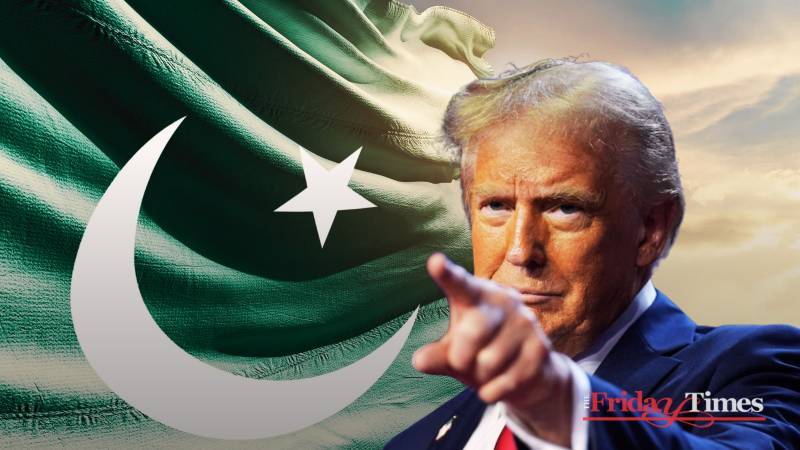
There are two categories of people at present in Pakistan. Those who like Imran Khan and want him out of jail and there are there who don’t like him or don’t care whether he comes out or not. For the latter, the state of the country and its economy are more important than any individual personality. For them, the coming of Donald Trump as US president for a second term brings in a lot of uncertainty, not least because one of the defining features of the new US president is his unpredictability.
For the former, i.e. the Imran Khan supporters, the expectation is that having Donald Trump in office for the second time will be good for their party because it will be good for their leader. They believe that with Trump as president, Pakistan will be pressured by the US to release Imran Khan, and given the leverage many think that the US enjoys over Pakistan, the former prime minister will indeed be released, and rehabilitated. The reasoning goes like this: America still enjoys leverage over Pakistan given the military assistance it provides it and given the close collaboration between the Pentagon and the Pakistani military.
However, the reality is that Pakistan doesn’t figure too high on the priorities of the incoming US president. For starters, there are no US troops in Afghanistan anymore and that was one of the key basis for the extended cooperation and collaboration in recent years between the US and Pakistan. That said, the Taliban now have a government there, and it's far less ostracized and isolated than the one in the late 1990s. America is likely to keep engaged with Pakistan because of this and because of its overriding concern that no terrorist outfit anywhere in the world should have the US in its sights. Such an engagement is likely to be far reduced, however, than in the past.
For Trump, the priorities, as he’s repeatedly mentioned both in the run-up to the election in November, and more so since being elected, have been China, Russia, Europe, Ukraine, Gaza-Israel-Palestine, Canada, Mexico, the EU and NATO, trade, and of course, illegal migrants. On trade, he has said he would consider imposing a flat tariff on all imports into the US and then spoke of imposing 25% tariffs on imports from Canada and Mexico. All such statements by him have been qualified, as in imposition of tariffs has been mentioned because the country in question has trade policies that harm US interests. It remains to be seen if he will impose such tariffs once he takes office, ironic in itself because the US Republican Party has historically been the biggest proponent of free trade.
Pakistan will have to be very cautious and careful because several Indian Americans, all sympathetic to Modi and the BJP, have been nominated to senior posts in the incoming US government, and also that the wife of the incoming Vice President is of Indian origin
Other issues like Gaza and Israel, Ukraine, the EU, and how it doesn’t fulfill its due role in NATO, have also figured in Trump’s statements. Apart from that no country in Asia, not even India, has figured in his speeches or statements. That of course has come as a major disappointment to Modi’s government which even sent Foreign Minister S Jaishankar to the US and he stayed there for several days in the hope of getting an official invite for his boss – but none was forthcoming.
Trump has also spoken publicly about China, and his recent statements have been more amiable, including one where he said he had spoken to Chinese President Xi Xinping and had hoped for a good working relationship with him. An indication of this is also from Trump’s most recent statement of Jan 19 where he said he would be issuing an executive order on Jan 20 soon after taking oath to allow TikTok to continue and be available in the US. This is a major U-turn given that he was a leading campaigner for its ban in the US in the past because it was accused of being hand in glove with the Chinese government and had been accused of spying on the US on behalf of China.
Trump has also spoken extensively of late on the European Union and NATO, how he thinks the EU countries need to step up, and how the US should stop funding the security of Europe on its own. On Ukraine, he has indicated an end to the war and also is not keen on giving any further US aid to Ukraine, and in fact, the US media has reported that a ceasefire is in the works, the details of which would seem to favour Russia, since it already holds the upper hand.
The reason for listing in detail all that Trump has been saying is that Pakistan – or even India, or South Asia – has simply not figured much into what seems to be on his mind.
Of course, Pakistan will have to be very cautious and careful because several Indian Americans, all sympathetic to Modi and the BJP, have been nominated to senior posts in the incoming US government, and also that the wife of the incoming Vice President is of Indian origin. Pakistan will have to be on its toes for the next four years as far as relations with the US are concerned.
Given that the US is its largest trading partner, it can try and expand that relationship further so that the US-Pakistan matrix isn’t overly based on a security framework. In any case, Pakistan and those who run it need to realise that the leader of the world’s most powerful country and the largest economy will only really care about your country – like he would any other – if your country had the economic clout needed to have a strong and equal bilateral relationship.