

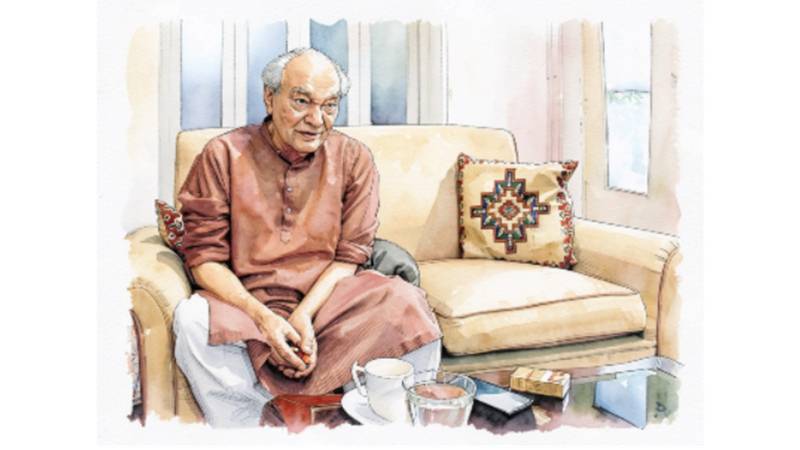
The passing of Raza Kazim at the age of 94 marks more than just the end of a long and storied life; it signifies the final collapse of a vital bridge. This bridge once connected the refined, intellectual Tehzeeb (culture) of North India to the increasingly fragmented and chaotic reality of modern Pakistan. In a world defined by the noise of hyper-specialisation and the frantic pace of the digital age, Kazim stood as the "Last of the Mohicans." He was a polymath—a lawyer, philosopher, musicologist, and inventor—who spent nearly a century diagnosing a profound national ailment: the disappearance of society itself and its replacement by a collection of isolated, survivalist individuals. To understand the weight of his loss, one must look beyond his courtroom successes or his musical inventions and examine his radical anatomy of the Pakistani soul—a critique that suggests our national struggle is not merely political or economic, but deeply psychological.
Raza Kazim’s philosophy was rooted in his lived experience of the mid-20th century, specifically the transformative decade of the 1940s. Born in 1930 in Sitapur, Uttar Pradesh, he was a child of the "Ganga-Jamuni" heartland, a region where intellectual depth was historically paired with a fierce sense of social responsibility. To Kazim, the year 1946 represented the peak of what he called "collective magnetism." He described the pre-Partition era not as a simple political campaign for a new country, but as a "countrywide movement" characterised by a powerful social equation. During this time, individuals from diverse backgrounds were "magnetised" toward a common goal. This shared purpose created a momentum that superseded individual or group differences, allowing people to move forward together as a unified nation and a cohesive society. It was a moment in history where the collective "We" was stronger than the individual "I."
However, the riots of August and September 1947 acted as a violent and sudden "repellent." For Kazim, Partition was much more than the redrawing of administrative borders; it was a "psychological earthquake" that fundamentally altered the human psyche in the region. The trauma of burning houses, communal slaughter, and the sudden uprooting of millions shattered the social magnetism of 1946. This violence did not just break homes; it broke the "social equation" that held people together. The collective spirit evaporated, replaced by a jagged, panicked, and survivalist instinct. Kazim famously described this post-Partition mindset as "everyone for himself." The trauma turned neighbors into strangers and citizens into competitors, marking the beginning of what he termed the "disappearance of society."
As the state transitioned from a 'People's Garage' of reform to a 'State Parade' of authority, it became an adversarial force standing over the people rather than moving with them
This lead to Kazim’s most haunting and enduring critique: the concept of the "Disintegrated Society." He argued that after 1947, Pakistan ceased to be a Samaj (a cohesive community) and fragmented into a collection of "reduced individuals." In a healthy society, there is a web of mutual care and collective planning—a shared understanding that the well-being of the one is tied to the well-being of the all. In a disintegrated society, that web is snapped and replaced by a cold, transactional individualism. Kazim observed that "success" shifted from being a national or communal milestone to a purely personal achievement. A young person’s ambition was no longer to build a better nation, but to follow an isolated career track, such as becoming a surgeon or a doctor, with no regard for the broader social framework or the needs of the community.
This fragmentation birthed a state of "cultural corruption" and extreme selfishness. To Kazim, cultural corruption was not merely about the decline of the arts or the loss of language; it was the decay of the moral and social norms that bind people together. He viewed the modern social structure as "inimical"—hostile and harmful—to the very existence of a social fabric. When the fundamental sense of "caring" for one’s neighbor or fellow citizen vanishes, the society technically ceases to exist. What remains is a crowd of people sharing the same geography but disconnected from each other’s humanity. In this environment, the collective "magnetism" of the past is replaced by a "repulsion" where people act as isolated units, driven solely by personal gain.
Kazim also applied this critique to the evolution of the state. He used a powerful metaphor to describe the state’s ideal role: the "People’s Garage." In this vision, the state is a service-oriented institution—a place where citizens go to have their social problems "repaired" and their collective lives improved through reform. It is a tool for the people, much like a garage is a tool for a car owner. However, he witnessed the Pakistani state transition into a "State Parade" of authority. The doctrine of the state shifted from reform to a focus on "orders and demeanour," enforced by a display of power. He spoke of the "divided bullet"—a state doctrine that uses force, such as "mounted police charges," to maintain control over a fragmented population rather than fostering genuine unity.
As the "Society Cargo"—the collective momentum and shared values of the people—was "cut" or severed from the state, the government became an adversarial force. It began to stand over the people rather than moving with them. This disconnect is the reason why the state often feels like a foreign or hostile entity to its own citizens today. The state operates as a "parade" of power, disconnected from the actual needs and social fabric of the people it is meant to serve. Without the "cargo" of a unified society to give it direction, the state becomes an institution of control rather than an instrument of progress.
Despite this bleak sociological outlook, Kazim lived his life as a defiant polymath, refusing to be reduced to a single label. He was a man of radical intersections: a high-profile lawyer who fought landmark cases like Reko Diq and the anti-usury (Riba) cases entirely for free. He saw these legal battles not as "billable hours," but as moral obligations to the public. He famously referred to his lucrative private legal work as "part-time intellectual prostitution"—a necessary means to fund his true mission of social and artistic reform. His earnings were poured into the Sanjan Nagar Institute of Philosophy and Arts in Lahore, which served as a sanctuary for intellectual exploration and the development of his original theories.
At Sanjan Nagar, he developed "Mentology," his own system of understanding the human mind. He believed that traditional frameworks like those of Marx, Freud, or Darwin were insufficient to explain the "post-biological" complexities of modern human consciousness. Mentology was his attempt to find a path toward human happiness through a deeper understanding of our internal mental processes. His search for harmony also extended into the world of music. Kazim spent decades and millions of rupees perfecting the Sagar Veena, a complex string instrument designed to produce a "perfection of sound." For him, tuning the Veena was a metaphor for tuning the human soul; he sought a beauty that was not just aesthetic, but structural, intellectual, and profound.
Kazim’s life was also defined by a masterclass in resistance. He did not just write about the "State Parade"; he stood directly in its path. He was imprisoned by almost every major regime in Pakistan’s history, including those of Ayub Khan, Zulfikar Ali Bhutto, and Zia-ul-Haq. The most harrowing of these experiences was the 1984 Attock Conspiracy Case, where he was accused of plotting against the Zia regime. He endured 19 months of psychological torture and the administration of experimental drugs, yet he emerged with his intellectual clarity and his spirit untouched. His resistance was never about a desire for political power; it was fuelled by a North Indian sense of Khuddari (self-respect) and an unwavering commitment to the "disappeared society" he hoped to revive.
As we look at Pakistan today, Raza Kazim’s diagnosis feels more relevant than ever. We are a nation struggling with economic collapse and deep political polarisation, but beneath these issues lies the fundamental problem of social disintegration. We have the "bullets" and the "parades" of state authority, but we have lost the "social magnetism" required to function as a community. Success is still measured in personal milestones—the degree, the job, the wealth—while the collective "cargo" of the nation remains adrift. Kazim’s mirror is a harsh one, showing us a population that has largely abandoned the idea of being a unified people in favour of individual survival.
The legacy of Raza Kazim is not just his legal victories or his musical inventions; it is the stinging question he leaves for the younger generation: Can a disintegrated collection of individuals ever truly become a nation again? He warns us that no amount of personal success can compensate for the collapse of the social fabric. He was the "Last of the Mohicans" because he belonged to a tribe that believed in the "Social Cargo"—the idea that we are all responsible for the direction of our collective ship.
In his life’s work—from the halls of Sanjan Nagar to the strings of the Sagar Veena—he left a blueprint for how we might begin to find that magnetism once more. Raza Kazim has left the "People’s Garage," and the lights at Sanjan Nagar may dim, but the clarity of his critique remains. He has given us a mirror that is hard, uncomfortable, and true. It is now up to us to decide if we have the courage to look into it and find the "We" that was lost in the trauma of 1947. Only by rediscovering mutual care and collective responsibility can we hope to move from being a "disintegrated society" back to being a true nation.