

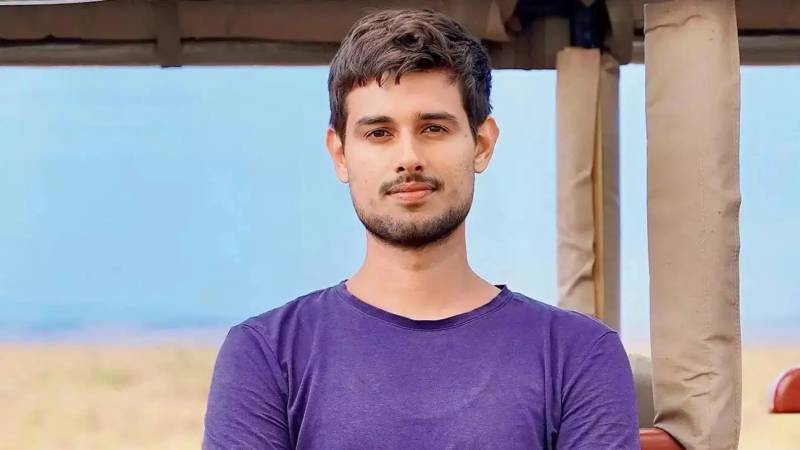
I have been following Dhruv Rathee for a while. He was the first channel that introduced me to educational content on social media. Like many others, I was impressed with the way he imparted well-thought-out content on social media that is often rife with negativity. His content showed that Indian youth were shining just as their country had progressed with its space program.
However, I also acknowledged in 2022 that he had his share of blind spots when his narrative equated Jinnah with Savarkar. Having reviewed Yasser Latif Hamdani’s Jinnah: A Life and Jinnah: Myth and Reality, and Muhammad Umair Khan’s Secular Muslim, I tend to support their narrative over the Pakistani liberal version that is consumed by self-flagellation. I thought that the Pakistani liberal version was too self-critical, whereas Dhruv’s critique was tempered by love for his country.
For a long time, I also felt that Dhruv had avoided the issue of Islamophobia in India under the BJP. However, I was surprised when video after video, Dhruv critiqued Hindutva and PM Modi. He even showcased case after case of false flag operations, where Hindutvists implicated Muslims to stoke communal violence.
With the terrorist attack on Pahalgam, I was anticipating that Dhruv might fall for nationalist tropes, but his video again had a mature take on calling for Hindu-Muslim unity in India.
However, he eventually succumbed to hyper-nationalism when he ignored Pakistani civilian casualties and collective punishment by India and instead engaged in essentialism by reducing Pakistan and Pakistanis through a singular lens, whilst ignoring the complex nuances that allow for a deeper understanding.
It seems that liberalism is susceptible to the weaponisation of victimhood and the terrorism narrative
In this regard, he is not alone, as even a more seasoned, well-traveled, and well-read person like Dr. Shashi Tharoor projects the same caricatures on Pakistan. The same holds for a cadre of educated and mature Indian Uncles who end up trolling Pakistani sites.
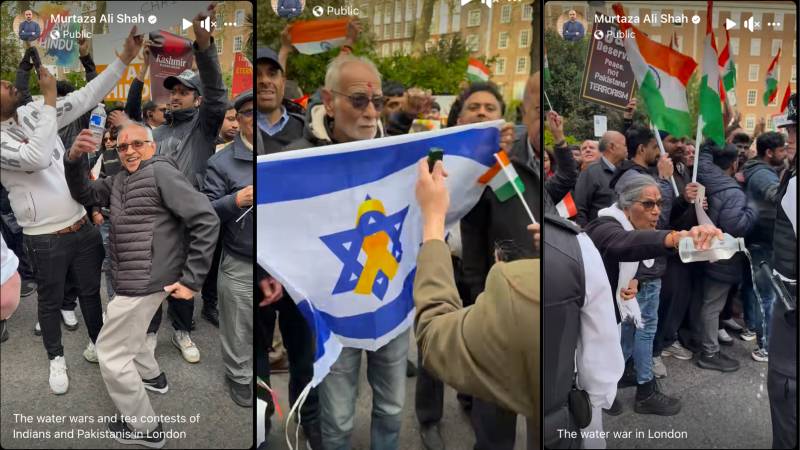
Such visuals were on full display at the protest against the Pakistan High Commission in London. Some Indian seniors held Israeli flags whilst other Uncles and Aunties expressed glee at the collective punishment through water. One even graphically mimicked washing his hindside with a water bottle.
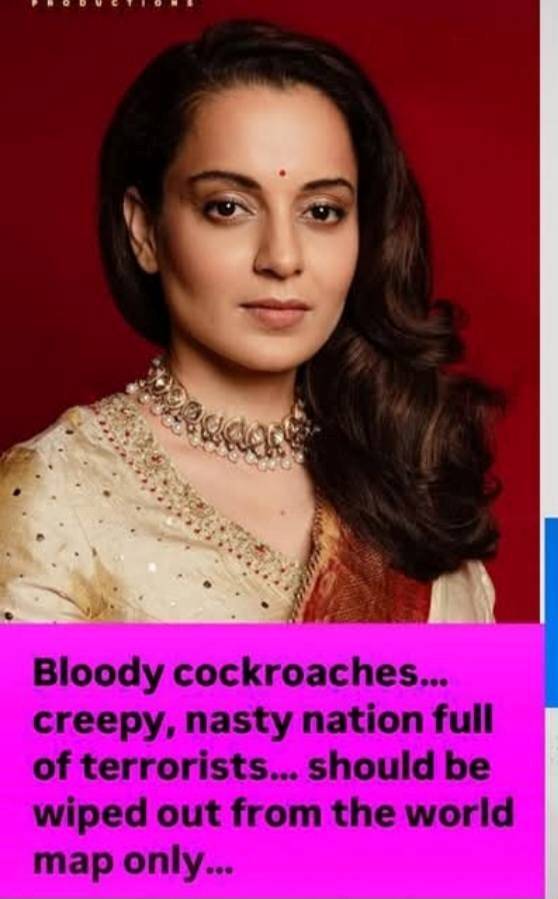
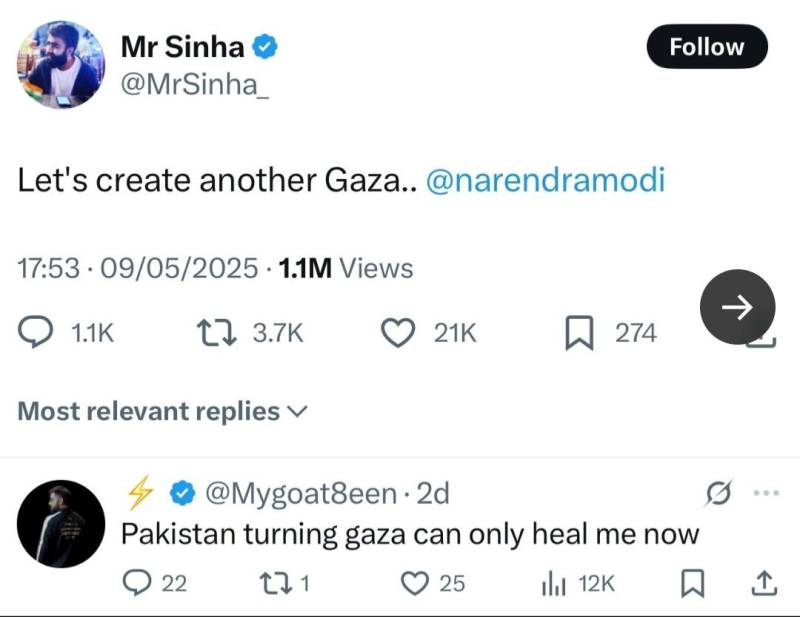
Indian actor Kangana Ranaut, celebrated by the BJP government, used genocidal language reminiscent of 1994 Rwanda with impunity. Educated Indians employed similar tropes of genocide and murdering babies. Their minions reflect a death cult that celebrates dead children with laughing emojis.
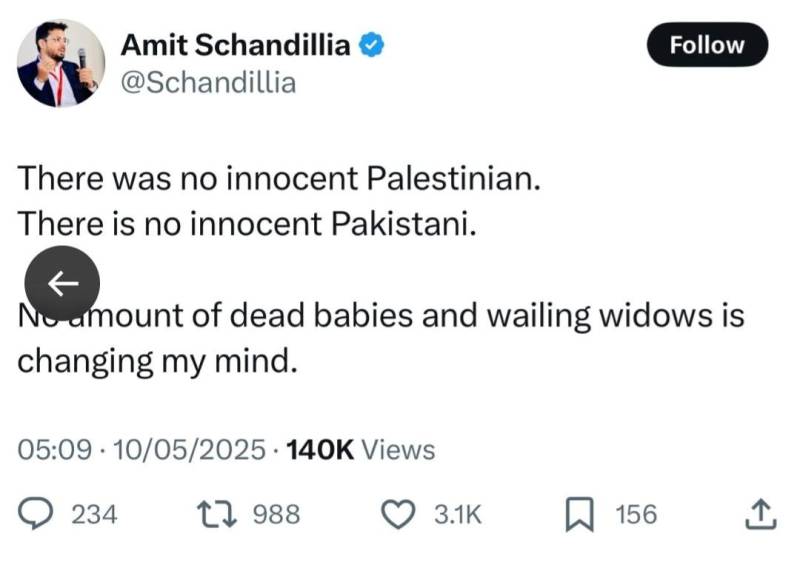
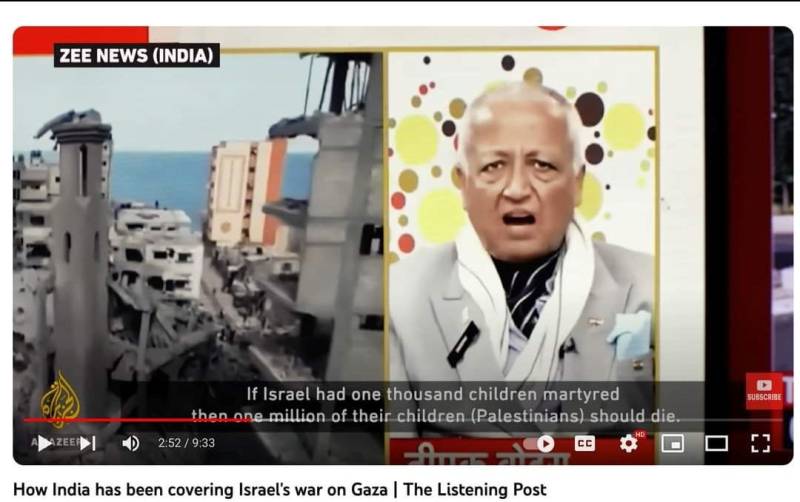
A former Indian diplomat, Deepak Vohra, openly justified the death of Palestinian children through the cold logic of a 1:1000 ratio, i.e., 1000 Palestinian children should die for every Israeli child. He remains a regular fixture on Indian television.
Is this the fruit of the BJP IT cell's indoctrination through WhatsApp forwards, or is this a latent phenomenon that was merely tapped into by the far-right political party in power?
Pankaj Mishra sheds light on this through a perceived “lack of manhood” amongst Indians who constitute Netanyahu’s “largest fan club in the world”. Regardless, it shows that much like World War II Germany, a highly educated society can succumb to fascism, where the other is dehumanised.
That the ideological founders of the RSS and hence the BJP were inspired by fascism is evident from their writings. Their political and ideological heirs downplay those connections to continue with their nationalist project. Nationalism here for a Hindutvist plays the same role as religion for an Islamist. Both are imbued with purity and supremacy.
However, Pakistanis on social media have critiqued Dhruv’s nationalist video. Taimur-Laal, Shehzad Ghias at The Pakistan Experience, Syed Muzammil Shah, Mansoor Ali Khan, and Faisal Warraich, amongst others, have all pushed back. They provide educational content on understanding the nuances in the Pakistani political landscape and emphasise the flaws with essentialism.
They also showcase both the limits and the weaponisation of the terrorism narrative. For instance, where al-Julani was once viewed as a terrorist, he now openly meets U.S. President Trump. Similarly, the U.S has removed bounties on key Taliban leaders. The same inconsistency is evident in Indian politics that cozies up to the Taliban. Such reversals seemingly bolster the narrative that the line between freedom fighters and terrorists is based on perspective.
The price of the terrorism narrative is paid by civilians who were bombed in Iraq under a trumped-up “weapons of mass destruction” narrative, the civilians in Gaza whose cleansing is justified through a parallel dehumanisation, and now Pakistanis through liberals like Dhruv Rathee and Shashi Tharoor. It seems as if liberalism, unlike radical socialism, is susceptible to dehumanising narratives wielded by neoconservatives.
Pakistanis like Laal, Muzammil, Shehzad, Mansoor, and Faisal amongst others are refusing to play by the manufactured narrative of Indians on social media whose caricatures of Pakistan as “bhikaristan” and Muslims contemptibly reduced to “Abdul” or “madrassachaps” (which parallel racist tropes of "Gunga Din”) reflect a mentality of what Bisma Tirmizi refers to as the “nouveau riche neighbour”.
Overall, it seems that liberalism is susceptible to the weaponisation of victimhood and the terrorism narrative. It then falls upon the much maligned radical/socialist thinkers to push back against the dehumanisation of people and the justification for their extermination in neoliberal economies.