

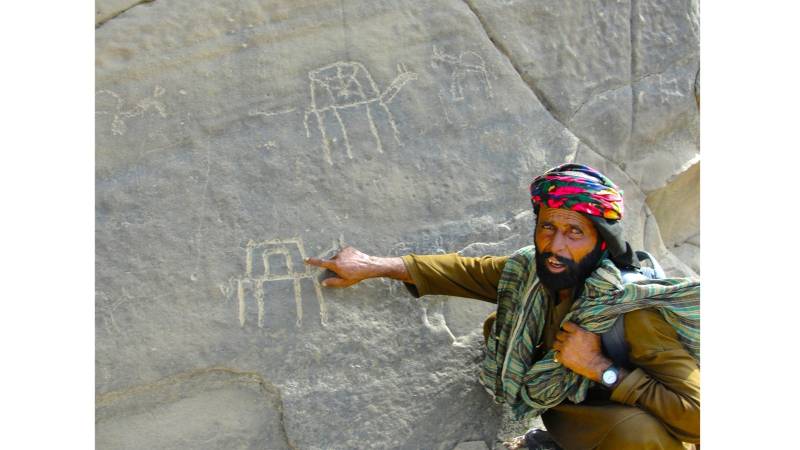
Documenting rock art is quite challenging in the rugged terrain of Sindh's Khirthar and other mountain ranges. I have been exploring and documenting rock art in Sindh for over two decades. To gain a broader understanding of Sindh's historic and prehistoric rock art, I explored every mountain range in the province, from Mol Valley in Karachi's Malir to Makhi in Dadu district. Everywhere, rock carvings unfold Sindh's prehistoric and historic cultures. I have also visited various rock art sites across Pakistan. During these explorations, I discovered several rock art sites not only in Sindh but also in Balochistan and even in Gilgit-Baltistan, particularly in the Gojal Valley. My exploration of rock art continues, revealing insights into Sindh's prehistoric and historic perspectives.
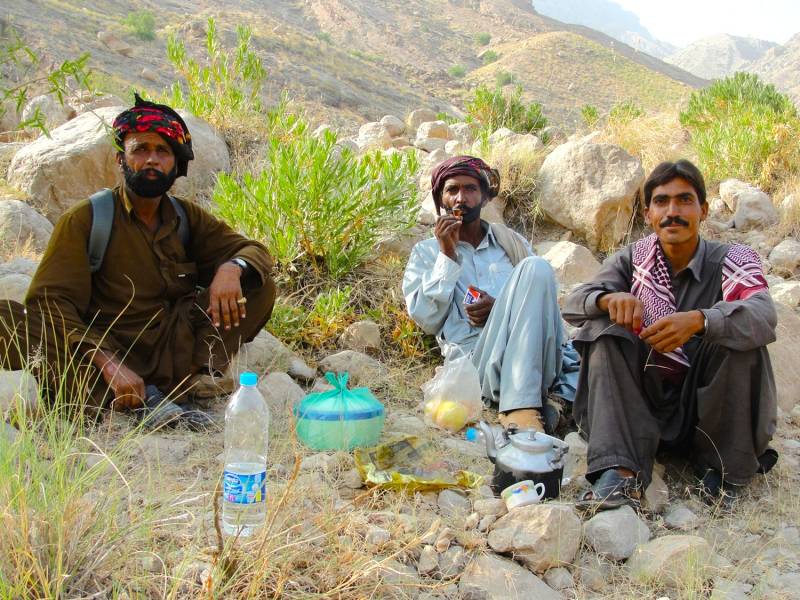
My rock art discoveries are opening new perspectives, offering scholars and laymen insights into Sindh's little-known heritage. Like other valleys of Khirthar in Dadu district, I have travelled to Mamani Dhoro, a tributary of Taki Valley, several times with my companions Nihal Khan, Abbas Dahri, and others. I discovered several rock art sites during my various trips to the Mamani Dhoro, which is home to the most impressive carvings.
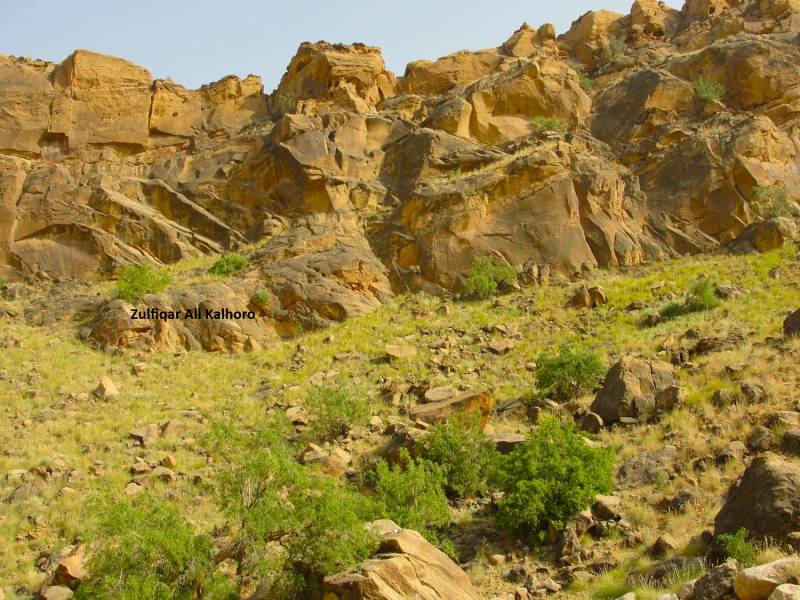
What is fascinating about these engravings is not only their antiquity but also the way they have been preserved through successive episodes of human activity. Rather than erasing earlier carvings, later communities often added new images beside or over them.
The representation of conflict and armed figures engaged in combat provides insight into the social tensions and historical realities of the period during which these carvings were created
The most important site that I discovered in Mamani Dhoro includes 'Pherani Loi Daf Dandi’. Apart from Pherani Loi Daf Dandi, several other rock art sites are known to local communities. Another one, for instance, is called Ban sath. The names local communities assign to these sites provide important clues. They reflect a deep, personal connection to the land and its enduring art. These names serve as reminders that this heritage is neither lost nor forgotten; it is an integral part of the stories and traditions that the people in these valleys and beyond continue to share.
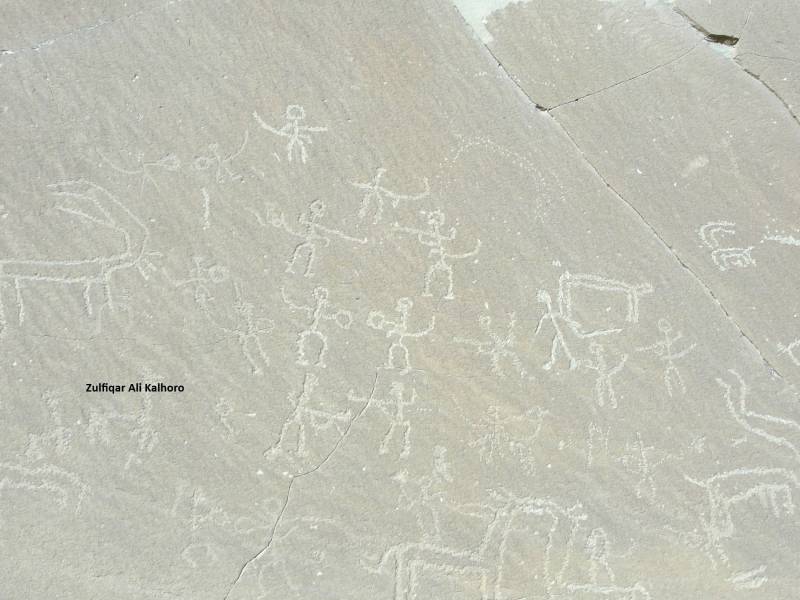
There is a large rock wall at Pherani Loi Daf Dandi that contains several rock art panels, each showing different motifs. The Pherani Loi Daf Dandi features multiple engraved panels. Moving along the wall from left to right, one notices various motifs. The sequence of images reflects different concerns, technologies, and historical moments. Among various panels, one stands out for its dramatic portrayal of human figures, clearly identifiable as warriors wielding swords, depicting a battle. The representation of conflict and armed figures engaged in combat provides insight into the social tensions and historical realities of the period during which these carvings were created.
A close look at the rock art panel at Pherani Loi Daf Dandi reveals an impressive group of warriors. These engravings depict men holding swords, guns, and shields, skilfully carved into the rock surface. The entire rock wall is filled with figures of warriors, some shown on foot and others mounted. Other human figures are also engraved near the warriors. However, posture and martial attributes distinguish warriors from other human figures depicted in hunting or herding scenes.
Within a pastoral landscape of Mamani Dhoro and beyond, where access to water, grazing lands, and movement routes could easily become contested, such imagery may have carried significant social and symbolic meaning. There are two possible interpretations regarding these warrior figures. First, they could have served as markers of territorial presence and communal strength, signalling control over resources and visually asserting power. At the same time, these images reinforced a shared sense of security and identity within the community by celebrating the qualities necessary for protection and survival. Secondly, when these figures are carved in groups, they are likely to represent a battle scene, either from the Kalhora period (1700-1783) or the Talpur period (1783-1843). One knows that in the last quarter of the seventeenth century and the early eighteenth century, there were frequent conflicts between Kalhoras and Brahuis of Kalat. Interestingly, depictions of warriors and battle scenes are also seen in the painted tombs across Johi taluka in Dadu district. Notably, the Talpur tombs at Drigh Bala, the Jamali tombs, the Laghari tombs, and others in Johi taluka depict such battle scenes. These tombs were mostly constructed during the Kalhora and Talpur periods. It is likely that artists were inspired by these paintings and engraved the same motifs on a rock wall in Mamani Dhoro.
Apart from Mamani Dhoro, one can also see such impressive carved figures of warriors in the Angai valley in the Dadu district. I have seen similar depictions at several rock art sites in the Makhi, Sallari, and Gaj valleys. The most noticeable carving among the group of warriors is a royal figure on an elephant, likely leading them into battle. Such scenes are common in other rock art sites in Sindh.
One can also see engravings of ibex in Mamani Dhoro from earlier and later eras, suggesting a continued engagement with these stones by subsequent communities; however, the presence of earlier, archaic motifs is of considerable significance. Among these ancient representations, the ibex emerges as a preeminent symbol. Carved with a sophistication that reflects both artistic proficiency and cultural reverence, the ibex holds a prominent position in this mountainous terrain. These depictions extend beyond mere sketches; the elongated bodies and prominently extended, curved horns of the ibex exemplify a stylistic tradition that resonates across a broader geographic region, including the adjacent Trig side valley, a tributary of the Gaj valley.
Some hunters are shown holding guns. These engravings are modern and not ancient. These gun-holding hunters are shown hunting ibex. Apart from these hunters, one can also see horse and camel riders, probably standing on the animals' backs. These also represent warriors. Thus, one can see warriors shown on foot and mounted on horses and camels holding swords and guns. These carvings have been engraved by the pastoral nomads who move along with their herds from place to place in the valley. Along all the ancient routes, these pastoral nomads move and leave behind several carvings that help rock art scholars understand the continuity of rock art traditions in Mamani and other tributaries of the Taki valley.
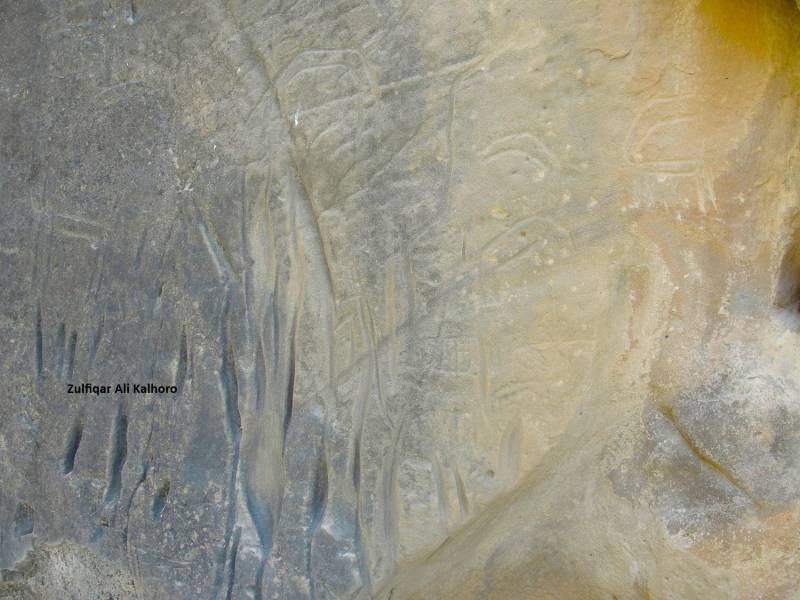
Apart from animals and human figures, one can also observe vertical deep lines on boulders at various sites in Mamani. These are actually axe-sharpening or grinding grooves. The axe-sharpening grooves can also be seen in the neighbouring dhoro of Trig in Gaj valley. The presence at both Mamani Dhoro and Tirg Dhoro reinforces the idea that these sites were associated with both functional and potentially ritualistic practices. These grooves, worn into the hard rock from the repeated sharpening of metal or stone tools, tell a story of practical necessity. They highlight the importance of tool maintenance for survival, hunting, and crafting—the everyday tasks of life. However, their location at rock art sites, often with more symbolic carvings, suggests that these places may have served dual purposes. Perhaps they were locations where daily activities occurred in a socially or symbolically significant environment. The act of sharpening an axe may have been as integral to the site's ritual life as the carving of a hunting scene.