

After returning from a short stay in his village the other day, at iftar, my father spoke about giving fitr, and how its rate had changed over the last several decades. His remark stays with me not as an observation about rising prices, but as the difference between a duty that remains fixed and the world through which that duty takes form.
Fitr is a religious obligation, but the amount through which it becomes socially legible does not pass unchanged from doctrine into life. It takes shape within changing conditions of everyday life, shifting judgments about what is enough, and the effort to move through the month in a manner recognisable as proper and pious. The obligation does not move, but the ground through which it is enacted does, and it is within that difference that its meaning becomes visible.
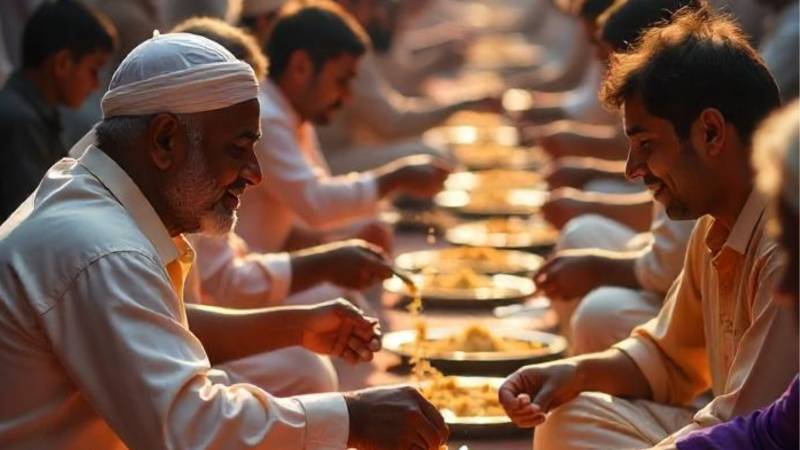
Ramadan in Pakistan makes this visible not only in fitr and zakat, but also in eidi, langar, iftar distributions, remittances, and gifts to workers, alongside quieter exchanges through which one household ensures that another can carry through the month and reach Eid without falling behind in ways that become socially evident. These acts do not appear in a single form or scale, nor do they belong to one register of giving, since some take shape as organised distributions while others move through small, often unremarked gestures that nonetheless carry weight within ongoing relations.
A shared question runs through them concerning how much is to be given and in what manner. Giving must remain proportionate both to the obligation itself and to the changing circumstances in which it is carried out, and within this effort to remain proportionate, giving cannot be understood either as charity or as price, because neither term captures how these acts hold together relations, hierarchy, and material life in ways that require continual adjustment if they are to remain recognisable as proper.
The question of how much to give cannot be reduced to a decision made by an individual, because giving does not take place in isolation but within relations that carry expectations and judgments about how one is to act. Anthropologists argue that exchange cannot be understood as the movement of things alone, since giving establishes obligations that do not end with the act itself but continue through expectations of return, acknowledgement, and response.
Giving during Ramadan cannot be reduced either to generosity or to transaction, because it involves carrying a duty in ways that must be recognised by others, even as the conditions for doing so become harder to sustain
These expectations are not external to social life, but part of the conditions through which relations take form, such that exchange does not simply move across a fixed arrangement but participates in shaping how people remain connected and how those connections are sustained in practice.
The question of how much can be given becomes harder to settle once the conditions through which households manage their everyday lives begin to shift unevenly. Inflation does not appear only as a rise in prices, but as a change in how giving is measured and carried out across households whose circumstances no longer align, a condition that is not limited to one place but shared across poorer and subaltern settings where obligations persist even as the means to meet them become strained.
It shifts how far a sum of money can reach and alters how one household stands in relation to another, making it harder to determine how much is sufficient for a duty that must still be fulfilled in recognisable terms. The rate of fitr may be set, but its adequacy is not contained in that figure alone, since the same amount no longer carries the same weight across different situations.
Attempts to adjust it do not resolve the issue so much as displace it into new forms of strain. Each adjustment places demands on those who must give, requiring them to manage delays, stretch limited means, and respond to expectations that remain in place even as the conditions for meeting them have become more uneven, with the result that the ability to give is shaped not only by income but by whether one can still sustain a position within shared expectations that others can recognise as proper.
As anthropologist Arsalan Khan shows in The Promise of Piety, piety is worked out through dawat as a practice that draws people into relations structured by discipline, hierarchy, and mutual obligation, rather than existing as a belief set apart from everyday life. In that sense, giving during Ramadan cannot be reduced to an exchange between individuals, because the act itself takes place within relations that are already charged with expectations and judgments about how one is to act.
Transfers of money, food, care, and time follow these relations, taking shape through assessments of who must be supported and how giving is to be carried out in ways that remain recognisable to others. Giving, therefore, does not move across a settled arrangement but takes part in sustaining how people remain connected and how obligations are met, deferred, or adjusted under changing conditions. Devotional life is carried through such acts, through the ordinary work by which relations are maintained in circumstances that do not hold steady.
Ramadan brings into view the effort required to sustain everyday life when the conditions through which people secure their needs and remain recognisable to one another no longer align as they once did. The practices through which people support one another do not separate into moral and material domains, since each act of giving carries religious duty, material need, everyday discipline, social expectations, and hierarchy at once.
Giving during Ramadan cannot be reduced either to generosity or to transaction, because it involves carrying a duty in ways that must be recognised by others, even as the conditions for doing so become harder to sustain.