

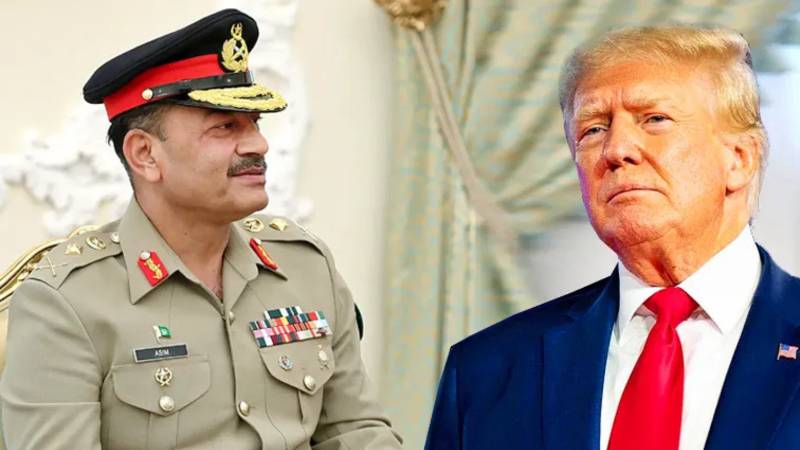
Following his lunch (which lasted two hours) with Pakistan Army Chief Field Marshal Asim Munir, US President Donald Trump was asked by reporters about the meeting. President Trump said that one of the primary reasons for meeting the Army Chief was to thank him for not going to war with India.
This stands in stark contrast to claims made by the Indian media prior to the 18 June meeting—that Trump had requested the meeting because Asim Munir had said Trump should be nominated for the Nobel Peace Prize. That report, carried solely by Indian news websites and channels, was also widely circulated by many Pakistanis. However, with the US President himself now stating the reason for the meeting, it is clear why he invited Field Marshal Munir for lunch.
The lunch meeting is a defining moment in US–Pakistan relations—not least because it is highly unusual for a sitting US President to meet the military chief of another country. This also highlights how, following the four-day conflict with India in May, Pakistan’s global profile has been significantly elevated—thanks in large part to the prowess and capability of the Pakistan Air Force, which shot down six Indian Air Force jets within an hour (grounding the entire IAF thereafter) and rewrote the history books on aerial combat planning, execution, and tactics in the 21st century.
The meeting further underscores the fact that it was India that approached the US for a ceasefire—after its entire air force was grounded following the aerial battle on the night of 6–7 May. The US President’s statement, thanking Pakistan’s army chief for not going to war, clearly indicates this sequence of events.
Trump’s very public meeting with Pakistan’s army chief may also serve as a signal to India: not to get carried away, and to avoid escalating towards war consciously
India, however, continues to bury its head in the proverbial sand—with Indian Foreign Secretary Vikram Misri’s readout of a telephone call between Trump and Modi sounding more like a fantasy tale, in which Modi claims that the US had no role in the ceasefire and that Operation Sindoor is still ongoing.
Back in the real world, it is also quite likely that the lunch between the President and the Field Marshal included discussions on the ongoing Iran–Israel conflict, and the possibility of direct US involvement. Any such development would have major implications for Pakistan and its western border, and could spark consequences for the wider region.
Even before it occurred, the lunch meeting was under intense media scrutiny—especially in the Indian media, where the main narratives ranged from ‘Why is America doing this?’ to ‘India should reconsider its ties with America’ to ‘America has a history of engaging and rewarding dictatorships’. Regardless of tone, the underlying theme was clear: India felt sidelined by what was clearly a public recalibration of US–Pakistan ties, just a month after the conflict between the two nuclear-armed neighbours had ended.
There was none of the usual ‘do more’ rhetoric, nor any attempt to place India on a higher pedestal—it was a case of both India and Pakistan being treated equally. One could argue that, with the one-on-one lunch, Pakistan was even placed on a higher footing. And again, it bears repeating: none of this would have been possible without Pakistan’s performance during the May conflict, particularly the resounding response delivered by its air force.
Of course, any celebration must be short-lived. Regardless of who emerged with the upper hand (Pakistan did), the threshold for war between the two nuclear-armed states has been dangerously lowered. Modi’s remark to Trump during their 17 June phone call—that Operation Sindoor was still active—along with India’s declaration that any future Pahalgam-style incident would prompt a strike on Pakistan, have all created a volatile environment. The risk of full-scale war is now just a trigger away.
In this context, Trump’s very public meeting with Pakistan’s army chief may also serve as a signal to India: not to get carried away, and to avoid escalating towards war consciously.