

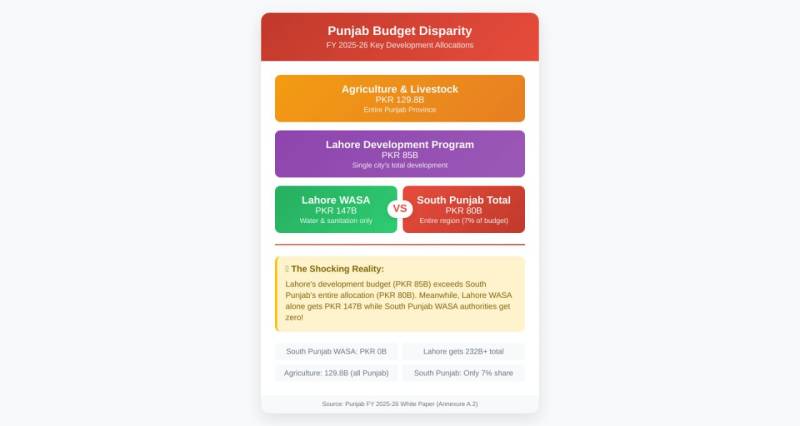
When Punjab’s 2025–26 development budget was unveiled this June, hopeful murmurs in the Saraiki heartland quickly gave way to despair. Of the province’s total development outlay, a mere 7 percent (roughly Rs 80 billion) was earmarked for South Punjab, while Lahore alone received nearly Rs 85 billion for its own projects. For a region already grappling with some of Pakistan’s highest poverty rates, this was not just a missed opportunity—it was a confirmation of neglect.
‘Crumbs Off the Table’
In Multan, Dera Ghazi Khan, Muzaffargarh, and Rajanpur—districts whose fields and towns feed Punjab’s agrarian engine—voices of protest rose alongside coverage in Dawn, The Express Tribune, and Business Recorder. PPP lawmakers decried “continued injustice” after South Punjab’s Water and Sanitation Agency (WASA) received zero rupees, while Lahore’s WASA was allotted Rs 147 billion (Express Tribune, 30 June 2025). Agriculture and livestock—lifelines for millions—were granted only Rs 129.8 billion, a pittance compared to Central Punjab’s urban projects (Budget Highlights, Finance Ministry, June 2025). Though there were fresh allocations for other urban authorities, those sums were mere peanuts when set against Lahore’s windfall.
Local contractors and suppliers may scrape by; some daily wage earners might earn a few hundred rupees plastering roads or mixing cement. However, the real profits and planning contracts flow inexorably to firms headquartered in Lahore or Rawalpindi. “Whatever crumb falls off the table keeps the labourer fed for a day but does nothing to build lasting prosperity,” notes a Saraiki speaker from Multan.
Despite being one of Pakistan’s most widely spoken languages, Saraiki is often sidelined in media, academia, and policymaking
A History of Neglect
The 7 percent figure is not an aberration. A 2019 Express Tribune analysis found that over five years, Lahore alone had absorbed 50 percent of Punjab’s development funds, leaving South Punjab divisions to forgo an estimated 43 percent of their rightful share. Per capita development spending in the Saraiki belt was less than half that of the rest of Punjab, exacerbating the already “monstrous” poverty in the Wasaib. The latest World Bank data (April 2025) place Pakistan’s national poverty rate at 42.4 percent, while UN-sourced findings show South Punjab’s multidimensional poverty is roughly twice the provincial average (The Friday Times, 17 January 2024).
Youth, Anger, and Cultural Erasure
Economic frustration is only part of the story. Over countless cups of sweet, milky tea in Multan’s alleys, Saraiki youths voice a profound sense of cultural erasure. Despite being one of Pakistan’s most widely spoken languages, Saraiki is often sidelined in media, academia, and policymaking. This absence is deeply felt:
“Punjabi nationalism is making inroads into the English-medium intelligentsia. They champion every minority but draw a firm line at standing up for Saraiki identity,” laments one young graduate.
This identity gap fuels a new resistance. On university campuses, students publish zines; on social media, hashtags like #SaraikiLivesMatter and #JusticeForWasaib trend alongside anguished posts about disappearing folk songs and shrinking budgets. Their anger is raw: disappointment at political elites who promise “development” but deliver little more than token road patches in their hometowns; sorrow for parents who cannot feed their children; and fear for a future defined by migration to far-flung cities, where they will remain second-class citizens.
The Stakes Are Existential
When entire districts are deprived of clean water projects, bridges, and schools, the consequences extend far beyond material loss. Public health suffers, literacy rates stagnate, and a generational brain drain accelerates.
“How can we build a future when even basic water and roads are denied to our communities?” asks a Saraiki activist from Dera Ghazi Khan.
Without ring-fenced funding or meaningful representation in Lahore’s budgetary process, the Wasaib risks being boxed into permanent poverty and invisibility.
Hope, however, is not yet lost. Saraiki youth are organising, writers are documenting their story, and the spark of collective outrage may yet force a rethink in Lahore’s corridors of power. But it will require unwavering pressure and genuine solidarity from across Punjab to ensure that Wasaib’s next budget is not just a number, but a promise kept.
“When you ignore a people’s identity and their basic needs, you plant the seeds of unrest. Our fate should not be decided in Lahore alone.” — A Saraiki speaker from the Wasaib