

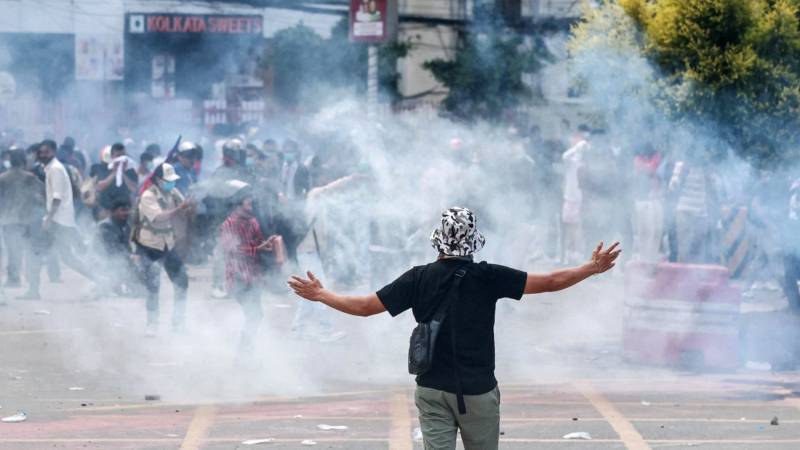
The political drama that unfolded in Nepal the other day, where large-scale youth-led riots compelled the Prime Minister to step down, underscores a reality that South Asian regimes can no longer afford to ignore: the growing assertiveness of the region’s restless youth. What began in Kathmandu as sporadic demonstrations over unemployment, inflation, and allegations of corruption soon transformed into a formidable force that paralysed governance. The resignation of Nepal’s premier was not merely a capitulation to street pressure but an acknowledgement that young citizens, once considered politically dormant, have emerged as a decisive political actor in that country.
The recent developments in Nepal closely mirror what transpired in Bangladesh last year when students and unemployed youth spearheaded nationwide protests against the long-standing premiership of Sheikh Hasina. Initially triggered by grievances over government control of educational institutions, spiralling food costs and perceptions of personalist authoritarianism, the movement snowballed into a popular uprising. The relentless mobilisation ─ marked by both peaceful marches and violent confrontations ─ ultimately led to Hasina’s dramatic exit after more than a decade in power. Both in Dhaka and in Kathmandu, the underlying message was clear: youth discontent, if unaddressed, can upend even the most entrenched political structures.
Regionally, Sri Lanka, too, offers a cautionary tale. In 2022, amid severe shortages of fuel, food, and medicine, the island nation witnessed mass protests led largely by students and young professionals. Encamped outside the presidential secretariat, the youth movement, popularly known as the Aragalaya (struggle), became a symbol of frustration against elite mismanagement and corruption. The sheer persistence and moral authority of the young demonstrators forced Gotabaya Rajapaksa to flee the country and resign. Although Sri Lanka’s political and economic crises were deeper in scale, the youth-led mobilisation echoed the same theme evident in Nepal and Bangladesh.
Youth anger, once mobilised, can alter political destinies overnight
Comparing these cases reveals striking similarities. First, the trigger issues ─ unemployment, inflation, corruption, and governance failures ─ are socio-economic in nature but carry immense political consequences. Second, the movements were spontaneous rather than centrally organised, suggesting that the digital age has enabled decentralised mobilisation through social media and peer networks. Third, state responses, often marked by repression, failed to deter the momentum. Instead, crackdowns inflamed public anger and broadened the protests’ support base. Finally, in all three instances, the youth not only demanded immediate change but also symbolised a generational rejection of stagnant and dynastic leadership and political control.
Noticeably, there are important differences in the said cases too. Bangladesh’s movement, for example, toppled one of the region’s most entrenched leaders while Nepal’s upheaval targeted a relatively fragile government already plagued by coalition infighting. Sri Lanka’s protests, on the other hand, arose out of a full-blown economic collapse and carried an existential urgency for survival rather than reform. These variations highlight that while youth discontent is a common denominator, the trajectories of mobilisation and outcomes are shaped by domestic contexts.
For Pakistan, the lessons are sobering. With nearly 64 percent of its population under the age of 30, Pakistan has one of the largest youth bulges in South Asia. Yet, a majority of these young citizens remain unemployed, underemployed and excluded from meaningful political participation. Recent floods have further devastated the livelihoods of millions, disproportionately affecting younger communities, especially in rural areas. Unless policymakers address these structural grievances, through job creation, quality education, and climate rehabilitation, the potential for similar eruptions of youth-led discontent cannot be ruled out.
Finally, the message from Nepal, Bangladesh and Sri Lanka is unmistakable: youth anger, once mobilised, can alter political destinies overnight. Pakistani authorities would do well to take this reality seriously. It is imperative to engage the country’s young population, address their socioeconomic grievances and prioritise rehabilitation for those affected by recent floods ─ before the simmering frustration transforms into a storm of political upheaval.