

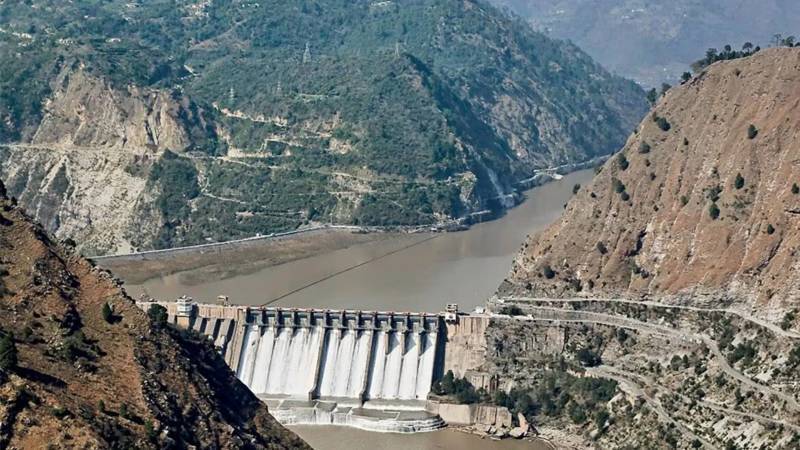
In April 2025, India placed the 1960 Indus Waters Treaty in abeyance on the pretext of an attack in Pahalgam that killed 26 civilians in Indian-administered Kashmir. Hydrological data sharing stopped. Joint inspections were suspended. Operational constraints on the western rivers were loosened. New Delhi linked any restoration to Pakistan’s action against cross-border militancy. Even as ceasefires held, the arrangement persisted into 2026, while India advanced hydropower projects on the Chenab and undertook sediment flushing operations that added fresh uncertainty to downstream flows.
Pakistan responded in the language of sovereignty and survival. Officials denounced the move as water warfare, a violation of international law, and a threat that could escalate into open conflict. Diplomatic appeals were made to global institutions, including the United Nations and the World Bank. Yet behind the rhetoric of outrage lay a more troubling realisation: the shock was not only diplomatic. It was epistemic. The crisis had not merely disrupted flows of water; it had disrupted flows of certainty.
For decades, Pakistan’s hydraulic order rested on a particular way of knowing rivers. It treated water as a manageable quantity, a resource that could be captured, redistributed, and disciplined through engineering. The Indus Basin was reorganised into one of the world’s most extensive irrigation systems, anchored by Mangla, Tarbela, link canals, and a dense network of barrages. This system did more than irrigate land. It structured the state’s imagination of development itself. Control over water became synonymous with control over destiny.
Yet this hydraulic epistemology assumed a stable natural world. Winters were expected to follow snow accumulation in predictable cycles. Monsoons were expected to arrive within narrow seasonal bounds. Rivers were expected to behave as measurable instruments of planning. On this foundation, the state built not only infrastructure, but confidence in its own administrative capacity.
That confidence is now eroding under two converging pressures. The first pressure is geopolitical uncertainty, which removes the informational stability that once allowed the system to function. The suspension of the Indus framework has not only raised questions about flows; it has disrupted access to upstream data and coordination. In a system where timing is as critical as volume, uncertainty becomes a structural stress. Irrigation planning, reservoir management, and flood preparedness all depend on anticipating river behaviour. When anticipation weakens, governance shifts from planning to reaction.
The second is climate variability, which is no longer a background condition but a destabilising force in its own right. Winters are shorter and drier, reducing the natural storage of snow in upstream catchments.
The river is no longer only a channel of irrigation. It is a system of uncertainty, feedback, and constraint
Heatwaves stretch across longer periods, intensifying evaporation from reservoirs and accelerating glacial melt in ways that disrupt seasonal balance. The monsoon, once a relatively contained seasonal pulse, now extends across nearly four months, oscillating between destructive floods and uneven rainfall distribution. The result is not simply more or less water, but a loss of rhythm in the hydrological cycle itself.
These two forces, climatic and geopolitical, do not operate in isolation. They reinforce each other. Climate change multiplies unpredictability within the basin, while the breakdown of cooperative frameworks amplifies the political meaning of that unpredictability. What was once treated as seasonal variation now appears as strategic vulnerability. Water becomes not only a resource issue, but a security variable.
Yet the deeper crisis lies beneath both. It is the cognitive architecture of the hydraulic state itself. This system does not merely manage water; it thinks through water in a particular way. Its epistemology is built on the assumption that nature is legible, divisible, and ultimately controllable through centralised expertise. In this worldview, uncertainty is a problem to be eliminated rather than a condition to be engaged.
This creates a structural rigidity. Even as evidence accumulates that climate systems are becoming non-linear, the institutional response remains anchored in expansion: more storage, more diversion, more engineering control. At the same time, hydrologists and policy analysts increasingly point towards a different logic—one based on adaptation, efficiency, ecological restoration, and demand-side transformation. But moving towards this model requires more than technical adjustment. It requires a shift in how authority itself is organised.
Here, the hydrological trap becomes visible. Adaptation threatens existing power structures. A move away from water-intensive agriculture implies redistribution of resources, institutional authority, and political influence across provinces and sectors.
Greater efficiency reduces the justification for large-scale hydraulic expansion projects that have long defined state capacity. Demand management disperses control rather than concentrating it. As a result, the system experiences cognitive dissonance: it recognises the limits of its model but hesitates to abandon the very structures that sustain its authority.
This hesitation produces inertia. Policy oscillates between recognition and denial, between calls for reform and continued reliance on outdated assumptions. Infrastructure continues to expand even as ecological constraints tighten. Crisis is acknowledged, but framed as a temporary disruption rather than a structural transformation. In this gap between knowledge and action, the hydraulic state drifts deeper into contradiction.
What emerges is not collapse in a dramatic sense, but entrapment. The system continues to operate, but on increasingly unstable foundations. It responds to climate volatility with tools designed for stability. It responds to uncertainty with frameworks designed for predictability. It responds to ecological feedback with administrative routines shaped by control. Each response reinforces the mismatch between reality and governance.
Breaking this trap does not mean abandoning rivers or infrastructure. It means rethinking the epistemology that treats water as something to be fully mastered. It requires accepting variability not as failure, but as structure. It requires shifting from command to adaptation, from expansion to balance, from control to resilience.
The Indus still defines Pakistan’s geography. But the meaning of that geography is changing. The river is no longer only a channel of irrigation. It is a system of uncertainty, feedback, and constraint. The question is no longer how fully it can be controlled, but how wisely its unpredictability can be lived with.