

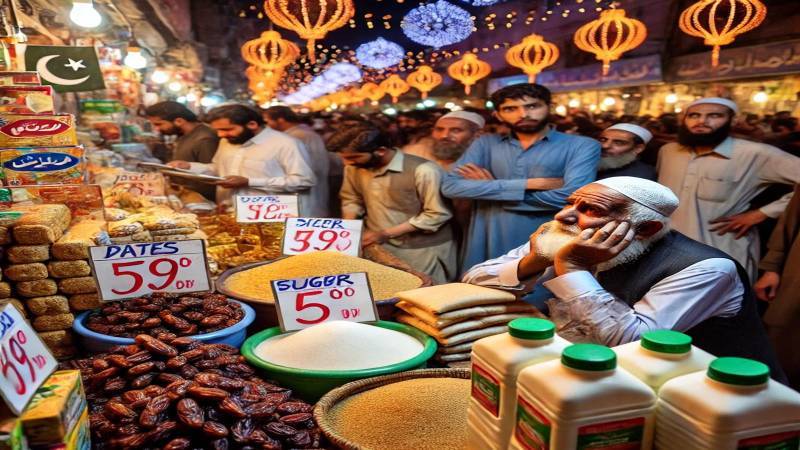
With the sacred month of Ramzan in full swing and today marking the 17th fast, the spirit of generosity, self-restraint, and compassion should be at its peak. Instead, the streets and bazaars of Pakistan tell a different story—one of ruthless profiteering, unchecked inflation, and a governance structure that has abandoned its duty. Prices continue their cruel ascent, making essential commodities—flour, sugar, fruits, dates, pulses, and even the simplest Iftar and Sehri items—unaffordable for millions. The very month meant to bring solace to the poor has become a time of financial oppression.
The government touts economic improvement, citing a decline in annual inflation from a record 38% in May 2023 to a reported low of 1.5% in February 2025. But these figures mean little to the common man. Markets tell a different story, where prices defy official claims, exposing the disconnect between government statistics and ground realities. How can inflation be declared "tapering off" when families remain unable to afford basic sustenance? Numbers and graphs cannot ease the agony of those crushed under relentless exploitation.
Despite the government announcing a reduction in petroleum prices by Rs. 5.3 per liter and LPG by Rs. 6.15 per kg, transportation costs refuse to drop. Market mafias dictate their own rules, openly defying regulatory price lists, while authorities remain indifferent. Shopkeepers, traders, and wholesalers shift blame in an unending cycle, leaving the common man to bear the brunt of market exploitation.
Beyond economic hardships, the crisis exposes something even more troubling- a wholesome collapse of moral and ethical values that contradicts the essence of Ramzan. The same traders who rush to secure the first rows in overcrowded mosques and embark on Umrah pilgrimages show no hesitation in inflating prices and hoarding essentials remaining utterly indifferent to the suffering they cause. Their fasting bodies may bow in prayer, but their hearts are consumed by greed. The contrast is shameful and exposes the hypocrisy that plagues our society.
Strolling through the historic bazaars of Shikarpur, once vibrant centers of commerce, I am confronted with a painful reality. Prices continue to surge with every passing day—children’s apparel, clothing, footwear, crockery, kitchen items, vegetables, and staple foods all slipping further from the reach of the common man. Even basic commodities like eggs, sugar, and poultry are relentlessly jacked up by market manipulators.
Ramzan is meant to be a time of mercy, charity, and social solidarity. Yet, in Pakistan, it has become a period of cruel exploitation, where the poor bear the heaviest burden
The most heart-wrenching sight is that of poor villagers who visit city markets hoping to buy essentials. Women carrying their emaciated children, with barefoot little ones trailing behind, repeatedly inquire about prices—only to return to their huts empty-handed. Their suffering stands in stark contrast to the government’s boastful claims of economic stability.
While the poor struggle to afford a basic Iftar, Pakistan’s elites remain untouched by this crisis. They do not stand in long queues, haggle over prices, or worry about how to feed their families. Shielded by their privileges, they exploit every opportunity to amass wealth at the expense of the people.
The elite capture of Pakistan’s economy and politics has turned the country into an oligarchy, where a select few control resources while the masses suffer. They contribute little but take everything, enjoying state privileges, tax exemptions, and unchecked access to national wealth. Their extravagant lifestyles widen the chasm between rich and poor, making a mockery of the very idea of a welfare state.
Despite Pakistan’s rich agricultural resources, staple food prices remain unreasonably high due to hoarding and administrative neglect. Instead of acting against market manipulators, authorities stand as silent spectators, either complicit or utterly incompetent.
The Bureau of Supply and Prices, along with district administrations, boast of price control mechanisms, yet their inaction tells a different story. Regulatory price lists are brazenly flouted, and hoarders operate with impunity. Whether due to negligence or collusion with profiteering mafias, these authorities have allowed market manipulation to persist, leaving the common man at the mercy of exploiters.
Recognising the hardships, Prime Minister Shahbaz Sharif has launched a Rs. 20 billion Ramzan Relief Package, offering Rs. 5,000 to four million families. Similarly, Punjab’s Nigahban Ramzan Package provides Rs. 10,000 to ease hardships. While these initiatives offer temporary relief, they do not address the root cause—the unchecked greed of profiteers who exploit every opportunity, be it a religious festival or a natural calamity.
The fundamental question remains: Will these subsidies bring lasting relief, or are they just an eyewash? or mere band-aids covering a festive wound? Government price lists are brazenly flouted by traders, while enforcement mechanisms remain ineffective. Without strict enforcement, market mafias will continue dictating their terms, making a mockery of official policies.
Across the world, festive seasons bring relief for consumers. In Western countries, Christmas and New Year sales ensure that all can celebrate with dignity and honour. But in Pakistan, the opposite occurs—prices are hiked to exploit the faithful. This predatory and perverse trend violates not only basic ethics but also the teachings of Islam, which emphasise fairness and compassion in trade.
Pakistan’s economy requires structural reforms to break free from exploitation, and the government must take decisive action. Enforcing price controls through digital monitoring, surprise inspections, and hefty penalties can deter violators, while stricter laws against stockpiling and black-market trading, supported by real-time stock monitoring, will ensure market stability. A fair tax system, where the wealthy contribute more and indirect taxes on the poor are reduced, is essential for economic equity. Strengthening accountability mechanisms can help curb corruption and market manipulation, while long-term welfare programs should be established to protect vulnerable populations. Additionally, educating consumers on their rights and promoting ethical consumerism will empower people to make informed choices. Finally, setting up permanent affordable markets, especially during religious festivals, can prevent price manipulation and ensure fair access to essential goods.
Ramzan is meant to be a time of mercy, charity, and social solidarity. Yet, in Pakistan, it has become a period of cruel exploitation, where the poor bear the heaviest burden. This is not just an economic crisis—it is a crisis of conscience.
The consequences of moral decay are visible in our markets, bazaars, and businesses. The struggling multitudes are preyed upon with a double-edged knife—one of economic greed and the other of administrative neglect. The need of the hour is a revival of moral values and ethics, fostering a culture of fair dealings and protecting consumers from exploitation.
Breaking free from elite capture is crucial. Pakistan cannot progress as long as a privileged few monopolise resources at the cost of national welfare. The burden imposed by an elite that contributes nothing but claims everything must be dismantled.
Only then can Pakistan truly embody the spirit of a welfare state, where fairness triumphs over greed, and justice prevails over-exploitation.