

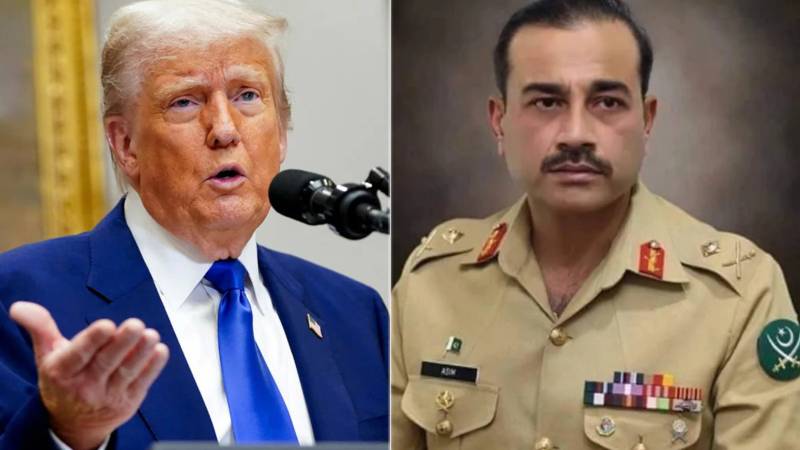
The meeting between President Donald Trump and Pakistan’s Chief of Army Staff, Asim Munir, scheduled for Wednesday, 18 June 2025, could signal a significant shift in U.S.-Pakistan relations. The precise timing of this engagement—set against a backdrop of escalating Iran-Israel tensions and recent India-Pakistan hostilities—places it at a critical juncture, suggesting urgency and strategic intent.
President Trump left the G7 meeting in Canada on Monday evening, a day earlier than scheduled, immediately after the leaders’ dinner. His early departure raised questions about whether he intended to defuse tensions or escalate them. Upon returning to Washington, he met with his national security team and stated that Iran must not be allowed to obtain nuclear weapons. German Chancellor Friedrich Merz, who remained at the summit, said a U.S. decision on whether to join the conflict militarily would come later that day. He also warned that if Iran refused to resume negotiations, “the complete destruction of Iran’s nuclear programme may be on the agenda.”
Whether this is a pressure tactic or a genuine threat, the potential for a wider war is prompting regional responses. Turkish President Recep Tayyip Erdoğan has ordered an acceleration of medium- and long-range missile production to boost Turkey’s domestic defence capabilities. Meanwhile, Russia is watching Israel’s ongoing strikes on Iran with growing alarm, concerned for the survival of a key ally.
Many observers had long viewed Pakistan as firmly entrenched in China’s camp, thanks to deep economic and military ties. Yet, Asim Munir’s outreach to Trump has caught analysts off guard, hinting at a potential strategic reset. While no communiqué may follow this closed-door lunch, the unspoken implications—tied to Pakistan’s need for U.S. support for IMF and World Bank aid, Saudi Arabia’s regional backing, and a long history of U.S.-Pakistan military ties—may prove far more consequential than any public statement.
The timing is striking. It coincides with heightened global tensions, notably Trump’s aggressive stance toward Iran following his 17 June 2025 demand for Tehran’s “unconditional surrender” amid the Israel-Iran conflict. In South Asia, the aftermath of India’s Operation Sindoor in May 2025—targeting alleged terror sites in Pakistan after the Pahalgam attack—has left the region on edge. The U.S.-brokered ceasefire that followed (though denied by India) highlights Washington’s stake in stability. This precisely timed meeting, to be held in the Cabinet Room with no press access, suggests sensitive discussions—possibly about covert cooperation or regional realignment—are underway. The timing amplifies its significance, framing it as a potential pivot point in U.S.-Pakistan relations.
The Trump–Asim Munir meeting could give a boost to U.S.–Pakistan military cooperation, focusing on counterterrorism or regional security, leveraging a foundation that has endured decades of ups and downs
Does this meeting mark a major strategic reset? For years, Pakistan’s alignment with China seemed unshakable, with CPEC symbolising an “all-weather friendship.” However, Asim Munir’s engagement with Trump challenges that narrative, surprising those who saw Pakistan as Beijing’s unwavering ally. As Pakistan’s first Field Marshal since Ayub Khan, Asim Munir brings a pragmatic military perspective, possibly aiming to counterbalance China’s growing influence as CPEC’s debt burdens weigh heavily. This does not signal an abandonment of China but rather a rebalancing—diversifying Pakistan’s strategic options. For the U.S., eager to curb China’s reach in South Asia, Pakistan offers a nuclear-armed partner with strategic proximity to Iran and Afghanistan. Asim Munir’s move suggests a calculated pivot, potentially heralding a reset in bilateral ties.
Pakistan’s outreach to the U.S. is also driven by economic necessity. The country faces serious economic challenges. Aid from the International Monetary Fund (IMF) and World Bank is a lifeline, and U.S. backing is pivotal to securing it. In 2023, Pakistan narrowly avoided default with a $3 billion IMF bailout, contingent on tough reforms. Asim Munir likely sees Trump’s support as key to future packages, a point almost certainly on the meeting’s agenda. The U.S. could use this leverage to gain concessions on security or alignment, making Pakistan’s economic dependence a cornerstone of this potential reset.
Pakistan’s principal regional backer, Saudi Arabia, adds another layer to this dynamic. The Kingdom enjoys excellent relations with Trump, a bond forged during Trump’s first term and reinforced by shared interests in countering Iran. Saudi Arabia has long bolstered Pakistan with financial aid—such as oil on deferred payments—and diplomatic support. Riyadh’s influence could nudge Pakistan toward closer U.S. ties, aligning with Saudi strategic goals. This U.S.-Saudi-Pakistan triangle may quietly shape the meeting’s outcomes, with Saudi Arabia acting as a facilitator, enhancing the prospects of a strategic realignment.
The U.S. and Pakistan share a storied history of military cooperation, providing a bedrock for this engagement. During the Cold War, Pakistan was a vital U.S. ally against Soviet expansion, receiving significant aid. In the 1980s, it channelled U.S. support to Afghan mujahideen, and post-9/11, it became a key partner in the War on Terror—despite later strains over trust issues. Asim Munir, a former ISI chief, embodies this legacy of institutional ties, from joint exercises to intelligence-sharing.
The head of U.S. Central Command (CENTCOM), General Michael Erik Kurilla, began a new chapter with Pakistan after Asim Munir became Army Chief in November 2022. Since then, they have had four official meetings. Kurilla visited Pakistan from 14–16 December 2022, meeting Asim Munir at GHQ in Rawalpindi and visiting Khyber Pakhtunkhwa to observe border security. On 24 July 2023, Kurilla returned to meet Asim Munir again. In December 2023, Asim Munir visited the U.S. for the first time as COAS. On 18 December, he met Kurilla at CENTCOM HQ in Tampa, Florida. Kurilla visited Pakistan again in May 2024 to observe the Inspired Union 2024 naval drills and review border security, though no official meeting with Asim Munir was recorded.
The Trump–Asim Munir meeting could give a boost to U.S.–Pakistan military cooperation, focusing on counterterrorism or regional security, leveraging a foundation that has endured decades of ups and downs.
It is unlikely that Trump would seek military bases in Pakistan, as the U.S. already maintains a substantial military presence in the Middle East. This includes approximately 40,000 to 50,000 troops across at least 19 sites, including eight permanent bases in countries such as Bahrain, Qatar, Kuwait, Saudi Arabia, the United Arab Emirates, Iraq, and Jordan. Key installations include:
Al Udeid Air Base (Qatar): The largest U.S. military base in the region, housing around 10,000 troops and nearly 100 aircraft—including bombers, fighters, and drones. It serves as the forward headquarters for U.S. Central Command (CENTCOM) and plays a central role in operations across Iraq, Syria, and Afghanistan. Its strategic location in the Persian Gulf also positions it well for strikes on Iran.
Al Dhafra Air Base (UAE): Hosts advanced aircraft such as F-22 Raptors, surveillance planes, and drones, supporting both reconnaissance and combat missions. Located roughly 200–300 miles from Iranian targets, it is a practical staging point for regional operations.
Naval Support Activity (Bahrain): Headquarters of the U.S. Navy’s Fifth Fleet, supporting naval and air missions in the Persian Gulf, with about 9,000 personnel stationed there.
Camp Arifjan (Kuwait): A major logistics and command center for U.S. operations throughout the region.
Erbil Air Base (Iraq): Supports air operations in northern Iraq and Syria. However, its closeness to Iran makes it susceptible to Iranian retaliation.
Other Locations: Bases in Saudi Arabia, Jordan, and temporary facilities in Syria provide further operational flexibility for air and missile campaigns.
In addition, the U.S. can deploy long-range bombers such as the B-2 Spirit and B-52 Stratofortress from bases outside the region, including Diego Garcia in the Indian Ocean. Aircraft carriers operating in the Persian Gulf or Arabian Sea under the command of the U.S. Navy’s Fifth Fleet also offer land-independent strike capabilities.
While Pakistan's proximity to Iran could offer some tactical advantages, the political, diplomatic, and security complications make it an unlikely—and ultimately unnecessary—option.
No communiqué may emerge from this meeting, but what is not said outweighs any official remarks. The closed-door setting implies discussions on delicate matters—intelligence sharing, geopolitical shifts, and economic aid, in addition to matters both sides may prefer to keep under wraps. For Pakistan, this allows flexibility to secure U.S. support without alienating China. For Trump, it avoids complicating relations with India or escalating tensions with Beijing. The absence of a public statement preserves ambiguity, letting actions—perhaps covert agreements or quiet policy shifts—define the meeting’s true impact.
The Trump–Asim Munir meeting may indeed mark a major strategic reset. Asim Munir’s surprise engagement with Trump upends assumptions of Pakistan’s fixed alignment with China, driven by economic needs, Saudi backing, and a military history ripe for renewal. While the timing underscores its urgency, the lack of a communiqué highlights the weight of unspoken outcomes. Whether this resets U.S.-Pakistan relations will depend on what follows—aid deals, security pacts, or regional moves—but the meeting’s implications are already reverberating.