

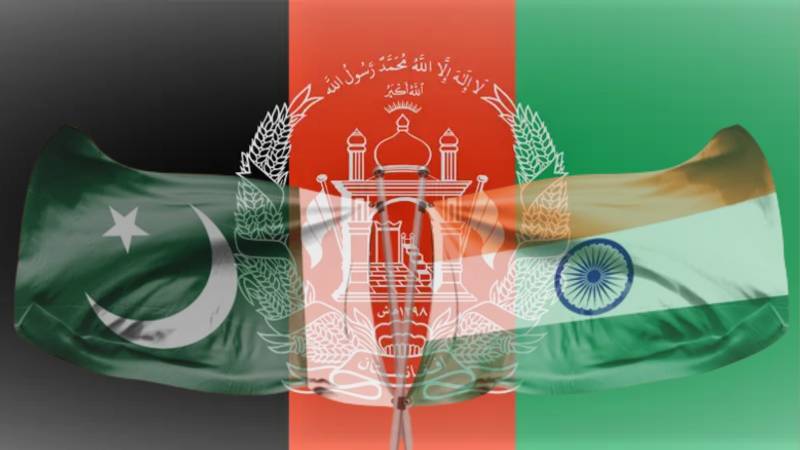
The escalation of border conflicts with Afghanistan in the backdrop of airstrikes on Kabul, and the brewing tension with our neighbour to the east, India’s romance with the Taliban after watching the evolving situation in Afghanistan from a distance for over four years after the fall of the Ashraf Ghani regime and the return of the Taliban to power, could now possibly head towards the revival of the earlier trilateral alignment comprising India, Afghanistan and Iran to isolate Pakistan in the region, if not in the world or there is a new strategic game plan conceived by the devilish mind of Narendra Modi. It may seem a hasty and rash conclusion, but the indications surrounding the security situation in the region and the moves being made by the players unmistakably point to the above possibility.
Diplomacy is a game of surprises. Sometimes, unexpected events take place at regional and international levels in quick succession, and it becomes impossible to predict the changing geopolitical and geo-strategic landscape. Who had thought that the brief air war between two rivals in May this year would change the strategic landscape of South Asia?
India, it seems, has smarted out of its humiliation in the short air war, its shock over the sudden shift in the US policy with an unexpected tilt towards Pakistan, and the imposition of high tariffs on Indian exports. The Bihar by-elections are only three weeks away. Drumming up the rascality of Pakistan in the region against its purely innocent and peace-loving neighbours would pay him substantial electoral dividends. This is what it apparently looks like. However, the Indian move, in my view, purports more than what meets the eye.
India was quietly engaged in wooing the Taliban. Afghanistan is infested with RAW agents who disguise themselves as engineers, doctors and technicians working on the half-completed projects funded by New Delhi from the period of the Ashraf Ghani regime.
Their diplomatic infrastructure, including their missions and consulates, remained intact. Under their influence, the Taliban continued the earlier policy of supporting the TTP and BLA as leverage against Pakistan. Indian leadership is adept at hiding its power and real motives and bidding for an opportune time to strike. The intensification of tension between Islamabad and Kabul has certainly provided them with the opportune moment to make some Machiavellian moves to push Pakistan into a difficult bind by fanning the military confrontation between Islamabad and Kabul and doubling its aid and assistance to the TTP and BLA.
We have suffered because of Afghanistan for over three decades. India is reweaving the cobweb to keep us away from the Central Asian region
The main purpose of India is to keep hurting the economy of Pakistan. Over two decades ago, Pakistan had over three billion dollars in bilateral trade with Afghanistan, which fell below one billion dollars before the exit of the Ashraf Ghani regime. Pakistan’s plans to pivot geo-economics and economic connectivity with Afghanistan, Iran and the Central Asian Republics in CPEC and the evolving energy corridors have remained a distant dream.
We closed the Wagah border between Pakistan and India when the latter revoked the constitutional clauses of 370 and 35A, which guaranteed a separate political and constitutional status to Jammu and Kashmir in August 2019, and carried out airstrikes in Pakistan. In retaliation, and at the behest of India, the Afghan regime also denied us access to Central Asia.
During the second tenure of Benazir Bhutto in 1995, the Quadruple Agreement was signed between Pakistan, China, Kyrgyzstan and Kazakhstan for overland trade and transportation of goods through the Khunjerab Pass and Naryn, the first town of Kyrgyzstan after the Xinjiang territory of China. In 2005, my colleague and I in Kazakhstan joined hands to facilitate the road travel of a combined delegation of 25 traders, importers, investors, parliamentarians and media men from Kyrgyzstan and Kazakhstan, all the way from Almaty to Bishkek, Naryn, Khunjerab, Northern Areas and Islamabad. The delegation was also taken to Gwadar to evaluate the facilities provided for exporters and importers from the Central Asian Republics. The trip was very well received. This land route was rendered dysfunctional by the accidental formation of Atta Lake as a result of a massive landslide hindering the natural water path of the Indus River.
The closest seaports to the Central Asian Republics are Gwadar and Karachi. Islamabad is at a distance of 800 kilometres from Tashkent, 600 kilometres from Dushanbe, and 1,040 kilometres from Almaty, the former capital of Kazakhstan. Karachi is at a distance of only 2,700 kilometres from Dushanbe, Tajikistan. Chaman is at a distance of 1,290 kilometres from Tashkent. The closest Iranian seaport, Abadan, is 3,490 kilometres from Dushanbe, and Bandar Abbas seaport is almost 5,000 kilometres from Bishkek, while the Russian seaport of Vladivostok is 9,500 kilometres from the Tajik capital.
The short transit period, short distance and reduced freight are important factors in trade. Pakistan has made transit facilities for these republics at the Gwadar seaport since 2005. Their export-import trade goes on through the Iranian seaports or the Black Sea ports of Turkey. The security violence, political fragility, law and order situation and the harassing posturing of Taliban 1.0 towards the Central Asian Republics, and then the anti-terrorism war in Afghanistan for over two decades, have deprived Pakistan of economic connectivity with the Central Asian Republics and of the vast treasures of hydrocarbon and mineral resources of the region.
Iran has been doing well in providing shipment facilities for the export and import of the region through its seaports of Bandar Abbas and Abadan. Iran is also very well linked with the Central Asian Republics through rail and road infrastructure. The Central Asian countries are also connected by rail and road with each other and with Moscow, too. India is also trying to connect with this resource-rich region through Chabahar, on which it has invested over 500 million dollars. It is also a member of many energy corridors.
We have suffered because of Afghanistan for over three decades. India is reweaving the cobweb to keep us away from the Central Asian region.