

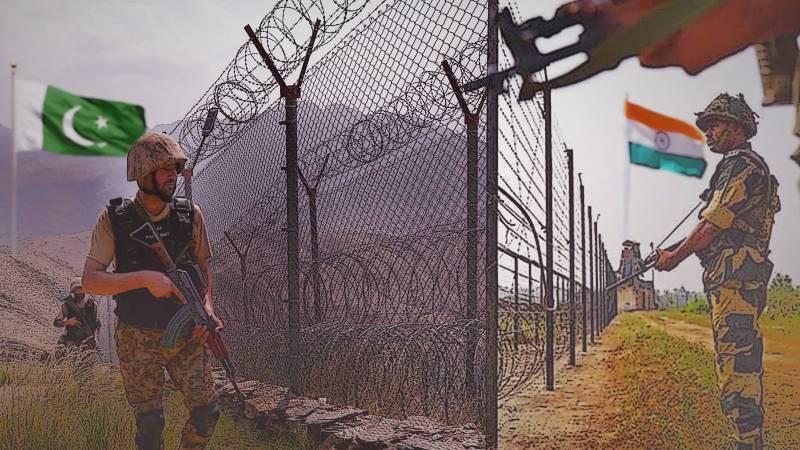
Despite initial fears, the Eastern Fronts remain quiet; military contacts have extended the ceasefire a few more days. Deputy Prime Minister Dar insists on eventual political dialogue to address all issues, reiterating opposition to India's revocation of Kashmir's autonomy.
The theatre of the four-day war ended well. But all may not be that proverbial well; it ended at the cost of about 100 lives, going down just a number, and mercifully, they agreed to drop the curtains. A sigh of relief spiked with the victory celebrations and congratulations, transcending the bloody borders, the attackers, defenders and retaliators- wonder of the wonders. Another instance of David defying Goliath, yet this time with the support of Chinese slingshots. Tethered to deep-seated animosity and grievances, trading threats and teaching the other side a lasting lesson, though it still goes on. Absurdum infinitum.
We are not the people given to introspection, yet the moment demands a frank assessment of the situation with sobriety of thought. This is the recipe and not bombastic bravado and playing with fire that makes a nation great.
Reportedly, the US concern grew after an Indian missile strike near the control centre of sensitive installations, prompting them to relay an alarming intelligence to India. Veering round from the initial position of ‘none of our business’ to blowing a whistle for an immediate ceasefire, the Americans averted a potential nuclear escalation and inferno. So the much-cherished nuclear deterrence doctrine seemingly holds, preventing an all-out war. However, a new normal of limited war below the nuclear threshold, of ballistic missile strikes and drones, perpetuates the conflict.
One positive outcome of the short confrontation is that the Kashmir issue has again been resurrected into international consciousness, pushing India from its avowed position that the ‘era of uninterrupted talks is over, to holding composite talks
After Pokhran in ’74, it took Pakistan 25 years to assemble and test a weapon and another 25 years to develop an effective delivery system. Had that dedication been applied to two far more vital pursuits: improving the socio-economic lot of the masses and the resolution of the Kashmir dispute, a peaceful environment would have yielded exponential benefits.
With the Kesariya colours grabbing the whole territory of J&K in 2019, the issue went further down the rabbit hole. Still, it didn’t appear to sit well in Hindutva’s Wonderland. What the Modi regime had been flaunting for about six years, the stripping of 370 as its great success story, the Pahalgam, then happened to scupper it all. State repression, breeding resentment and violence got a new lease with the reckless transformation of the constitutional nature of the valley. The lava spewing out of the fissures from Kashmir every few years, especially for the last four decades, flares up the tensions in the already overwrought atmosphere of the region. Yet this time, the world has barely pushed the old nuclear-armed rivals back from the brink.
Seemingly, the Kashmir issue for its eternity and the wars and violence it has spawned has become a metaphor. Now it’s a festering sore, an open wound, an unfinished business of 1947, and it all makes the dispute look as old as the Kashmir hills themselves. Had it been just a dispute, the people could have countenanced it as another nuisance. But the blood-soaked history of the valley and its perpetual defiance to all sorts of efforts to address it make one wonder if the pattern of geopolitics that precedes the issue is too complex to understand. Not to be discounted is the way the issue has injected the culture of hate and extremism and distorted the progress and polity of both states, with its overall implications.
No wonder many now take it for granted to think that the only common point between the two states vis-à-vis Kashmir is to keep the kettle steaming, maintaining the status quo. The powerful circles are not keen to soothe the geographical wedlock between India and Pakistan. Hence, many take it as an open secret that vested interests have so many stakes in it that they wouldn’t allow the cold logic to take its course, loath to admit the urgency to take it up with courage and commitment. The perpetual deadlock over the issue takes a more enigmatic turn when the people note that both countries never run short of the popular leadership, diplomatic and legal acumen to challenge the entrenched interests. This is how they have sorted out several contentious matters through talks and treaties. But when it comes to the Kashmir issue, where every few years the situation becomes fraught with nerve-racking tensions, the states, with all their might, find themselves too helpless to settle it for good.
The ramifications of the never-ending rattling on Kashmir extend far beyond the militancy and outright belligerence it breeds. It has become South Asia's primary source of instability. In a quest to claw it back, Pakistan, which started as a democratic, progressive, liberal country, gravitated into a garrison state relying on foreign military alliances. Policies and priorities at home deviated to relegate the development programmes to the back-burner, and the public disaffection grew to the point that East Pakistan finally said Au revoir. Feeling more desperate, the rump state devolved the territorial dispute into an age-old Hindu-Muslim clash, unwittingly fueling religiosity and extremism across the borders. In due course, our society specifically suffered severe backlash at the hands of sectarian and militant outfits, rendering the state an international pariah and internally insecure. Now politically stunted with socio-economic indices touching the floor, the fatal fault lines within the country have taken a substantially more menacing turn.
What prudence dictates is to pursue the trajectory, aborted a couple of decades ago, to take on the Kashmir issue head-on. One positive outcome of the short confrontation is that the Kashmir issue has again been resurrected into international consciousness, pushing India from its avowed position that the ‘era of uninterrupted talks is over, to holding composite talks. The blueprint and framework for dialogue already exist with input from both belligerent sides. Seize the opportunity before it disappears, and certainly before the contenders themselves go bust, with the more fragile party likely to suffer first.