

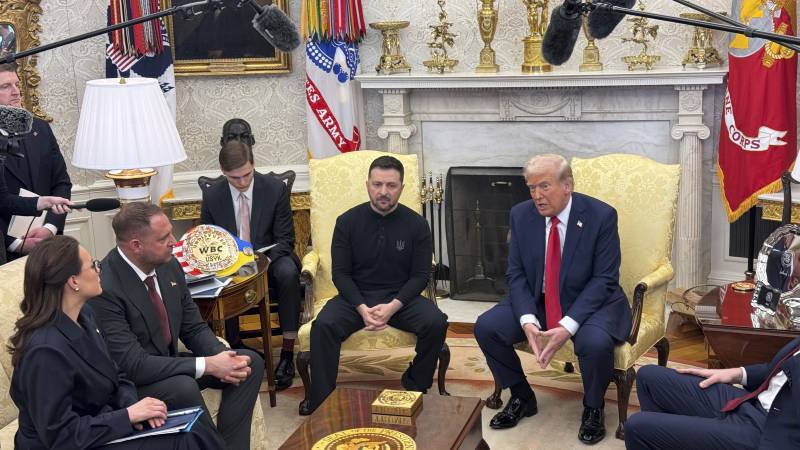
The recent Oval Office spat between US President Donald Trump and Ukrainian President Volodymyr Zelensky marks a turning point in their bilateral relations. This confrontation was a calculated move by the Trump administration to, on the one hand, redefine America’s role in the Russia-Ukraine war and, on the other, to realign US foreign policy in terms of reinforcing Trump’s skepticism of NATO. Nonetheless, the strategic rationale behind Trump’s approach is based on weak empirical foundations as analysed below.
To begin with, one of Trump’s key motivations in publicly humiliating Zelensky was to contrast his leadership with what he perceives as the failures of the Biden administration. By depicting Ukraine as a drain on US resources, he reinforced the narrative that taxpayer money is being wasted on a foreign war instead of domestic priorities. This aligns well with his broader populist stance of “America First”. Moreover, by framing continued military and financial assistance as unnecessary, he signals his intention to reduce Washington’s involvement in the Ukraine war. Another dimension of Trump’s strategy is to recalibrate US relations with Russia. By questioning the American support for Ukraine and NATO, he aims to complicate Russia’s strategic alliance with China. In addition, his desire to end the war in Ukraine carries economic motivations. Given his past business dealings with Russian entities, a more accommodating approach toward Moscow could facilitate his business empire.
Beyond these immediate calculations, through the harsh treatment meted out to Zelensky, Trump did strategic signaling to other NATO countries, especially Germany and France. By questioning the transatlantic security framework, he reiterates his longstanding critique that European countries have failed to contribute adequately to their defence. This aligns with his demand that European allies need to increase defense spending ─ a position he has maintained since his first term.
Rather than depending solely on Washington, Islamabad should strengthen partnerships with alternative geopolitical actors, including ASEAN and the BRICS Plus
However, Trump’s assertions on the Ukraine war rest on misrepresentations. His claim that the US has spent $350 billion on Ukraine is inaccurate, as the actual figure is around $183 billion, a portion of which is still to be distributed to Kyiv. Moreover, his foreign policy approach disregards historical precedent. For instance, American military and financial assistance to Europe has never been purely altruistic but has consistently been driven by strategic and economic interests. American intervention in both World Wars aimed to protect global trade routes and prevent adversarial powers from dominating key markets, which the US-led capitalism captured post-WW II. Importantly, the post-war expansion of NATO was a calculated move to contain Russian influence and maintain US strategic dominance in Europe and beyond.
Ironically, from Franklin D. Roosevelt to Joe Biden, every American administration has regarded Russia as a key geopolitical rival. Hence, the integration of Eastern European states into NATO was not incidental but a strategic move to prevent Moscow from reasserting dominance over former Soviet territories. Ukraine’s NATO aspirations stemmed from these broader regional security dynamics, which ultimately resulted in the Russia-Ukraine war. Had the US-led NATO seen Ukraine as a buffer state rather than encouraging its integration into Western security structures, this ongoing war might have been avoided.
However, Trump’s unilateral approach ─ disengaging from Ukraine without a viable diplomatic alternative ─ does not provide a sustainable remedy. If the NATO countries including the US seek a durable solution to their Russia problem in terms of ending not just the ongoing war but also preventing future conflicts, they must reassess their approach to Russia’s strategic calculus and consider a negotiated settlement, which may involve compromises regarding contested regions such as Donbas. After all, the late Henry Kissinger suggested the same.
Without such a recalibration, the Russia-Ukraine war is likely to persist, with far-reaching consequences for European security and the global economy. Indeed, Germany has also committed to strengthening its defense capabilities. With a stable economy and the growing influence of far-right ideology, which is making electoral gains, a re-militarised Germany could gradually emerge as a challenge for the US, which has long sought to keep it in check through its military presence. In other words, the NATOisation of especially Eastern European countries risks undermining regional peace by structurally pushing Russia to resort to military measures. Of course, there is no moral justification for Russia waging war on a country that it perceived is being used by the US-NATO alliance for strategic expansionism. European leaders, particularly UK Prime Minister Keir Starmer, ought to engage in strategic deliberations to prevent the re-militarisation of the European continent. If such a scenario unfolds, it could lay the groundwork for a third world war ─ far beyond the ongoing Russia-Ukraine conflict.
Besides, Trump’s public confrontation with Zelensky also serves as a warning for smaller states that are dependent on US military and financial assistance. The Oval Office spat should be a lesson for countries such as Pakistan, which have historically relied on American support. Trump has threatened the Taliban to return the American leftover weapons. If indeed he shifts his attention to Kabul, Islamabad may feel the heat. Hence, Islamabad must walk cautiously by not sending undue signals to the unpleasant Oval Office. The most recent release of $397 million and positive mention of Pakistan by Trump is a reflection of bilateral cooperation on counterterrorism, which reflects the transactional character of bilateral ties, not necessarily any strategic shift in the US policy towards Pakistan.
For Pakistan, the key takeaway from the Trump-Zelensky episode is the need to diversify its foreign policy engagements. Rather than depending solely on Washington, Islamabad should strengthen partnerships with alternative geopolitical actors, including ASEAN and the BRICS Plus. Nonetheless, Pakistan must address its internal security challenges, i.e. suicide terrorism, in close coordination with major powers including China. Given the unpredictability of Trumpian foreign policy, Pakistan must navigate its international alliances with strategic caution to safeguard its national interests.