

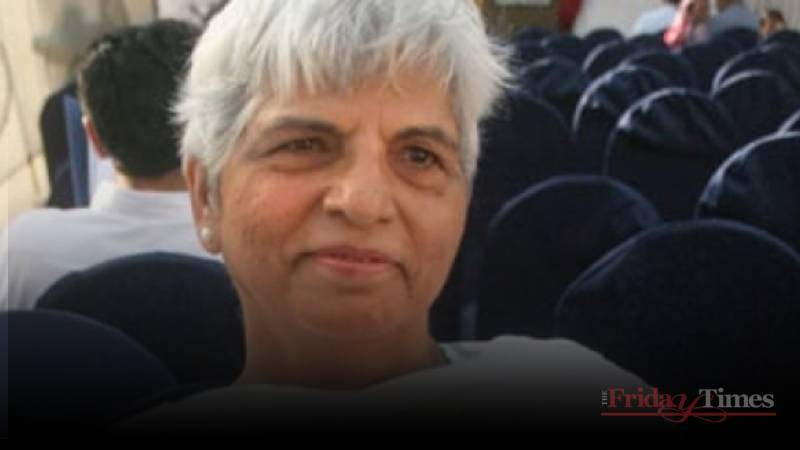
She was my Hero, every woman journalist’s hero, but there are just a few of us lucky ones out there who had the opportunity to be taught by her, learn from her directly, to be mentored by her, and luckier still to call her a friend.
I was 21, or maybe 22 when I joined Dawn as a sub-editor. Mrs Mustafa was assistant editor and one of the big guns in the Islamabad corridor, as we playfully called it, and what an impressive woman she was. Kind, giving, humble, interested, a teacher who was always available, and then later she became my friend.
The late eighties and nineties were the golden age of real journalism, before the advent of online/internet. Those were the best days for any woman working at Dawn, because Mrs Mustafa was the one we all looked up to as our leader. Her straight talk and kind manner was a winning combination; as for her constructive criticism, it came twinned with her commitment to teach us young journalists everything she knew. She was generous in sharing, imparting, guiding and always willing to share her wisdom and expertise in craft. I would go to her office often to chat, for advice, and sometimes just because I wanted to feel important. She had an amazing ability to make one feel valued. I don’t know how she did it, but she just did.
Her voice was different; very assured and commanding, manner of speaking precise, gentle and uniquely her own, her laughter genuine and full, and her persona absolutely unpretentious.
It was in the spring of 1997 that she called me to her office. I was a sub-editor at the then Tuesday Review, a weekly magazine distributed with the main newspaper, and was asked to help her with the thick supplement on fifty years of Dawn, coinciding with Pakistan’s fiftieth independence day.
I spent many days in the Dawn Library, run under the expertise of Sabahat Kalim, the then-brilliant librarian. My back and forth between the library and Mrs Mustafa’s office became a ’97 summer routine. Hours spent bent over old papers, articles read, ads discovered and many exchanges. What struck me most was how she exactly told me of her expectations, and then gently nudged me to work towards and deliver it all before the deadline. We spent hours talking, she told me how she got started, we discussed books, she told me of her journey, and the many challenges in being a woman journalist. And we became friends.
When it was time for me to get a blurb for my book, Mrs Mustafa was so enthusiastic in sending me one, and in her unending support and affection
I got married and moved to the US in 1997. For my wedding present, she gave me a chandi bowl and a book, Arundhati Roy’s God of Small Things. A book I carried with me to the US and have cherished since. The chandi bowl sits in my drawing room.
Whenever I reached out, she responded.
She was personable, likeable, brilliant, empathetic, she had an astute understanding of her craft, a go-getter, a trailblazer, a torch bearer for many generations who chose journalism as their career, from baby boomers to Gen Z. That’s one thing that is so true about her, Mrs Mustafa did not belong to one generation. She was a teacher to Boomers, Gen X, Millennials, Gen Z; and that makes her an institution.
My proudest moment in journalism has to be when Mrs Mustafa trusted me as the person who gave the final read to her manuscript before it went in for publishing.
It was in October of 2017. I had reached out to her regarding a matter related to the Press Club, as per her efficient self she took care of my query and reverted promptly. It was during that very conversation that she mentioned to me that she had discovered a typo in her final manuscript after it had been sent to her by the publisher for a final read, and she was most anguished by it.
What if there were more typos and the publisher had missed them, was her big concern. With compromised sight how was she to give it a final read with exactness? She asked me if I would give it a final read and look for typos.
I remember tearing up.
Her asking me took my breath away.
I was overwhelmed. The very woman who was my journalist goddess had trusted me with her manuscript.
I read the manuscript and had it back to her within a day.
I still have the PDF of My Dawn Year saved in my laptop, and the cherished email that Mrs Mustafa sent me after my having read it.
When it was time for me to get a blurb for my book, Mrs Mustafa was so enthusiastic in sending me one, and in her unending support and affection. Her genuine interest will be so missed.
She supported, listened and mentored tirelessly with both my books.
Oh, Mrs Zubeida Mustafa, we so admired and loved you. You were a brilliant journalist for the world, a trailblazer, a torch bearer for the ones following you in your craft, but for the ones who knew you personally, you were all that and so much more.
Mrs Mustafa, your pen still has so much ink.
The causes you were passionate about, you tirelessly wrote about them, and did immense groundwork to support them. SUIT, women’s education, children’s education, Garage School and many others that were supported in every which way by you.
I had a missed call from her in January of this year. I saw it in March, somehow I missed it, and called her back. It went straight to voicemail. That was my last direct interaction until I got a text from a mutual friend about her passing.
Salute to you my dear Mrs Mustafa, I’m better because of you.