

Walking into the St. Louis Art Museum, you are immediately struck by the grand opulence of a bygone era, the soaring marble columns, intricate stonework, and vast galleries echoing the ambitions of a city long past its peak. These buildings stand as monuments to an age when the world seemed stable, certain, and ordered.
But outside these walls, the world is moving fast: faster than ever before. Technology, climate change, political upheaval, and social fractures challenge every assumption. In the midst of this dizzying transformation, art offers a rare chance to pause and reflect.
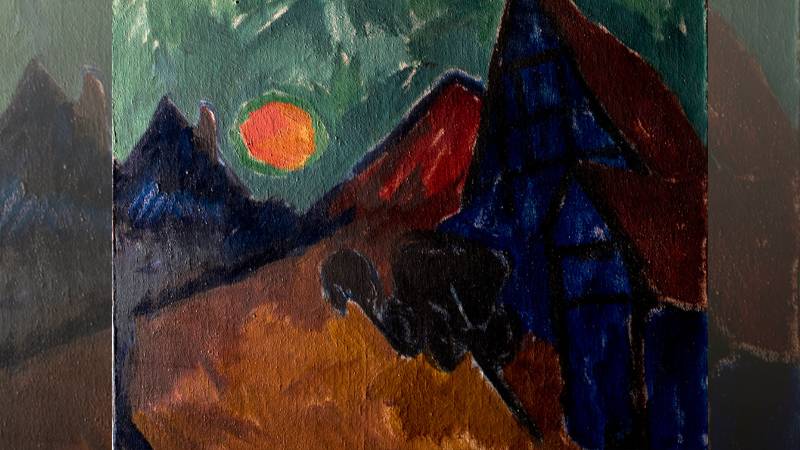
In one of the quieter galleries, I stopped in front of Karl Schmidt-Rottluff’s Rising Moon, a 1913 woodcut etched in stark lines and blackened woods. The forest was tangled. The moon, pale and cold, hovered not as a comfort but as an accusation. This wasn’t a peaceful nightscape. It was a moral terrain.
There was no one else in the gallery. Just me, the trees, and the slow rise of that moon.
I couldn’t help but think of a doctoral class I took over a decade ago, just across from Forest Park, during one of those harsh, grey St. Louis winters. I was contextualising the theme of representation in Dostoevsky, grappling with how his characters, especially in The Brothers Karamazov, reflect the moral and spiritual crises of their time. We were deep in questions of agency, inner conflict, and the paradox of moral freedom. Back then, the conversations felt abstract; dense, philosophical inquiries in a seminar room where the radiator clanked louder than our disagreements. But standing now in front of Rising Moon, it all felt urgent. Real. A line returned with force:
“There is nothing more seductive for man than the freedom of his conscience, but there is nothing more tormenting either.”
The world doesn’t need clarity as much as it needs courage, the kind of courage it takes to live in moral twilight and still keep walking
That line has followed me ever since.
The freedom of conscience — it promises everything: moral clarity, self-respect, authenticity. But it also strips away excuses. It demands that we decide for ourselves what is just, what is merciful, what is true — and then live with those choices.
The moonlight in Schmidt-Rottluff’s print doesn’t illuminate in the usual sense. It distorts. It casts long shadows. Like conscience, it reveals what was hidden, but it does not comfort. There is no road in the image, no guide. Only trees, stark and angular, and a light that offers no direction, just awareness.
That, perhaps, is where the world finds itself now.
In our time, we are freer than ever before — freer to speak, to resist, to decide who we are. But that freedom comes at a cost. Moral complexity surrounds us: from artificial intelligence and climate collapse to genocides streamed in real time and political rhetoric hollowed by outrage. There are no longer clear sides, only echo chambers. No shared truth, only curated conviction.
What we face is not just a political crisis or cultural fatigue. It is a crisis of conscience. We crave moral certainty but live in a fragmented world. The seductive promise of inner freedom — “think for yourself” — has become an anxious burden. Algorithms reward quick judgement. Institutions have lost moral authority. And public discourse no longer encourages listening, only labelling.
Many respond to this torment by giving their conscience away — to ideologies, to influencers, to factions that offer the illusion of moral clarity. Others retreat altogether, numbed by contradiction and helplessness. But the moon keeps rising. The conscience keeps whispering. The torment does not go away; it waits.
That’s what Schmidt-Rottluff’s Rising Moon captured: not serenity, but the moment just before decision. The moment when you see too much to remain innocent, but not enough to be sure.
Dostoevsky and Schmidt-Rottluff never met. One wrote in the shadow of Tsarist Russia; the other carved his images in the volatile wake of pre-WWI Germany. But both understood the same thing: moral freedom is beautiful, and it is brutal. It is the essence of our humanity, and the price of it.
We do not need more slogans. We need more moonlight. More people are willing to live with the torment of conscience rather than surrender to the comfort of certainty. We need people who can sit with the complexity of a world where no one is entirely innocent, and no answer is entirely pure.
The world doesn’t need clarity as much as it needs courage, the kind of courage it takes to live in moral twilight and still keep walking.
As I left the gallery that day, I turned back once more to Rising Moon. The moon was still there. The trees, still twisted. But I no longer saw paralysis; I saw possibility. Not a path, but the permission to keep seeking one.
And that, in the end, is the quiet gift of conscience: not comfort, but direction. Not certainty, but motion. Our conscience is in constant flux, like the moon’s slow rise — ever changing, always calling us forward.
The moon rises. The forest waits. We walk on.
But in this restless moral landscape, will we be able to negotiate in our minds the shadows and light, and choose to keep walking?