

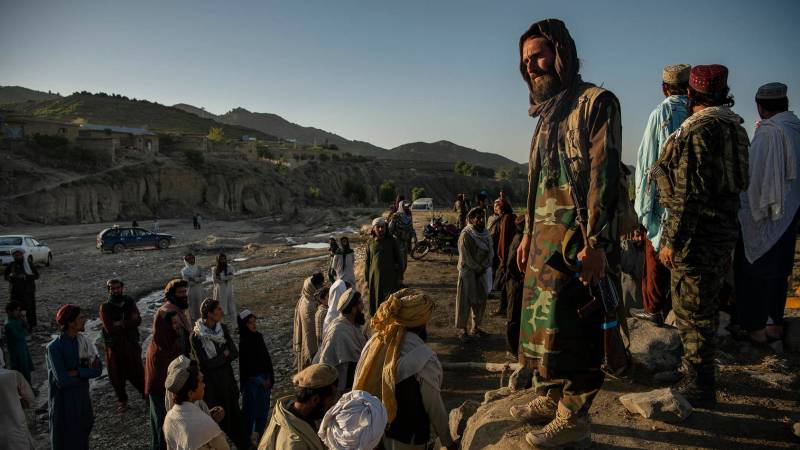
A stern message was sent across the region, specifically to the Taliban government, with recent Pakistani airstrikes targeting prominent Tehrik-i-Taliban Pakistan (TTP) leaders holed up in Afghanistan. One wonders whether there will ever be peace in Afghanistan after the gradual obliteration of rogue TTP leaders and cadre from the escalating regional war theatre. Mainly operating from Afghan soil, the TTP, with an ambition to overthrow the government and replace it with its own, has consistently attempted to fracture Pakistan’s regional peace efforts.
The overblown trumpet—the arguably “good governance and peace” in the first stint of the Taliban government in Kabul (1996–2001) enlivened popular narratives across Pakistan during the late 1990s. “Because their community service is readily available and their justice is swift,” observed a senior cleric (requesting anonymity). Hallucinating that propaganda, he was not alone, as a bunch of like-minded eminent personalities had joined the chorus. The Taliban then swiftly tried to spill over the controversial Islamic Emirate 1.0 into the soft belly of the neighbouring countries.
Despite my respect for the elderly cleric, genuflecting that perspective remained void in the backdrop of still-prevalent brutality and serious violations of human rights, especially against womenfolk in the Emirate 2.0 (since August 2021). Nothing much has changed since the day an extraordinary session of the Organisation of Islamic Conference (OIC) commenced in January 2022 and multiple episodes of mediation in Doha, Qatar, and elsewhere.
The Taliban justice might be swift, but their kangaroo courts failed to allow fair investigation and defence opportunities for the accused. Such were the times when the optics-based narratives hyped in favour of Emirate 1.0, recognised only by Saudi Arabia, the United Arab Emirates (UAE) and Pakistan, the host of the largest concentration of several million Afghan refugees in the world for over four decades. Yet the successive governments in Kabul never missed a chance to mudsling and attack Pakistan.
Such were the times when the Taliban were consolidating their footprints in the tribal areas of the country, particularly the Swat Valley. It was the time when Osama bin Laden’s Al-Qaeda jihadists snatched camps, expelling the desi zealots and gaining significant popularity as the “authentic” leader of the Ummah who would reclaim the world order. So much so that newborns were named after Osama far and wide. Even commercial commuters proudly carried Laden’s posters across Pakistan.
The shattered level-playing-field myth and misunderstood peace—during the past four decades, the trumpet of peace was overblown without a fair understanding of the concept. The pseudo-political pundits, in particular, were overwhelmed by President Barack Obama’s statement in December 2010 about the withdrawal of US troops from war-torn Afghanistan. They blew it far bigger on their small television screens, as if the American troops stationed in Afghanistan (over 100,000 at one point) would evaporate into thin air in a spur-of-the-moment. They fantasised about a post-withdrawal scenario where the other rival players in the region would play around unescorted on the “level playing field”, the fallacy that miserably bounced back. Even after the combat mission was officially concluded in December 2014 and American forces completed their full withdrawal in 2021, the kind of peace hoped for never materialised in Afghanistan.
There has never been a period of peace in the Afghan region throughout history, and anyone hoping for it in the future will simply be disappointed
Such is the rogue culture of war and violence in Afghanistan that even when not fighting external intruders, they violently pursue ethnic strife. However, that situation is considered a kind of peace in its own right! The battle-hardened forty-two per cent ethnic Pashtuns in the south, who remained a power to reckon with, took over Kabul by storm in August 2021, pushing almost half a dozen fragmented ethnic minorities to the wall.
Successfully galloping into their fifth year in power, the Taliban tipped earlier as lacking political acumen despite their unmatched military resilience, reinvented rogue political dealings, employing inborn cunning trading skills. However, they failed to meet the prerequisites of statecraft; the deficiency led overconfident Taliban decision-makers to keep playing on the wrong foot.
The rogue peace—other stakeholders brokering peace in Afghanistan failed in an “us versus them” quagmire while veiling behind the pretext “peace in Afghanistan guarantees peace in the region”, because of a maladroit definition of peace in the context of Afghanistan.
Had it been the controversial socio-political stability sought for acquiring strategic depth or to gain trans-border political mileage, the Taliban made inroads to introduce their very own culturally drenched version of peace and stability. Just like their own interpretation of Sharia (Islamic legal system), the Taliban coined a twisted version of peace as “my way or the highway”, meaning no war and no violence (by others only), as cherished by authoritarian regimes in the annals of history.
“Values of a society determine how it wants to live and behave,” stressed a senior foreign diplomat with a solid handle on the cultural and political history of Afghanistan. He observed that Afghanistan, unfortunately, has been dominated by an ethnic group that “views peace as of no benefit” and that “violence comes easily to them as a means of achieving goals.”
Galtung’s peace paradigm—The Norwegian Professor Johan Galtung, revered by scholars across the world as the father of peace studies and peace journalism, shattered the myth of false peace. Decades ago, Prof. Galtung came up with the iconic definition of peace, vividly distinguishing positive peace from the negative. The absence of war and violence does not mean peace, Galtung determined, stressing that it is a negative peace because it holds the factors that can be catalysts to conflict, particularly the presence of structural violence. Prof. Galtung described positive peace as the absence of war, physical and structural violence that is embedded in the state policies of discrimination against particular individuals, groups and communities.
During their over three decades of evolving history, the Taliban, like any other fascist authoritarian group, infused an excessively obsessive use of a twisted interpretation of religion in politics to consolidate authority and accomplish economic objectives. The conflict is generated through varieties of extremism that turn violent on different pretexts, exercised alike by authoritarianism. War and violent conflicts—physical and psychological, economic or cultural—the primitive mode of economy remains in more or less the same imperialist modus ponens as the prime pivot for some contemporary modern states. The initiatives employed by such countries, including voicing and championing peace and rights, revolve around fomenting and galvanising the conflicts to oil their warmongering profit mechanisms!
Peace in Afghanistan never — There has never been a period of peace in the Afghan region throughout history, and anyone hoping for it in the future will simply be disappointed. The notion of peace for Afghanistan has to be totally different from that understood by the West and westernised mindsets, in a similar way to the failed application of the Western democracy model grafted onto most of the developing world.
The dimensions and dynamics of peace and conflict must altogether be understood in their very own ingenuity in the context of deep-rooted Afghan ethnic tribalism, should any type of peace be hankered after in the region. If there were ever to be any peace in Afghanistan, it would be negative peace.