

Language is never innocent. It is the most portable of empires and the most intimate of prisons. Those who inherit it as a mother tongue forget that it once arrived in ships and statutes; those who acquire it as an instrument of survival know that each verb carries the weight of a verdict. The postcolonial condition, if it has any coherence as a philosophical predicament, resides less in flags and frontiers than in the grammar of aspiration. To speak English in a provincial town of Pakistan is to rehearse a claim upon the future, to negotiate with ghosts of empire, to insist that mobility may yet be conjured out of syntax.
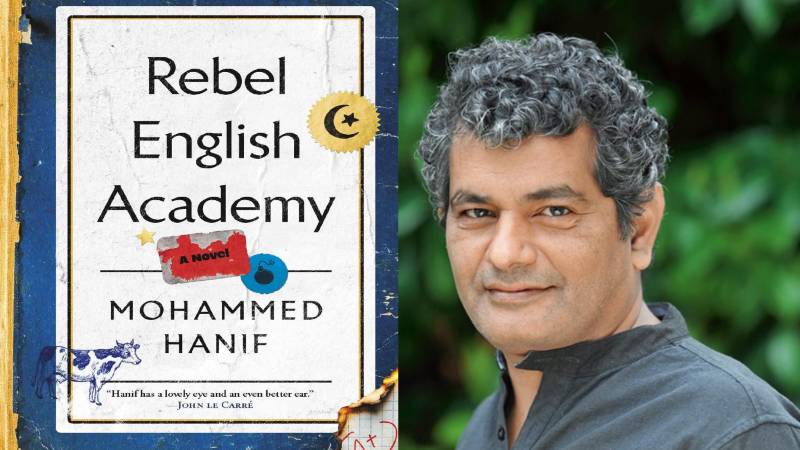
Mohammed Hanif has long understood that political power in Pakistan is theatrical, conspiratorial and linguistically overdetermined. In his fiction, language does not simply describe authority; it parodies it, exposes its insecurities, and occasionally replaces it. Rebel English Academy, published in 2026 by Grove Press, is both a culmination and a transmutation of this preoccupation. The novel returns to a familiar historical trauma, the execution of a deposed leader, yet relocates its moral and comic energy to a tuition centre in a cantonment town where English grammar becomes a subversive catechism.
Hanif’s earlier work anatomised the state from within its fortified compounds. Here he moves outward, into the cramped pedagogical spaces where the next generation is drilled not in arms but in tenses. The ending carries a reflective, summative air, suggesting not an authorial farewell but a reckoning with satire’s diminished leverage in a political culture that has learned to parody itself. The novel thus stages the possible end of an era in which satire could still wound power directly. It asks whether rebellion has migrated from the parade ground to the classroom, from the coup to the clause. Its answer is neither consoling nor simple.
The Theatre of the Gallows
The novel opens on the night of a hanging. The condemned man shaves, perfumes himself, smokes a cigar and rehearses his own corpse-like stillness. The jail bureaucracy fusses over razors and coffins; a captain on a secret mission photographs the dead man’s genitalia to settle a rumour about circumcision. The grotesque absurdity of this episode establishes the moral climate of the book. Execution is not solemn justice but an administrative farce, and even death is subjected to the logic of documentation.
To name ruin is to anticipate it; to teach a child the conditional tense is to insinuate the possibility of an alternative history
Hanif’s control of tone in these early chapters recalls the assured brio of A Case of Exploding Mangoes, published in 2008. There, the mysterious plane crash that killed General Zia ul Haq was refracted through the sardonic testimony of Ali Shigri, a cadet who survived by accident and irony. In Rebel English Academy, the hanging operates as a historical echo. The rituals of state violence are rendered with meticulous detail, yet the emphasis falls not on martyrdom or tragedy but on the petty anxieties of officials who fear embarrassment more than injustice.
The captain’s punishment posting to a town known chiefly for its vehicle registration plates initiates the novel’s spatial shift. Authority, once concentrated in palaces and airbases, is now dispersed into the banalities of cantonment life. The gallows scene functions as prologue and diagnosis: a polity obsessed with symbols of purity and loyalty, incapable of dignity, and perpetually suspicious of its own narratives. In such a world, the teaching of English acquires an unexpected charge.
Sir Baghi and the Pedagogy of Dissent
At the centre of the novel stands Sir Baghi, founder and sole instructor of the Rebel English Academy. His surname means rebel, and the irony is deliberate. Baghi is a failed revolutionary who once dreamed of violent upheaval and now drills shopkeepers’ children in grammar. He buttons his collar to conceal a faded hammer and sickle tattoo; he reads Virginia Woolf while marking essays; he reduces life’s complexities to single English words in order to render them manageable.
Hanif sketches Baghi with affectionate severity. He is vain, wounded, intermittently cowardly, yet possessed of a stubborn ethical residue. His academy, despite its misleading name, is described as law-abiding and affordable. It is not a clandestine cell but a modest tuition centre where the future is parsed into manageable clauses. In a town suffused with funeral prayers for a recently executed leader, Baghi insists on the difference between an idea and a corpse.
The arrival of a young woman with a sports bag disrupts this precarious equilibrium. Her handshake, her defiant voice, and her ambiguous past threaten to transform the academy into a sanctuary and a battleground. Hanif’s gift lies in allowing political allegory to emerge from intimate gestures. A handshake becomes a referendum on gender norms; a grammar lesson becomes an argument about agency. Baghi’s pedagogical technique of isolating single words acquires symbolic weight. To name ruin is to anticipate it; to teach a child the conditional tense is to insinuate the possibility of an alternative history.
Women, Witnesses, and the Inheritance of Violence
Hanif’s fiction has always been attentive to women who inhabit the peripheries of male power. In Our Lady of Alice Bhatti, published in 2011, a junior nurse navigated the toxic corridors of a Karachi hospital, her partial sanctity and partial vulnerability exposing the cruelty of sectarian and patriarchal structures. Alice Bhatti’s world was one in which miracles were indistinguishable from survival strategies.
Rebel English Academy consolidates Mohammed Hanif’s significance as one of the most incisive satirists of contemporary Pakistan
In Rebel English Academy, a young woman who initially appears unnamed but is later identified as Sabiha Bano seeks refuge with Baghi and inherits this lineage. She is neither saint nor victim; she is pursued by her own past and by the town’s appetite for scandal. Hanif resists the temptation to romanticise her defiance. Instead, he situates her within a network of men who oscillate between protection and possession. Molly, the pious friend who deposits her at the academy before leading funeral prayers, embodies the uneasy alliance between faith and politics.
The novel’s most incisive passages occur when the woman’s presence forces Baghi to confront the limits of his rebellion. He can teach irregular verbs; he cannot guarantee safety. He can mock feudal demagogues; he cannot dismantle the structures that empower them. In this tension lies one of the book’s strengths. Hanif recognises that language is a shield but not a fortress. The academy is porous; the town’s gossip and violence seep through its walls.
From Mangoes to Birds: Continuities and Departures
To appreciate the significance of Rebel English Academy within Hanif’s oeuvre, one must trace the arc from A Case of Exploding Mangoes through Our Lady of Alice Bhatti to Red Birds, published in 2018. The first novel dismantled the mythos of military omnipotence through exuberant conspiracy. The second transposed satire to the civilian sphere, exposing the absurdities of bureaucracy and the vulnerability of minorities. Red Birds ventured into a desert war zone where a lost pilot and displaced villagers confronted the machinery of global intervention.
Across these works runs a consistent suspicion of grand narratives. Generals, surgeons, colonels and aid workers are revealed as improvisers in systems too complex to master. In Red Birds, the desert was both literal and metaphysical, a landscape of mirage and moral disorientation. In Rebel English Academy, the desert recedes, replaced by the dusty streets of a cantonment town. Yet the mirage persists. English itself becomes a shimmering promise, alternately redemptive and illusory.
What marks the new novel as a departure is its relative inwardness. The earlier books thrived on the multiplicity of voices and baroque plotting. Rebel English Academy is more contained, more attentive to the micro-politics of a single institution. This concentration yields moments of acuity but also exposes certain weaknesses. The narrative occasionally relies on reiteration rather than escalation; secondary characters flicker without attaining the density of Ali Shigri or Alice Bhatti. The satire, once volcanic, sometimes simmers.
Satire at Dusk: Limits and Legacies
Rebel English Academy reads as a meditation on the fate of satire itself. The hanging that inaugurates the book belongs to a recognisable historical script, yet the academy suggests a future in which rebellion must operate obliquely. The novel intimates that overt confrontation with the state has become both futile and theatrical. What remains is the slow insurgency of education, the patient cultivation of linguistic dexterity in a society allergic to nuance.
Yet Hanif does not sentimentalise this strategy. The Rebel English Academy is vulnerable to co-option; its students may master grammar only to serve the same structures their teacher despises. The town’s authorities view Baghi with suspicion, not because he is dangerous but because he is ambiguous. Ambiguity, in Hanif’s moral universe, is the last refuge of integrity. But it is also a precarious refuge.
There are moments when the novel’s philosophical ambition outstrips its dramatic engine. The symbolic resonance of English as both imperial residue and emancipatory tool is sometimes stated rather than embodied. Baghi’s interior monologues, though often sharp, can verge on discursiveness. One senses that Hanif, after decades of anatomising Pakistani power, is less interested in plot than in diagnosis. For some readers, this will feel like a mellowing; for others, a thinning.
Nevertheless, Rebel English Academy consolidates Mohammed Hanif’s significance as one of the most incisive satirists of contemporary Pakistan. By relocating rebellion from the cockpit and the hospital ward to the classroom, he redefines the terrain of dissent. The novel’s closing gesture is neither triumphant nor despairing. It is conditional. The future, he implies, will be written by those who understand the grammar of power and dare to conjugate it differently.