

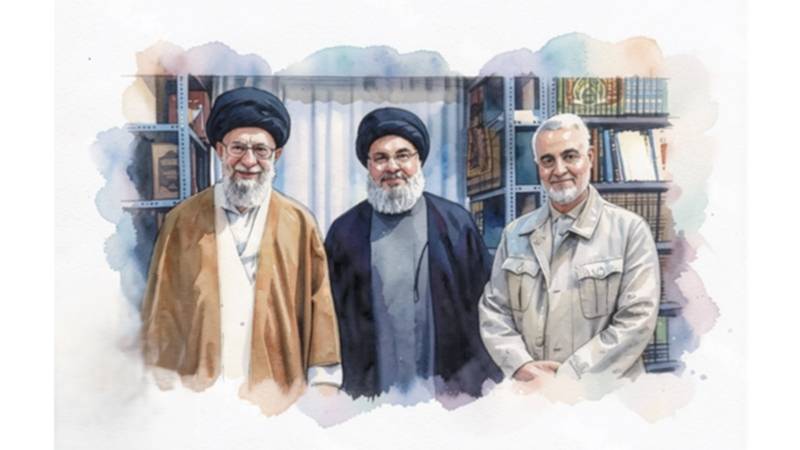
“ما ملت شهادتیم، ما ملت امام حسینی“
“We are the nation of martyrdom; we are the nation of Imam Hussain,” Martyred Quds Force commander, Qasem Sulaimani.
“We are the nation of martyrdom; we are the nation of Imam Hussain.”
(legendary Quds Force commander Qasem Soleimani, who was assassinated by the United States)
In 2022, after Mahsa Amini’s tragic death, people in the USA, EU, and Israel intensified efforts to support protests to overthrow the government. This wasn't new, as the West has repeatedly been involved in government-changing operations in Iran since the 1953 operation of overthrowing Dr Mossadegh. Apart from this incident, and particularly after the revolution, they have failed badly in achieving their target despite putting maximum economic and political pressure, an international boycott, and even the assassination of not only their top scientists and scholars but also of their top leadership, including Supreme Leader Sayyed Ali Khamenei in 2026. This raises a big question as to why the US keeps failing and how Iran manages to survive every time. Let's start with my article from 2022 and how those elements still stand valid.
My December 2022 article for The Friday Times, after Mahsa Amini’s death, titled “Why The Protests In Iran Are Unlikely To Cause Regime Change For Now”, discussed in detail why the US or the West will fail in overthrowing the government in Iran using its population, economic pressure, and international isolation. At that time, and in the past, the USA and the West have repeatedly attempted to incite people against the government, create internal destabilisation, political division, and economic sanctions not just to pressure the government to change its policies, but also to make people stand against the government. Interestingly, they failed badly each time, including in 2022, and are currently failing again in 2026.
Ideology of Red Shiism
In that article, I highlighted four major reasons why Israel, the USA, and European countries cannot achieve this target. The first point of discussion was the Iranian religious ideology of Red Shiism, which emphasises practical measures and a willingness to sacrifice for the right cause of humanity and justice. The cost in this ideology holds secondary value compared to the principles.
The integration of the Wilayat-e-Faqih government system is so profound that worldly gains and Western academic concepts of the state entirely fail to predict Iranian behaviour
Red Shiism is the ideology written by Dr Ali Shariati, and the main inspiration for this whole set of principles is derived from the tragedy of Karbala and the principles of Imam Hussain, the grandson of Prophet Muhammad (PBUH), which he followed, which cost him dearly, and he lost his entire family and companions. He was left alone with only 72 fighters against an army of thousands, and some reports put the numbers in the hundreds of thousands. Nevertheless, Iran, after the 1979 revolution, has followed these same principles, and they are so deeply rooted that no one can manipulate or change them with contemporary concepts of rationality, national interests, and survival. These aspects hold no value if the basic principles of Red Shiism are compromised because of them, even at the state level.
Iran, as a state, and its leaders follow the ideology of Hussain and have always been ready to sacrifice everything for the just cause of humanity, fighting for the oppressed and standing firm against imperialists. Iranian Supreme Leader Sayyed Ali Khamenei repeatedly stated that his nation won't surrender to Israel and, in fact, would bring his enemies to their knees. Similarly, Qasem Soleimani, the late IRGC Quds Force commander, stated that they are the nation of martyrdom and the nation of Imam Hussain. This shows that their approach to regional issues was not driven by Western concepts of rationality or national interest, but rather was driven by the ideology of Imam Hussain. Now, this system or thought is largely followed by Iranians, and that's why around 15 million people gathered in Tehran on the 6th of July 2026 to pay respect and bid farewell to their martyred leader, as per reports. And that's why my second point in 2022’s article was the discussion on the integration of this system among the Iranian people and leaders.
Integration of Wilayat-e-Faqih
The deep integration of the Wilayat-e-Faqih government system and the acceptance of this notion by the public and leaders of Iran is so deep that worldly gains and the rationality concept of Western academic explanation of the state fail. The people, the political leaders, and the supreme leader of Iran consider staying loyal to the system as their religious duty and abandoning it as a sin and betrayal to the cause of Imam Hussain. They didn't abandon the system in 2022 despite large protests, and are not abandoning it in 2026 either. In fact, even after a devastating military onslaught, the assassination of the top 50 government officials, and thousands of civilian and military commanders, millions gathered for the funeral ceremony of their martyred Supreme Leader Sayyed Ali Khamenei, showing the world how they profoundly miscalculated the Iranian ideology, system, government, and people.
The USA, before launching the military attack on Iran in late February 2026, thought that eliminating their top leadership and causing severe damage to public life and mass killings would eventually lead to the collapse of the government, and the public rising up and demanding a different system. This again was miscalculated and failed due to the strong organisational setup where one takes the place of another commander, leader, or soldier. Additionally, the historical legacy of Persian civilisation also makes them strong nationalists, and they avoid foreign interventions. Furthermore, the third point I discussed in the article was addressing who would lead the nation if they were successful in removing the supreme leader.
My assessment was simple and is proven today after the funeral procession: the Iranian people will choose another leader from among themselves with the same ideology of Red Shiism running in his veins. He will not compromise. He will not bow down just like his predecessor. He will not choose the definition of the West to run the government but rather will follow the same principles of his predecessor. Also, it is important to note that the West will find it very hard to install a puppet in Iran or, for that matter, help Reza Pahlavi’s son because Iranians are proud of their identity, culture, and history. They will not choose someone from the Pahlavi dynasty to rule them, for they have seen how Pahlavi treated the Iranian nation and surrendered Iran to America for personal gains.
Pillars of Defence: Basij and IRGC
At the end, the fourth point highlighted the importance of the Basij and IRGC in maintaining and safeguarding the government. With them being in the millions and having only one purpose of safeguarding the revolution, the West cannot succeed in any manner in Iran unless it can get rid of these two organisations. These points are still relevant and address the question of why the USA fails repeatedly in overthrowing the government.
My understanding is that Israel and America misperceive the Iranian system. The West’s International Relations subject revolves around the concept of rationality and the concept of “national interests”. In the case of Iran, these national interests and rationality have different meanings, and it revolves around the principles of Red Shiism, as discussed above.
In Red Shiism, national interest and rationality are replaced by the principles of humanity, justice, standing against oppressors, fighting for what is right, and calling out oppressors loudly without any fear of death or prosecution. These principles work as primary guiding principles or are the national interest that they would never abandon. Trump should have dug deeper when he asked and was disappointed as to why Iran was still not capitulating after a heavy military buildup before the USA strikes on Iran in February 2026. The West also fails to understand the collective participation of Iranians in national life and progress, and this alone is a big signal to understand, or at least think for a moment, why they are still participating in national life, let alone stay silent, leave the country and leadership, or stand against them for a new system.
Economic sanctions, international isolation, and boycotts by the international community are something very dangerous, and despite this, Iranians have always supported their government in its actions of supporting regional resistance fronts, its stance against the USA and Israel’s imperialist policies, and everything that has put Iran in this condition.
The West yet again failed because their minds are following its understanding of what a state is and how it works. Iranians have a different meaning for these. The West needs to design different policies to engage with Iran, as force and military actions have proven ineffective so far in changing its policies or overthrowing the government. Engagement, and not regime change, is the viable option for the USA, Israel, and Europe to solve the Iranian issue.