

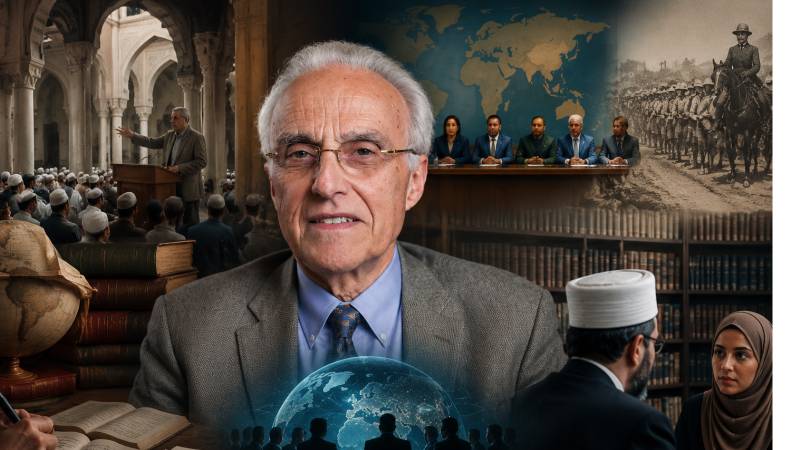
John L. Esposito’s death marks the passing of one of the most influential Western scholars of Islam in the past half-century. At a time when Muslims were routinely reduced to security threats or civilizational problems, Esposito insisted that they be understood as historical actors. He challenged the assumption that Islam was inherently hostile to democracy, pluralism, or modernity, and resisted the transformation of scholarship into an auxiliary of war. For that, he deserves respect.
In the United States, especially after the Iranian Revolution and September 11, expertise on Islam was often rewarded for confirming official anxieties. Policy circles wanted interpreters who could divide Muslims into moderates and extremists, allies and enemies. Esposito pushed against this machinery of simplification. He listened where others diagnosed and explained where others condemned.
Pakistan recognised this contribution by honouring him with the Quaid-e-Azam Award. For Muslims accustomed to being represented through fanaticism, Esposito offered dignity. But a critical obituary must ask not only what a scholar saw, but what his framework left obscure.
Esposito’s great subject was the Western representation of Islam. His limitation was that he did not always examine with equal force the institutions claiming authority to represent Islam within Muslim societies. He was alert to the way empire, media, and Orientalist scholarship manufactured an image of the Muslim. He was less consistently attentive to the way states, clerical establishments, courts, and political movements manufactured an authorised image of Islam and imposed it upon Muslims themselves. Pakistan makes this tension especially visible.
Esposito’s intellectual formation was linked to Ismail al-Faruqi, the Palestinian-American scholar associated with the Islamization of Knowledge. Al-Faruqi argued that modern disciplines were not culturally neutral: economics, sociology, and political science carried assumptions born of European history and colonial power. Muslim societies, he believed, should reconstruct knowledge through an Islamic moral framework.
The argument emerged from a real historical injury. Colonialism had not only occupied territory; it had reordered knowledge, teaching the colonised to see their own traditions as backward while presenting European categories as universal reason.
Yet ideas change when they enter institutions. They acquire patrons, bureaucracies, gatekeepers, and police powers. The issue is not simply whether a project begins with emancipatory intentions, but what happens when it becomes useful to the state.
The rejection of empire does not automatically produce freedom. National states can inherit colonial habits while speaking in the language of culture and authenticity.
Under General Zia-ul-Haq, Islamization in Pakistan became more than an argument about identity. It became a method of rule. A military regime without democratic legitimacy used selected interpretations of Islam to reorder law, education, gender policy, media, and public morality. Religious language gave authority to the state while narrowing the space for political and theological disagreement. Institutions developed during this period, including the International Islamic University in Islamabad, belonged to a wider environment in which Islamization of Knowledge was gaining influence. The relationship was not a simple line from al-Faruqi to Zia: local religious movements, Cold War alliances, Saudi patronage, military interests, and the state’s search for legitimacy also mattered.
Still, the convergence matters. A project that spoke of freeing Muslim knowledge from Western domination entered an authoritarian institutional order. A vocabulary of decolonization became available to the state. This is a recurring tragedy of postcolonial politics. The rejection of empire does not automatically produce freedom. National states can inherit colonial habits while speaking in the language of culture and authenticity.
Esposito understood the diversity of Muslim societies better than many contemporaries. He resisted reducing Islam to one political form and challenged the idea that religious belief necessarily led to authoritarianism. But his scholarship was strongest when the adversary was the Western caricature. It was less searching when the problem was the unequal distribution of authority within Muslim societies.
This limitation appears in the title of one of his best-known books, written with Dalia Mogahed: Who Speaks for Islam? The book used survey research to show that ordinary Muslims held far more complex views than Western media suggested. Its intervention was necessary. But public opinion and public authority are not the same thing.
To ask what Muslims believe is not yet to ask who has the power to define Islam in law, education, media, and political life. A believer may hold plural and democratic views while living under institutions that authorise a narrower doctrine. Public opinion does not decide the school curriculum, the blasphemy prosecution, the family law code, or the categories through which the state distinguishes the proper Muslim from the suspect one.
In Pakistan, the state speaks for Islam through constitutions, courts, ordinances, textbooks, and official bodies. Clerical organisations speak through mosques, seminaries, political parties, and street power. The military speaks through national-security doctrine and alliances with selected religious actors. These institutions do not merely interpret Islam; they possess the power to enforce interpretation. This does not mean that Esposito endorsed authoritarian Islamization. Such a claim would be unfair. A scholar cannot be held responsible for every political use made of ideas associated with his teacher or intellectual milieu.
The criticism is narrower and more important: scholarship built to defend Islam from external misrepresentation is not always equipped to defend Muslims from those who monopolise Islam internally. Esposito made it harder for Western power to speak casually about more than a billion people. But a bridge between ‘Islam’ and ‘the West’ can conceal divisions within both. It can obscure class, gender, sect, state power, and empire.
The task after Esposito is not to abandon dialogue, but to deepen it. Scholarship must oppose Islamophobia without romanticising religious authority, criticise empire without excusing authoritarianism, and defend Muslims from Western caricature and domestic coercion with equal seriousness. Esposito opened an important door. The work now is to walk through it farther.