

There is an old saying that hatred clouds judgement. If proof were ever needed, one need only read some of what now passes for commentary on Pakistan in sections of the Indian media.
A recent article by an editor at an Indian news website made an astonishing claim: that Pakistanis have only recently "discovered" that the cradle of the Indus Valley Civilisation lies within the borders of present-day Pakistan. It is difficult to know whether the author genuinely believes this or simply assumed that readers would accept it without question. Either way, the claim is spectacularly wrong.
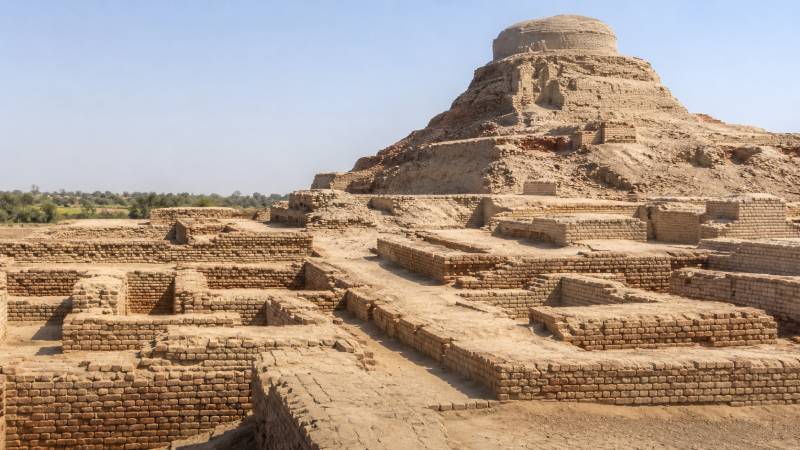
Pakistanis have not suddenly awakened to the fact that Mohenjo-daro and Harappa are among humanity's oldest urban settlements. We have known this for generations. It has been taught in our schools for decades. It has been part of our national consciousness since the country's earliest years. Anyone with even a passing familiarity with Pakistan's educational curriculum or cultural history would know this.
I grew up in Pakistan during the 1980s. Like millions of Pakistanis of my generation, I learnt about the Indus Valley Civilisation in school. I knew that Mohenjo-daro, in Sindh, and Harappa, in Punjab, were among the world's earliest centres of urban civilisation long before the internet, long before social media and long before today's endless online arguments over history.
Nor was this knowledge confined to classrooms. Pakistan has celebrated this extraordinary heritage through postage stamps issued decades ago. Our museums have showcased its treasures for generations. Images of Mohenjo-daro have appeared on Pakistani currency, reflecting a recognition that this ancient civilisation forms an integral part of our historical inheritance. These are not recent attempts to "appropriate" history. They are longstanding acknowledgements of geographical and archaeological fact.
Pakistan does not need to rediscover the Indus Valley Civilisation. It never forgot it
Educational trips to Mohenjo-daro and Harappa have been a rite of passage for countless Pakistani students. I went on one myself in the mid-1980s. Thousands before me and thousands after me have walked through those ancient streets, learning about a civilisation that flourished more than four thousand years ago. To suggest that Pakistanis have only now realised where the Indus Valley Civilisation was located is not simply inaccurate—it borders on the absurd.
Yet this is where sections of the Indian discourse on Pakistan increasingly find themselves: detached from evidence and driven instead by narratives that reinforce existing prejudices.
The disturbing part is not that one journalist wrote something so easily disproved. Journalists make mistakes. The disturbing part is how readily such claims are embraced and amplified by large numbers of social media users who appear far more interested in confirming their biases than examining the facts.
Spend enough time on X or other social media platforms and one encounters an alternate reality in which Pakistan is portrayed as perpetually ignorant, perpetually on the verge of collapse and perpetually discovering things that, according to this narrative, everyone else already knew. Historical facts are bent to fit political agendas. Nuance disappears. Evidence becomes optional.
This is not confidence. It is intellectual insecurity masquerading as certainty.
Ironically, the archaeological record itself is beyond dispute. Mohenjo-daro and Harappa are located in Pakistan. They have been excavated by archaeologists for decades. They have been preserved by Pakistani institutions. They are recognised by scholars around the world as among the greatest archaeological treasures of South Asia. None of this is controversial. None of this is new.
What is new is the growing tendency among sections of India's political and media ecosystem to view every aspect of Pakistan—even ancient history—through the prism of ideological rivalry. In such an environment, facts become inconvenient if they fail to support the preferred narrative.
This is unfortunate because history should unite rather than divide. The Indus Valley Civilisation predates both Pakistan and India by millennia. It belongs to the shared heritage of humanity. The location of its principal urban centres within modern-day Pakistan is simply a geographical reality. Recognising that reality diminishes neither India nor Pakistan. It merely acknowledges the map as it exists today.
The deeper concern, however, is what this episode reveals about the state of public discourse. When demonstrably false claims can be published by senior journalists and then enthusiastically repeated online without the slightest effort at verification, something has gone badly wrong. A society that values narratives over evidence ultimately loses its capacity for critical thought.
This is not to suggest that all Indians think alike. They do not. India has outstanding historians, archaeologists, journalists and academics who approach the past with intellectual honesty. Many ordinary Indians are equally capable of distinguishing fact from propaganda. But their voices are increasingly drowned out by those who treat hostility towards Pakistan not as a political position but as an article of faith.
Perhaps that is the real tragedy. Hatred has become so deeply embedded in parts of the public conversation that even straightforward historical facts are viewed through the lens of prejudice. When that happens, correcting misinformation becomes almost impossible because the objective is no longer to discover the truth—it is to sustain a narrative.
Pakistan does not need to rediscover the Indus Valley Civilisation. It never forgot it.
The question is whether those who continue to invent fictional versions of Pakistan are prepared to rediscover something far more valuable: respect for evidence, intellectual honesty and the simple discipline of checking the facts before publishing them.