

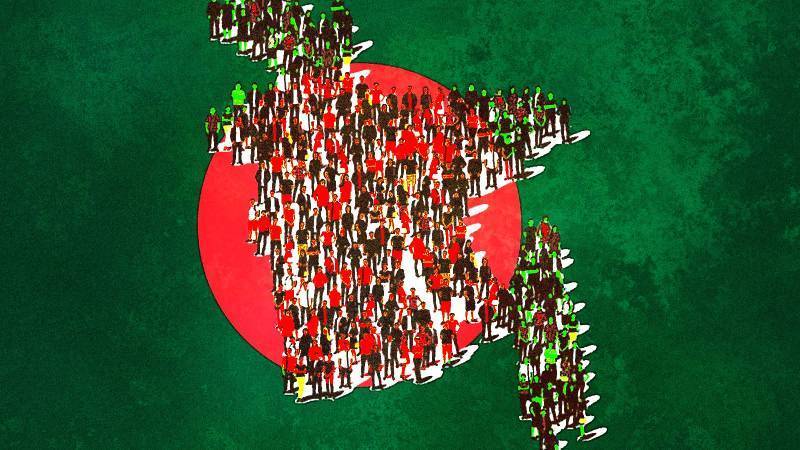
Bangladesh appeared on the map of the world as a sovereign independent state on 16th December 1971, exactly 54 years from now. It is about time that we give a second thought to the history of that tragic event—the cessation of East Pakistan and the breakup of a united Pakistan. The generations of Pakistanis born after 1971 need to be told this sordid tale as it actually happened, and not the doctored official version taught in our Pakistan Studies classes.
The two wings of the country founded by Mohammad Ali Jinnah were linked together by the flimsy thread of religion, and there was a huge chasm of language and culture between the two sides. It was this huge chasm that resulted in the breakaway of East Pakistan and the emergence of independent Bangladesh, just 54 years after independence in 1947.
Pakistan could have survived if the ruling classes had been able to see beyond the tip of their nose and allowed the Bengalis the freedom and political rights as enshrined in our constitution, and had allowed the Bengali language to be the state language of Pakistan along with Urdu, on the pattern of Canada, where French and English are both state languages.
The very idea that religion alone is enough to keep the country together was nothing short of madness, and the subsequent denial of all forms of democratic institutions finally resulted in the breakup of the country. The people of East Pakistan were subjected to the worst type of discrimination politically, socially, and economically during the period from 1947 to 1971. On top of that came the long military dictatorship of Ayub Khan, followed by Yahya Khan, accompanied by a civil-military nexus of the civil services and the armed forces, both based in West Pakistan.
The December 1970 elections were the fairest and freest in the history of Pakistan. The Awami League of Sheikh Mujibur Rahman won a landslide victory, gaining 167 seats in a house of 300 and over 90% of seats in the provincial assembly. Ironically, the transfer of power to the Awami League was denied, and this proved to be the last nail in the coffin of a united Pakistan, resulting in the inglorious surrender to the Indian army and the emergence of Bangladesh.
The elections of 1970 were a golden chance to transform the country into a modern democratic state, but the chicanery of some politicians and the will of the military high command squandered this opportunity, losing half the country, and the rest is history.
Once the aircraft taking Bangladesh’s founder to freedom took off from Chaklala Airport in Rawalpindi, Bhutto told journalists: “The bird has flown”
It is necessary to recount the last days of Pakistan before the surrender by General Niazi in the Racecourse Ground of Dhaka. Since March 1971, the Pakistan army had been fighting a losing battle with the local Bengali force called the Mukti Bahini, armed and supported by India, while the high command still believed in the doctrine that the defence of the East lies in the West.
In a rash move, air strikes were launched on Indian air bases in the Western sector on 3rd December 1971, igniting a full-scale war on both fronts, in the West and the East. Hardly any damage was done to the Indian Air Force, as the Indians had removed their planes from these bases in anticipation of such action. The war now became a slogging match with no visible progress on either the Eastern or the Western Front.
The military dictator Yahya Khan now tried a last-ditch desperate measure to convince the public that he was ready to transfer power to the elected politicians. He appointed Nurul Amin, Chief of the Pakistan Democratic Party, as Prime Minister, and Z.A. Bhutto was appointed Deputy Prime Minister and Foreign Minister in the new cabinet. Bhutto was dispatched to the United Nations to plead the case of Pakistan, but it was too little, too late, as by now the Indian army, along with the Mukti Bahini, was nearing Dhaka.
As the Indian forces neared Dhaka, the Commander Eastern Command, General Niazi, boasted to the foreign media that India would enter Dhaka over his dead body, but then meekly surrendered to the Indian army. In the United Nations, Bhutto was not able to do much because most of the resolutions in the Security Council were vetoed by the USSR, which continued to block all efforts for a ceasefire until an Indian victory was assured. Bhutto could only indulge in some melodramatic theatrics by tearing up his notes and walking out of the Security Council meeting.
By 16th December, as the Pakistan army prepared to throw in the towel in Bangladesh, Yahya Khan remained in his make-believe world, believing that everything was under control. On that very day, officials of the Pakistan government distributed documents regarding the new constitution the regime planned for Pakistan among the foreign journalists gathered at a five-star hotel in Rawalpindi.
As Khurshid Mahmud Kasuri, later Pakistan’s Foreign Minister, relates in his book Neither A Hawk Nor A Dove, within moments, the officials came back to earnestly request the journalists to return the constitution-related documents they had been handed earlier.
In Dhaka, through the services of the UN agencies in a dying East Pakistan, the Intercontinental Hotel was converted into a neutral zone where Governor Malik, his ministers, and civil servants who had been brought into the province from West Pakistan following the launch of the genocide in March were provided with safety guarantees under international law.
In the evening of 16th December, in what would be the remainder of Pakistan, state television broadcast images of the surrender in Dhaka by Niazi and the troops under his command. Yahya Khan was forced to step down and hand over the presidency to Bhutto on 20th December. Nurul Amin was appointed Vice President under Bhutto.
On 22nd December, Mujibur Rahman was freed from solitary confinement in Mianwali Jail and placed under house arrest at a guest house outside Rawalpindi. On the same day, the leaders of the Mujibnagar government arrived in Dhaka from Calcutta and immediately took charge of the administration of Bangladesh. Bhutto held two rounds of talks with Mujibur Rahman in Pakistan, but was compelled to order his release on 8th January 1972. Once the aircraft taking Bangladesh’s founder to freedom took off from Chaklala Airport in Rawalpindi, Bhutto told journalists: “The bird has flown.”