

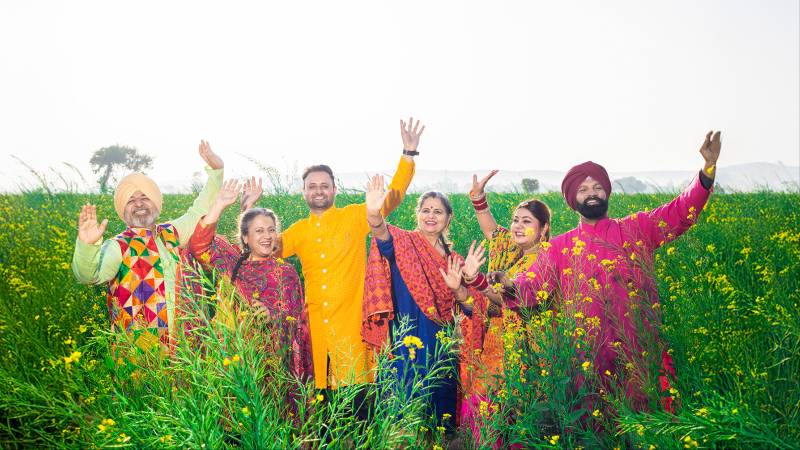
Baisakhi stands among Punjab’s most recognisable regional and cultural festivals, observed at the time when the wheat harvest is brought in. Yet its importance is not limited to the agricultural calendar, for it also occupies a deep and enduring place in Sikh tradition, where it is observed as a religious festival.
The day acquired a new and lasting sanctity in 1699, when under Guru Gobind Singh Ji, the Sikh army and the Khalsa Panth were organised for the first time. Since Sikhism itself was founded in Punjab, this day, which marks the beginning of wheat harvesting, gradually took on the character of a festival. Over time, its religious significance deepened further.
In 1726, on Baisakhi day, Jathedar Dabra Singh organised the Sarbat Khalsa in Amritsar, and the twelve misls gathered there. Thereafter, the key decisions of Sarbat Khalsa continued to be taken on Baisakhi in the years that followed. In this way, the festival became increasingly sacred within Sikh tradition. It was in recognition of this importance that Ranjit Singh probably declared himself Maharaja on Baisakhi in 1801.
Even so, the festival did not begin with Sikhism alone. Long before that, it had been celebrated across the Indian subcontinent for centuries under different names and in different forms. Besides Sikh tradition, Baisakhi is also sacred in the Vedic religion and Buddhism. In Kerala, Assam, Bengal, Himachal Pradesh, Uttar Pradesh, Odisha and several other regions, it is also observed as the beginning of the local solar new year.
In the social and cultural life of pre-Partition Lahore, Baisakhi was celebrated with the same exuberance that marked the wider Punjab. Indeed, the festival was not confined to Lahore alone, for its surrounding areas also came alive with festivity. Iqbal Qaisar notes that at the Gurdwara Chhota Nankia in Manga, a fair was held on Baisakhi.
Another, much larger gathering was held in Suman, a village near Raiwind, and the fair was known as Ram Suman. The village had a sizeable population of Bairagi faqirs, and Bairagi faqirs from across India would especially come there to take part in the Baisakhi fair. The Lahore Gazette of 1893–94 also records this event. According to the Gazette, nearly 60,000 people gathered for the fair, which continued for two days. It further states that when the railway was later constructed, the fair’s splendour diminished somewhat, and more people began to attend the central Baisakhi celebrations in Amritsar instead.
The principal fair was held in Eminabad, some thirty to thirty-five miles from Lahore, but Lahore’s own people celebrated it on the banks of the Ravi
Another important Baisakhi gathering, according to Syed Sharafat Hussain, took place by the banks of the Ravi and drew large crowds. Younus Adeeb has preserved a vivid description of this fair in his memoirs. He recalls that as soon as April began, choliya (fresh chickpeas) started appearing in the bazaars, and this signalled the arrival of the Baisakhi fair in Punjab.
By then, the harvesting season had ended, and the farmers, relieved of their work, began preparing for the festivities. The principal fair was held in Eminabad, some thirty to thirty-five miles from Lahore, but Lahore’s own people celebrated it on the banks of the Ravi. In that riverside celebration, participation was largely confined to the Hindu and Sikh population.
Before dawn on Baisakhi morning, Hindus and Sikhs from Lahore would move towards the Ravi. On the eastern bank of the river was the area associated with the Hindu population, where young Hindu men exercised in the early morning, and on Baisakhi day, it became crowded with people. Bathing in the Ravi was also an essential part of the river fair, and, as Younus Adeeb observes, people were deeply enthusiastic about it.
Separate arrangements were made for men and women. Alongside this, skilful swimmers who leapt from the bridge also drew attention. The special bathing continued until the sun had fully risen, and once the heat became intense, the groups who had come to celebrate Baisakhi would return home.
Near Lahore, in Eminabad, another very large fair was held on Baisakhi, where there were theatre performances, boating and other colourful attractions. According to Younus Adeeb, some families from Lahore would go there specifically to witness the fair. Taken together, these recollections reveal a world in which the festival was not merely observed, but inhabited through movement, bathing, gathering and delight.
Yet Baisakhi in Lahore was not only serene or devotional. It also had an unruly, boisterous and highly spirited side, and Tahir Lahori’s account captures that atmosphere with striking immediacy. He writes that groups would arrive from the villages accompanied by drums and celebration, and that they had fashioned their own coarse couplets in their own style.
People came dancing bhangra to the beat of the dhol, and while chanting vulgar verses, they gathered in large numbers at Shalimar and by the river. Because of this, quarrels often broke out among them.
Instead of preserving the shared cultural expressions that once animated these festivities, there is often a tendency to confine what survives within a narrow frame of interpretation
Drunken men also caused trouble as their behaviour led to mischief, and disputes sometimes became so prolonged that the fair would descend into panic and confusion. Yet even this disorder did not extinguish the festival’s energy. Once one side had withdrawn, the fair would resume with the same enthusiasm as before. Indeed, Younus Adeeb recalls that people would even stroll through the fair proudly wearing blood-stained clothes.
What is especially significant in the Lahore story of Baisakhi is the way it brought together communities that might otherwise appear separate. Although the festival was fundamentally linked with Sikh tradition, Lahore’s cultural diversity meant that Hindus, Muslims and Christians all took part. The festival, therefore, was not dominated by religious exclusiveness.
Naqoosh’s special issue on Lahore states explicitly that thousands of Hindus, Sikhs and Muslims participated together in the Baisakhi fair and also performed ritual bathing. Those who came from the villages would sing and dance bhangra with ghungroos tied to their feet, moving in rhythm with the drum. This is a crucial point in the social history of the city. Farmers, regardless of faith, shared the joy of the harvest and celebrated it alike.
Tahir Lahori’s account also makes it evident that this was a seasonal and agricultural fair. Syed Sharafat Hussain likewise remembered Baisakhi as a celebration of the wheat harvest. Dr S. M. Naz similarly writes that these fairs were organised in Lahore with great pomp and that Hindus, Sikhs and Muslims all took part together. In that shared space, the three communities met, interacted and became familiar with one another’s culture.
The wider meaning of Baisakhi lies in its deep connection with land, labour and gratitude for abundance. It was never merely the celebration of a single religious community or ritual; rather, it was a collective moment of relief, fulfilment and thanksgiving after the harvest. That is why it drew such wide participation in Lahore.
The fairs around the Ravi, the gatherings at Suman, the crowds in Eminabad and the festive bustle in the city itself all belonged to the same seasonal rhythm of spring and ripening wheat. In that sense, Baisakhi was both a social occasion and a harvest celebration, a festival in which the farmer’s joy at the crop’s ripening rose above religious difference.
After Partition, however, this shared cultural world could no longer be sustained in the same form. The diversity that once gave Lahore its distinctive character was gradually reduced, and many of the city’s traditions and famous fairs were displaced. What had once been a living, many-voiced festival lost much of its public breadth and became a thinner urban memory.
In our beloved country, people already have few occasions of simple joy, and even the little that remains is rarely acknowledged or celebrated with openness. Instead of preserving the shared cultural expressions that once animated these festivities, there is often a tendency to confine what survives within a narrow frame of interpretation. This narrowing is all the more poignant when one remembers that Baisakhi was rooted in the life of the farmer and in the joy of the harvest.
In a country where the farmer himself now lives under constant strain, one can speak only with a sense of regret about the fading of a festival so closely tied to his labour and livelihood. And yet Baisakhi still lingers in Lahore as a quiet reminder of a shared past, a time when the city’s radiance lived in its fields, along its riverbanks and in the vibrant fairs of spring.