

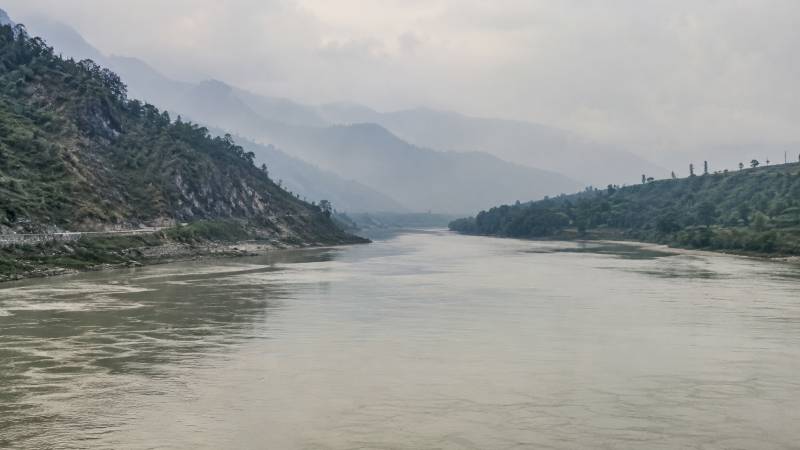
Habibullah Khatti is leaving. He has lived all of his fifty-four years in Abdullah Mirbahar, a village in the riverine flatlands of Kharo Chan, fifteen kilometres from where the Indus is supposed to meet the Arabian Sea. When he was a child, the village had a hundred and fifty households. As of last year, four remained. The fish stocks his family lived on began thinning in the 1990s; by the time he tried to retrain as a tailor, there were not enough customers in the village to keep him in thread. The water that surrounds his home is now saline on every side. He is making one last visit to his mother’s grave, and then he, too, will be gone.
Khatti's story has been told, in different versions, across a dozen recent news reports from Sindh's southern coast. It has been told because it is no longer extraordinary. The Pakistan Council of Research in Water Resources reports that the Kotri downstream, the stretch of the Indus that is supposed to feed the delta, now receives less than ten million acre-feet of water annually, against an established minimum of around twenty-seven MAF needed simply to keep the saltwater out.
The World Bank estimates that seawater intrusion now threatens roughly 1.2 million acres of farmland in lower Sindh. Soil-salinity mapping based on Landsat imagery between 2014 and 2021 found that between 35 and 55 per cent of land in the main agricultural area of the delta has been affected by salinity at varying levels of severity. In the worst-hit districts, more than 88 per cent of residents now live below the poverty line. These are not numbers from a future scenario. They are numbers from the present tense.
It would be tempting, and partly accurate, to file this as a climate story. Pakistan has been told, almost ritually, that it is among the world's most climate-vulnerable countries. The 2022 monsoon floods produced damages estimated at over thirty billion dollars and displaced millions, and Sindh bore the heaviest share.
Glacier melt in the upper Indus basin is rearranging the river's seasonal arithmetic. Monsoon patterns are no longer reliably anchored to their old months. The Indus Basin's surface-water storage capacity has been projected by various studies to fall by as much as a third in the current decade. All of this is true, and all of it is part of why the delta is dying.
The Cholistan Canal controversy of 2024–25 was the moment when the gap between formal accord and actual trust became impossible to ignore
But it is not the whole story. The other half, the part that keeps the climate emergency from triggering the policy response it requires, is internal. The 1991 Water Apportionment Accord was, when it was signed, an act of genuine federal maturity: four provinces agreeing on a formula that had eluded Pakistan for forty years. The Indus River System Authority was created the following year to administer that formula. In the three decades since, the Accord and IRSA have together produced a paradox. They have given Pakistan an institutional language for water-sharing without giving it a credible system of measurement, enforcement or downstream protection.
The signs of that paradox have been everywhere in the past eighteen months. In Rabi 2025–26, IRSA declared an eight per cent shortage even though the country's reservoirs were at 99 per cent capacity — a configuration of facts that, taken at face value, ought to be impossible. By March 2025, both Tarbela and Mangla were at, or perilously close to, dead-storage levels, with IRSA warning the provinces of shortages of up to thirty-five per cent for the tail end of the Rabi season.
The Kotri Barrage canals were running at 56 per cent below their normal water supply during the early Kharif sowing window. In April 2026, Sindh's water minister wrote to the federal government to flag continuing delays at Tarbela's Tunnel-4 and Tunnel-5, warning that outflows had been restricted to 150,000 cusecs and might fall to forty-five thousand if testing was further deferred. None of these crises was created by climate alone. Each was made worse by the absence of a real-time, transparent water-accounting system that all four provinces accept as authoritative.
The Cholistan Canal controversy of 2024–25 was the moment when the gap between formal accord and actual trust became impossible to ignore. Punjab maintained that the canal would draw only on flood surpluses and not encroach on provincial entitlements. Sindh, which has watched its own canal commands shrink for years, saw an upstream province expanding its irrigation footprint while downstream flows were already failing.
Without an agreed-upon database and a binding adjudicator, neither side could fully prove its case to the other. The federal Council of Common Interests has been the formal forum for the dispute, but in practice, the matter has cycled through letters, IRSA committees, and television talk shows without arriving at the kind of resolution the constitution actually contemplated.
Pakistan has spent considerable diplomatic energy demanding climate finance from the international community
To Sindh's credit, the province has not been a passive participant. The Sindh government's mangrove restoration project has, in patches, begun to revive natural barriers against saltwater intrusion. Farmer protests in the riverine areas of Sindh in early 2025 led to the halting of several military-led canal projects on the Indus, demonstrating that civic mobilisation can still bend policy when it is sufficiently coordinated.
The Living Indus Initiative, launched jointly by the federal government and the United Nations in 2021, has at least put the rehabilitation of the basin on the formal policy agenda. And Sindh's own engineers have, for years, made the technical case for a binding minimum environmental flow at Kotri downstream — a case that has been heard, but not adopted as binding federal policy.
What is still missing is the architecture, not the analysis. Three reforms, in particular, would be transformative if they were undertaken with seriousness.
The first is a real-time, jointly auditable water-accounting system covering every barrage, headwork and major canal in the Indus system. The technology to do this is not exotic. Provinces in similarly contested basins, from the Murray–Darling in Australia to the Mekong, operate such systems. What has been missing in Pakistan is not capacity but the political decision to subject inter-provincial water flows to verifiable measurement. As long as each province produces its own arithmetic, every shortage will continue to be litigated as a conspiracy.
The second is a binding volumetric obligation to maintain a minimum environmental flow downstream of Kotri Barrage, written into federal law and enforceable through the Council of Common Interests. The 1991 Accord acknowledged downstream needs in principle but attached no enforceable number. What is not measured and mandated, in any system, eventually becomes expendable. The Indus delta has been treated as expendable for thirty years, and the cost is now visible in the salt crusts of Kharo Chan.
The third is a structured climate-adaptation programme for the delta itself, funded partly through Pakistan's loss-and-damage entitlements under the international climate-finance architecture and partly through provincial own-source revenue. This means more than mangrove restoration, important as that is. It means concrete livelihood-substitution support for fishing and farming households whose primary occupations have collapsed.
It also means relocation assistance for villages already past the point of habitability, and protected-area regulation for what remains of the seventh-largest mangrove ecosystem in the world. Pakistan has spent considerable diplomatic energy demanding climate finance from the international community. Some of it is now arriving. The question is whether any of it will reach the people who actually live downstream.
None of this can happen without a federal political settlement that takes the lower riparian seriously. That is harder than it sounds, because Sindh's bargaining position has been weakened both by economic dependence and by the steady shrinkage of its political influence in the federation. But there is a useful precedent. The 2010 Eighteenth Amendment redistributed power between the federation and the provinces in ways that nobody would have called likely a decade earlier. The federal arithmetic has been adjusted before. It can be adjusted again, and the next major adjustment will have to be the one that takes water seriously.
It is fashionable, in policy seminars in Islamabad, to describe the Indus as Pakistan's lifeline. The phrase is accurate but increasingly euphemistic. A lifeline is not what the Indus has become for the people of Kharo Chan, Sujawal and Badin. For them, it has become an absence, a memory of fresh water, of fish stocks, of villages that used to exist. The river still flows. It simply does not arrive.
The Indus is, as one recent analyst put it, the federal contract in liquid form. If that contract is to mean anything to the country's lower riparian and to the climate-vulnerable communities the international community has spent years promising to protect, it has to begin meaning something at Kotri. We measure what we are willing to defend. The country has not yet decided to defend the delta. The delta has noticed, and the people of the delta are leaving.