

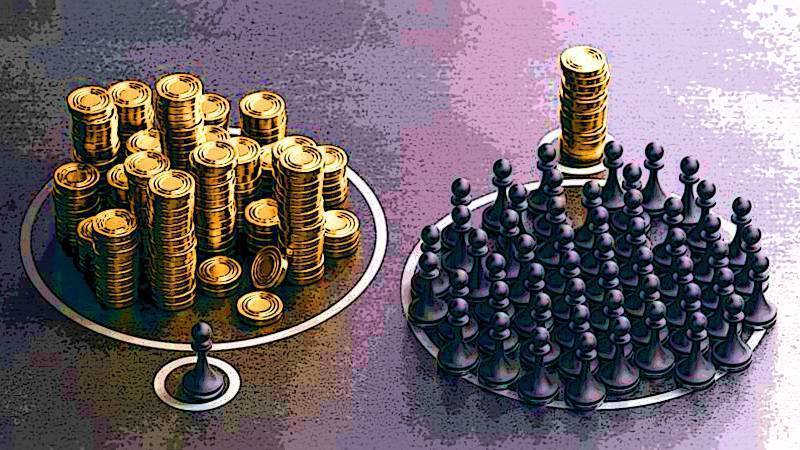
As the G20 leaders prepare to convene in South Africa, a powerful civil society movement has emerged, calling for a 2 percent annual wealth tax on the world’s richest 3,000 billionaires. The proposal, which could generate an estimated 250 billion dollars annually, aims to redress spiralling inequality and climate injustice—two symptoms of a world economic system that, despite its triumphalism, has failed the majority of humanity.
I was among those who signed the petition, reflecting deeply on the growing chasm between the privileged few and the struggling billions. The world today stands at a moral and economic crossroads. The much-celebrated capitalist model, based on wealth production and a so-called trickle-down effect, has become synonymous with structural inequality, environmental degradation, and corporate monopoly. A system that once promised shared prosperity has, in practice, delivered exclusion.
After the Second World War, two dominant economic ideologies—capitalism and socialism—competed fiercely for influence, particularly in newly independent states across Asia, Africa, and Latin America. As European empires collapsed under the weight of war and resistance, the United States and the Soviet Union emerged as rival powers, offering contrasting models of economic and social organisation. The capitalist system, led by the United States, emphasised free markets, private ownership, and the primacy of profit. In contrast, the socialist model inspired by Karl Marx’s Das Kapital focused on class struggle, public ownership, and redistribution of wealth.
In the Cold War era, this ideological competition played out across the globe, most violently in places like Vietnam, Korea, and Afghanistan. The Soviet invasion of Afghanistan in 1979 was an attempt to install a friendly Marxist regime. The United States responded by supporting the Afghan mujahideen, many of them trained in Pakistan’s Deobandi seminaries, with funding and arms. This not only hastened the Soviet collapse but also allowed capitalism to declare a premature victory over socialism in 1991.
With the Soviet Union’s dissolution, the United States and its allies declared the final triumph of capitalism. The 1990s ushered in an era of neoliberal economic policies, characterised by deregulation, privatisation, and an unshakeable faith in the invisible hand of the market—a term coined by Adam Smith in The Wealth of Nations. But Smith also cautioned that unchecked markets can lead to monopolies and exploitation. This nuance has been lost in the dogma of modern capitalism. Keynesian economics, named after John Maynard Keynes, had once advocated strong state intervention, especially during economic downturns. It was Keynes who famously argued that the market can stay irrational longer than you can stay solvent. But neoliberalism marginalised Keynesian principles in favour of austerity and profit maximisation. The 2008 global financial crisis and its aftershocks proved that unregulated capitalism not only fails to self-correct but can also bring the global economy to the brink of collapse.
More than half of the world’s population lives on less than 6.85 dollars a day, and the richest 1 percent control nearly half the world’s wealth
Today, more than half of the world’s population lives on less than 6.85 dollars a day, and the richest 1 percent control nearly half the world’s wealth. The International Labour Organization reports that nearly 2 billion people, mostly in the Global South, work in informal sectors, often without social protection or fair wages. Meanwhile, the planet teeters on the edge of ecological collapse, driven by unsustainable consumption patterns promoted by capitalist economies.
The post–Cold War world has witnessed the rise of multinational corporations with revenues larger than the GDPs of many sovereign nations. These corporate giants, dominating technology, pharmaceuticals, food, arms, and finance, wield enormous influence over global governance. They dictate trade rules, suppress labour rights, avoid taxes, and often compromise democratic processes through lobbying and campaign financing. Financial institutions such as the International Monetary Fund and the World Bank, while ostensibly aiding development, often impose structural adjustment programmes on poor countries, demanding cuts in social spending, privatisation of public assets, and trade liberalisation. These policies, aligned with the Washington Consensus, have led to increased poverty, weakened public services, and economic dependency.
This system of financial imperialism ensures that the Global South remains a supplier of cheap labour and raw materials, while wealth and decision-making power remain concentrated in the North. Even climate finance, a critical component of global climate justice, is often channelled through debt instruments, exacerbating the already unbearable financial burden on poor nations.
While the socialist model has retreated since the Cold War, it has not disappeared. In Latin America, countries like Bolivia and Venezuela—despite their internal contradictions—have experimented with redistributive policies and state-led development. Meanwhile, China’s unique hybrid model—a communist political system overseeing a market-oriented economy—has lifted over 800 million people out of poverty. However, it has also generated rising inequality, censorship, and surveillance.
Islamic economic thought, grounded in ethical principles, offers yet another alternative. Emphasising social justice, prohibition of interest, wealth redistribution through zakat, and moral accountability, Islamic finance seeks to align economic activity with human dignity. As Islamic scholar Maulana Maududi once said, an Islamic economy is neither capitalist nor socialist; it is an ethical system rooted in Divine guidance. While rarely implemented in full, these ideas challenge the moral vacuum of contemporary capitalism.
The world has grown dangerously accustomed to inequality. According to Oxfam’s 2024 report, just five tech billionaires possess more wealth than the bottom half of humanity combined. This is not merely a statistic—it is a crisis of civilisation. It raises the moral question: can a system that normalises such grotesque disparities claim to be just or sustainable?
When economic systems become instruments of extraction, not empowerment—when industries, social sectors, and even education are co-opted by elite interests—then humanity must ask whether it is time to envision a new model. Either wealth will be distributed more equitably through conscious reform, or history will repeat itself through upheaval. Karl Marx’s warning still resonates: the proletarians have nothing to lose but their chains; they have a world to win.
But violence need not be the answer. Redistribution of wealth, reparative justice, climate accountability, and global tax reforms are peaceful alternatives. The wealth tax proposed by civil society is a modest first step in this direction.
The myth of the trickle-down economy has failed to deliver. What we need now is a reimagination of the economic order—one that prioritises people over profit, cooperation over competition, and sustainability over exploitation. This new system must incorporate the best elements of past models: the Keynesian emphasis on welfare and employment, Marxist critique of class domination, Islamic principles of distributive justice, and indigenous values of ecological balance. It must be pluralistic, just, and adaptable to local realities.
If the G20 summit is to mean anything, it must listen to the voices rising from the streets, slums, and sinking islands. A wealth tax is not socialism; it is sanity. And sanity is long overdue in a world gone mad with profit.