

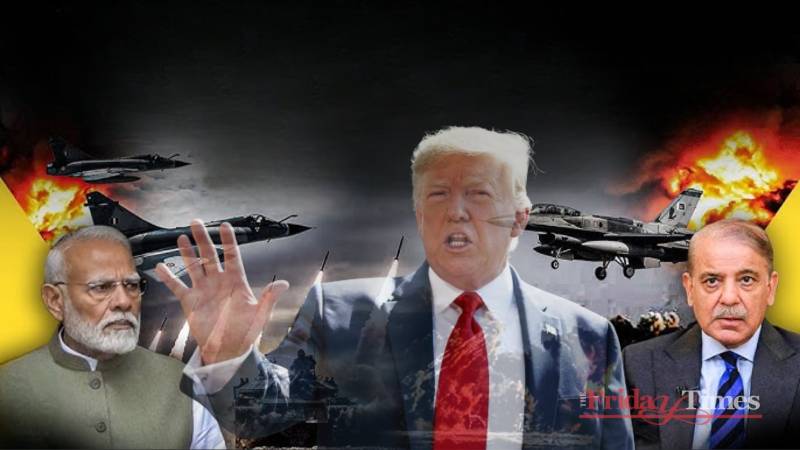
The recent conflict between India and Pakistan, though it did not escalate into a full-scale war, ended abruptly through American mediation. A considerable portion of the credit for brokering the ceasefire goes to U.S. President Donald Trump and his administration—particularly Secretary of State Marco Rubio and Vice President J.D. Vance. International media reports suggest that nearly 30 other countries also played a role in persuading the two nuclear-armed nations to halt hostilities.
The ceasefire was formally announced on May 10, 2025, after days of intense military exchanges. These included missile and drone strikes targeting key military installations. The crisis began when India launched strikes on Pakistani sites, allegedly targeting terrorist camps in retaliation for a deadly attack in Pahalgam. Pakistan responded with drone attacks, pushing both sides dangerously close to all-out war.
While the United States led the mediation efforts, other countries such as the United Kingdom—whose Foreign Minister David Lammy was acknowledged—and the United Arab Emirates were instrumental in easing the tension. Pakistan publicly appreciated the efforts of President Trump and these international actors in bringing about the agreement.
Despite the ceasefire, reports of explosions and mutual accusations surfaced soon after the agreement took effect. Both India and Pakistan have accused each other of violating the truce. These early breaches raise valid concerns about the durability of the ceasefire. However, both governments have reiterated their commitment to honoring the agreement without any further violations.
The U.S. President’s call for a “full and immediate” ceasefire treated both nations equally, which runs counter to India’s expectations and raises Pakistan’s image on the international stage
The international community has welcomed the ceasefire, viewing it as a step toward stability in a volatile region. The United Nations and several countries have urged India and Pakistan to build on this progress and move toward a lasting peace.
It is difficult to assess exactly what occurred during the days of rising escalation, as both countries have made grand claims of military success. However, rather than relying on conflicting narratives, it is more objective to analyze the situation based on the statements made by U.S. President Donald Trump. His messages provide a clearer picture of the actual outcomes and suggest who stands to benefit the most from the ceasefire.
Undoubtedly, the primary beneficiaries are the civilians on both sides of the border. Sadly, more than 100 lives were lost during the conflict. As President Trump rightly stated, millions could have perished if war had broken out between these two nuclear powers. I agree with the President—had it escalated, the destruction would have been catastrophic. The timely mediation by the U.S., supported by countries like Saudi Arabia, spared the region from a full-blown disaster.
From a diplomatic angle, Pakistan has achieved a key milestone. India has long insisted that the Kashmir dispute must be resolved bilaterally, without third-party involvement. However, Trump’s remarks have effectively internationalized the Kashmir issue again—something Pakistan has sought for years. The U.S. President’s call for a “full and immediate” ceasefire treated both nations equally, which runs counter to India’s expectations and raises Pakistan’s image on the international stage.
Though the U.S. deserves much of the credit, China has also emerged as a beneficiary. Reports from CNN, Reuters, and the BBC confirm that at least one Indian Rafale jet was downed. Additionally, Chinese J-10C jets equipped with PL-15E missiles reportedly gained air superiority during the exchange. This could have long-term implications, especially in the economic competition between China and the West, as Chinese military hardware challenges Western defense manufacturers on cost and performance.
To conclude, even senior Indian political voices have acknowledged the failure of India’s military operation. Former Foreign Minister Mr. Yashwant Sinha reportedly admitted that Operation “Sindoor” was a complete failure. This admission further underlines the limited gains for India and the relatively stronger diplomatic position Pakistan now finds itself in.