

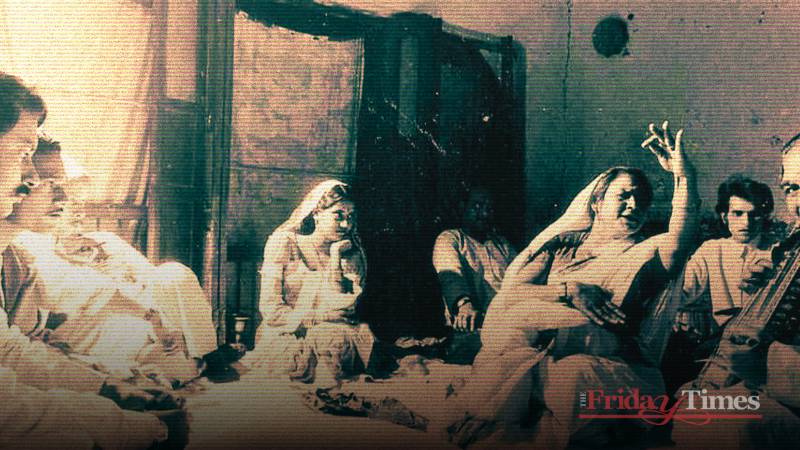
Heera Mandi (also Shahi Mohallah) is known as Lahore’s modern-day red-light district but was formerly a cultural and economic epicenter during the Mughal Empire. Established in the medieval era, Hira Singh Dobra, who this site was named after, originally began a grains market through which trade and exchange of foods unraveled frequent cultural crossovers within different regions of the subcontinent.
Gradually, women from within and beyond the region, frequently from Afghanistan and Uzbekistan were brought to Heera Mandi to become tawaifs (courtesans) and perform in public gatherings. These women were not merely just symbols of entertainment, but rather were trained artistically, some becoming renowned musicians, dancers and many playing crucial roles within Mughal or local courts – well versed in folklore, literature and often politics. The making of a tawaif was a ceremonial act, a milestone embraced by the community, and each tawaif was initiated through several rituals as a form of welcoming them into their professional lives. Many tawaifs were influential beyond Heera Mandi and are unequivocally woven into Indian history. One example is Begum Samru, who ruled one of the principalities within Uttar Pradesh and another was Begum Hazrat Mahal, a fierce warrior significant to the War of Independence Indians fought against the British in 1857.
With the advent of British colonial rule in the 18th century, over time, areas such as Heera Mandi witnessed an irreversible, devastating transformation that persists until today. The imposition of the British Raj included a narrow, and Victorian perspective on tawaifs, as these courtesans were reduced to mere sex-workers, functional only within the realm of prostitution. The acclaimed cultural statuses of these women were severely undermined and new generations of courtesans struggled to survive in this changing context. More and more sex-workers resided in Heera Mandi, and even the connotation of a tawaif, from a multi-faceted courtesan, shifted into those involved in prostitution.
Lahore, that houses Heera Mandi was deemed part of Pakistan during the Partition, and since beginning until present-day, Pakistani governments have become progressively conservative and ideologically rigid - leaving no room for the evolution of spaces such as Heera Mandi. Hence, today, while Heera Mandi continues to house sex-workers, it is in dire condition, a mere ghost of what it used to be, frowned upon by the larger Pakistani population. What were buildings known for performances are now run-down. Many are rented by street-shops and the only signs of the past are former homes of famous artists and musicians that lived there at the time of its decline.
This site is extremely significant as it rests in the heart of Lahore, and is surrounded by thoroughly preserved pre-colonial and colonial mosques, temples, museums and bazaars. The British institutionalized not only rigid notions of sex, and misogyny, but also transphobia during their rule, and in postcolonial Pakistan, these ideologies remain concrete and largely followed by the masses. Heera Mandi is in its actuality, a symbol of multicultural, multi-religious and multiregional intersections that are seldom found in the modern world of nation-states and political warfare.
Recently, the flawed perception of this place emerged in a Netflix show by Indian director Sanjay Leela Bhansali’s called Heeramandi. This high budget show glamorized the area hyper-focusing on the imagined grandeur and mystique without making any reference to the actual site, as it is very rare, due to political tensions, that India and Pakistan artistically collaborate. In response, Ashi Butt, a transgender woman and resident of Heera Mandi, was interviewed in her home to share insight on the show, and she pointed out that the show “depicted a royal Heera Mandi, for princes and Nawabs…in reality there were small rooms…tawaifs held the economic burden of her entire household…this was an educational institution of art” which is indicative of how marginalized voices are less likely to ever be heard, and rather Heera Mandi is deemed what multi-million dollar Bollywood industry dictates it to be.
The only existing restoration of Heera Mandi is the oral history through interviews, and specifically an archive on Youtube, Kahani Tawaif ki Zubani, (Tawaif’s Story in their Own Words) a series of interviews within which courtesans map out the otherwise erased history through generational anecdotes and lived experiences as sex-workers. The preservation of memory of Heera Mandi opens up possibilities for a more comprehensive understanding, and embracing of the vibrant, imaginative and limitless space it once was and still in some ways, through its existence, continues to be.
Heera Mandi’s conservation is crucial not only to restore its historical and cultural significance but also to reclaim its identity beyond colonial distortion. By preserving its varied past, we could honor the contributions of marginalized communities, particularly sex workers and transgender individuals, while challenging contemporary misperceptions. Through ongoing efforts such as documentation of oral histories, Heera Mandi can be reimagined as a space of art, and resistance, fostering a more inclusive understanding of the diverse histories that shaped it.