

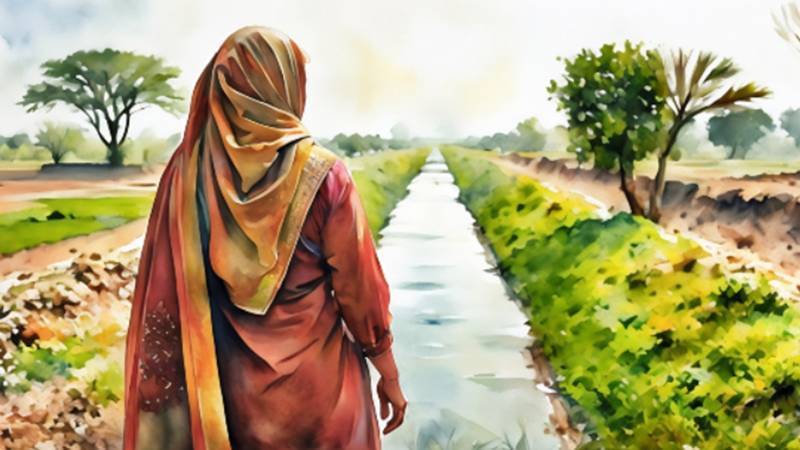
Pakistan’s booming cities face a hidden crisis: soaring food insecurity worsened by climate shocks and economic strain. With 35% of its 255 million people now urban, fragile food systems buckle under floods, heatwaves, and unpredictable rains. Globally, urban farming offers a powerful fix—growing food locally, cutting environmental harm, and building resilience. Yet Pakistan’s women, who make up nearly half the farming workforce, remain sidelined by policy gaps, social barriers, and lack of support. Overlooking them is not just unfair—it’s a missed opportunity to nourish cities and foster stronger communities.
Urban farming in cities like Karachi, Lahore, and Islamabad is growing, with women in low-income areas leading efforts to convert rooftops and vacant spaces into productive gardens. Despite their crucial role in boosting nutrition and income, women face barriers including limited land rights, credit access, training, and market connections. Targeted micro-grants, which are small and non-repayable funds, could provide crucial support. In early 2025, the Ministry of Climate Change launched urban agriculture pilots in Karachi and Lahore, but none focused on female-led ventures or included dedicated funding. A nationwide micro-grant programme for urban women farmers could unlock a powerful and untapped resource to boost food security and economic resilience.
Unlike microloans, micro-grants require no repayment, removing financial barriers that often block marginalised women from entrepreneurship. These grants fund essentials like quality seeds, organic fertilisers, efficient irrigation, farming tools, and protective infrastructure such as shading nets and compost bins. Globally, such programmes have proven transformative. India’s National Urban Livelihoods Mission combines micro-grants with skills training to empower women in urban farming, while Kenya’s “Shamba Shape Up” pairs microfinance with agricultural education to boost productivity and income. A 2024 FAO report found that micro-grants increased crop yields by up to 30% among women farmers in East Africa. Building on this, in early 2025, IFAD named micro-grants a key tool to empower rural and urban women farmers worldwide. Pakistan’s absence of a tailored micro-grant programme for female urban farmers represents a critical gap and missed opportunity to enhance food security and women’s economic resilience.
The real impact of micro-grants is embodied by women like Ayesha Khan from Karachi’s Korangi district. She says, “Before funding from a local NGO, I could only grow a few herbs for my family. The micro-grant helped me buy vegetable seeds and install a drip irrigation system. Now, I supply fresh greens to the local market, improving our nutrition and income.” Ayesha’s story reflects the resilience of many women who, despite social and economic barriers, use modest funds to transform their livelihoods. A 2025 UNDP report found that similar micro-grant initiatives across South Asia boosted women’s urban farming productivity by over 25%, highlighting the significant social and economic impact of such programmes.
Amidst rapid urbanisation, climate challenges, and gender disparities, female-led urban farming supported by targeted microgrants offers a powerful, underutilised solution
Despite its potential, female-led urban farming remains largely unsupported in Pakistan’s policy framework. Programmes like the Pakistan Poverty Alleviation Fund (PPAF) and the Benazir Income Support Programme (BISP) provide broad financial aid but rarely address urban agriculture or the specific barriers women face. Urban planning rarely allocates public land for cultivation, while socio-cultural norms and bureaucratic red tape continue to restrict women’s land rights. Without targeted reforms, women’s contributions to urban farming remain fragmented and informal, undermining food security and their economic empowerment.
Several global models offer valuable blueprints for Pakistan to empower female urban farmers. Brazil’s Programa de Agricultura Urbana Sustentável (revamped in 2024), institutionalises women’s roles in urban food systems through gender-sensitive microcredit, technical training, and access to public land, improving nutrition and reducing food insecurity in major cities. In India, the 2025 expansion of Mission Shakti introduced an Urban Agripreneurship module that combines micro-grants with vocational skills, agri-tech tools, and cooperative marketing, benefiting women in low-income urban areas.
Kenya’s updated AgriBIZ Programme (2024) adopts a holistic approach by integrating mentorship, women-focused urban farming incubators, and app-based market connections, enabling thousands of women to commercialise their produce. South Africa’s Women in Smart Agriculture Initiative (2025) emphasises climate-resilient practices and entrepreneurial support, giving female farmers access to rooftop greenhouses and hydroponics. In Rwanda, the Urban Green Women Hubs programme, launched in Kigali in early 2025, blends agro-innovation with cooperative governance, empowering over 3,000 women with micro-grants, vertical farming kits, and digital marketplace access. Similarly, the Philippines’ City Agri-SHE initiative (2024) supports female micro-entrepreneurs through partnerships with local governments and private sector actors, offering tailored financing, digital tools, and nutrition education. These international frameworks show that lasting change requires not only financial aid but also access to land, markets, education, and institutional inclusion. By adapting and localising these models, Pakistan can foster a thriving ecosystem for women-led urban farming.
To unlock the full potential of female-led urban farming, Pakistan must adopt a comprehensive strategy integrating financial support, capacity building, land access, and market inclusion. First, dedicated micro-grant funding should be embedded within national women’s empowerment and agricultural programmes. While initiatives like Ehsaas and BISP provide broad financial aid, they overlook urban agriculture and the specific challenges women face in this sector. The 2025 Ehsaas Nashonuma Plus, which introduced nutritional gardens for urban households, shows that targeted support is feasible and could be expanded to fund female-led food production enterprises. Second, technical training and extension services focused on urban farming and climate-resilient methods must be institutionalised. Pakistan’s agricultural education remains rural-centred, leaving urban women without access to knowledge on hydroponics, rooftop gardening, composting, and water-efficient technologies.
The Pakistan Agricultural Research Council (PARC) rooftop gardening awareness campaign in Islamabad and Lahore is a positive start that should be scaled nationwide and made gender-inclusive. Third, improving women’s access to urban land is critical. Cultural norms and legal restrictions often deny women control over property, limiting their farming capacity. The Karachi Metropolitan Corporation’s 2025 proposal to convert underutilised plots into community gardens with a gender quota is promising and could transform land access if adopted broadly. Fourth, strong market linkages are essential to transition women from subsistence farming to profitable enterprises.
Digital platforms like Sabzi.pk, Dastgyr and the 2025-launched Bazaar Rozgar Women’s Initiative are connecting women farmers with consumers and retailers. Still, these efforts are fragmented and need formal government-backed partnerships to ensure scalability, fair pricing, and quality. Finally, a robust monitoring and evaluation framework is vital to measure economic, social, and environmental impacts. Data-driven insights help identify gaps, inform policy, and validate progress. The Punjab Urban Innovation Lab (2024), which included urban farming as a pilot track, set a precedent by collecting gender-disaggregated data on productivity, income, and sustainability. Expanding such initiatives nationwide will build an evidence base to support and amplify female-led urban agriculture.
Amidst rapid urbanisation, climate challenges, and gender disparities, female-led urban farming supported by targeted microgrants offers a powerful, underutilised solution. It empowers women, strengthens food systems, and fosters community resilience. By investing in this model, Pakistan can lead a paradigm shift where small-scale support drives systemic change. It is time to cultivate empowerment in the heart of our cities and let women farmers lead the harvest towards a greener, more equitable future.