

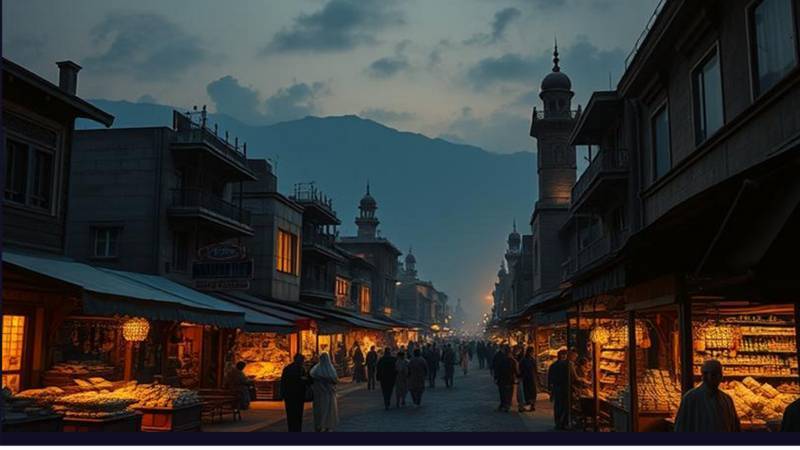
Peshawar, perhaps South Asia’s oldest living city, today finds itself trapped under a thick blanket of pollution. Home to 2.6 million people (urban) and nestled near the Afghan border, this city has long been a hub of trade and agriculture. Its rich heritage and strategic geography have sustained it for centuries.
Notwithstanding, unfortunately, in 2024, Peshawar was ranked the eighth most polluted city in the region, averaging 91 micrograms of PM2.5 per cubic metre (over ten times the WHO guideline) and, for several months, held the grim title of Pakistan’s most polluted city, according to the World Air Quality Report 2024. The air Peshawar breathes today is laced with toxins that silently choke its population. Despite this, the issue remains under-addressed, both in the public narrative and policy agenda.
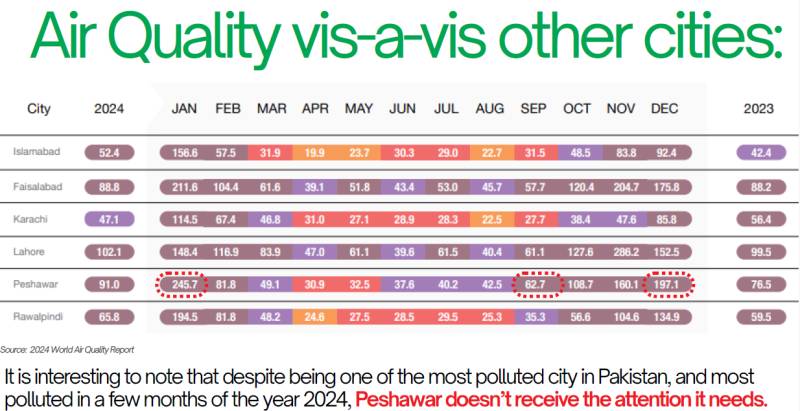
Urbanisation in Peshawar has occurred at a staggering pace. With a growth rate of over 45%, the city’s expansion has not been matched by adequate urban planning or environmental foresight. From the sprawling network of roads now congested with traffic to the mushrooming of unregulated industries, every corner of the city narrates a story of environmental neglect. The result is an air quality crisis that has evolved from a seasonal concern to a year-round emergency.
The most glaring culprit behind this crisis is transport emissions. Data from the Khyber Pakhtunkhwa Excise and Transport Department shows a 10.2% rise in vehicle registrations over two years, reaching 2.33 million in 2023. Of these, 1.45 million were motorcycles and scooters, 186,017 were cars and jeeps, and 995,326 were in Peshawar alone (with over 50,000 unregistered rickshaws).
The city’s contributions—19% of the provincial GDP, its historical significance, and its resilience—demand that it receives better care, cleaner air, and a liveable future
What this reflects is not only increased mobility but also a shift towards fuel-inefficient and high-emission transport options. The Bus Rapid Transit (BRT) system, an otherwise commendable effort, remains an isolated intervention, unable to curb the overwhelming emissions from private vehicles. In a city with such a large household size (averaging 6.7), the pressure on mobility systems is immense, and the dependence on two-wheelers and old vehicles further deepens the problem.
Peshawar also hosts the highest concentration of industries in Khyber Pakhtunkhwa. These industrial units, often lacking emission control mechanisms, are key contributors to both air and solid waste pollution. Compounding this are the approximately 450 unregistered, unregulated brick kilns operating across the city and its outskirts, many of which still follow the outdated clamp kiln method. These kilns burn coal, rubber, and other low-cost fuels, belching out clouds of black carbon and particulate matter into already toxic skies.
Domestic fuel usage is another invisible but potent contributor. Many households in Peshawar continue to rely on wood, coal, and other biomass for cooking and heating. During winters, the situation worsens as indoor and outdoor heating leads to high levels of PM2.5 particles, small enough to enter human lungs and the bloodstream. In parallel, municipal solid waste burning remains a persistent practice, particularly in low-income areas. Open burning of rubbish not only releases harmful chemicals but also illustrates the gaps in municipal service delivery.
These multiple sources of pollution operate within a broader context of weak urban governance and fragmented policy enforcement. Unregulated construction, diminishing green cover, and increasing traffic density all play into the feedback loop of environmental degradation. The lack of an integrated urban air management framework means that data on pollution remains sparse and unpublicised. Without consistent monitoring, the public is left unaware of the dangers lurking in the air they breathe.
Yet, there is a way forward. Several interventions, if implemented with political will and community involvement, can reverse the city’s trajectory.
The first priority must be expanding the air quality monitoring network. Real-time data displayed through apps and public boards can help inform public behaviour, especially during high-risk periods. Such transparency creates pressure for action and allows people to make informed decisions, whether it's avoiding outdoor activity or using air purifiers.
Transport reforms must go beyond isolated infrastructure projects. Expanding the BRT network, subsidising fares to reduce reliance on private vehicles, and adopting electric vehicles can all contribute meaningfully to tackling this Frankenstein. Introducing bike-sharing systems, walking paths, and designated lanes for non-motorised transport would not only reduce emissions but also promote healthier urban lifestyles. Cities like Bogotá and Copenhagen have successfully demonstrated how non-motorised transport can reclaim urban spaces.
Another area that demands attention is clean heating and cooking solutions. Subsidising electric heaters and promoting solar energy can dramatically reduce domestic air pollution. Banning biomass burning and providing cleaner alternatives must be treated as a public health imperative rather than a lifestyle change.
Urban green spaces have a crucial role to play. Parks, tree plantations, and green belts not only help filter the air but also serve as thermal buffers during extreme weather. These spaces promote community well-being and should be integral to Peshawar’s future urban design.
However, none of this will work without effective regulation and institutional accountability. Industrial emissions need to be controlled through stringent enforcement of environmental standards, regular inspections, and penalties for violations. Cleaner technologies and waste recycling incentives can push industries towards more sustainable practices. In tandem, a clear ban on open waste burning, backed by improved municipal waste collection systems, can close one of the most hazardous loopholes in current policy.
At the heart of this battle is community engagement. Change cannot be top-down alone. Forums, NGOs, and local volunteers can be powerful agents of change: raising awareness, monitoring violations, and demanding better services. Schools, religious centres, and social media can serve as channels to embed eco-conscious behaviours into daily routines.
CODA: Peshawar’s air quality crisis is not a matter of fate; it is a matter of choice. A choice between short-term convenience and long-term survival. It is a test of leadership at every level: from government offices to neighbourhood committees. The city’s contributions—19% of the provincial GDP, its historical significance, and its resilience—demand that it receives better care, cleaner air, and a liveable future.
Ignoring this pandemonium today is akin to accepting mass health hazards tomorrow. Asthma, cardiovascular diseases, cognitive impairments in children, and rising premature deaths are no longer distant threats—they are realities unfolding in silence. And if this silence is not broken by a loud and collective call to action, it might soon become irreversible.