

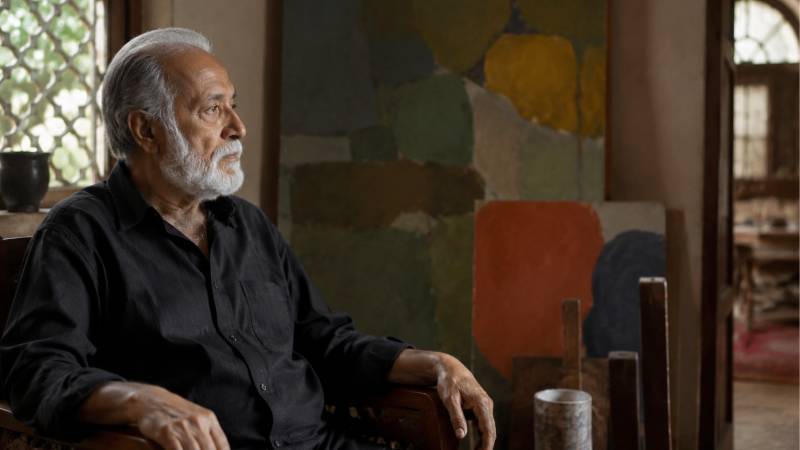
Satish Gujral was one of modern India’s most versatile creative figures: a painter, sculptor, architect and writer of rare range. Art historian Dr. S. S. Bhatti famously described him as “the Leonardo da Vinci of India,” a phrase that captures the astonishing range of his imagination. Born in Jhelum in 1925, in undivided Punjab, Gujral later became a defining figure of modern South Asian culture. Yet the story of his making does not truly begin in Delhi, Bombay, Mexico, or with the honours that came later. It begins in Lahore.
Lahore was the city where a boy marked by silence found an institution, a public world, a circle of minds and a language beyond speech. His Lahore years were not a decorative preface to his career. This was the place where injury began to turn into discipline, exclusion into entry, and provincial helplessness into intellectual ambition.
In his autobiography A Brush with Life, edited by Khushwant Singh, Gujral remembers Lahore as the answer his father found to a crisis that had seemed almost impossible to resolve. After losing his hearing in childhood, young Satish was placed in institutions that could not fully imagine him as a complete human being. His father, Avtar Narain Gujral, noticed him doodling on his slate while he lay sick in bed and began to think of a medium that did not depend on sound. Without telling Gujral’s mother, he wrote to Inder, the elder brother studying in Lahore, asking whether the city had an institution for students with artistic or graphic inclination. Lahore entered Gujral’s life not as romance or nostalgia, but as a practical possibility: a city that might give form to a life closed off by silence.
The decision was difficult inside the family. Gujral’s mother was disturbed by both the distance and the profession. Lahore was about a hundred miles from Jhelum, and her thirteen-year-old son would have to live in a hostel among strangers. She feared ridicule, loneliness and the cruelty of boys who would not understand his inability to communicate easily. She was also unconvinced that drawing and painting could be a respectable path. As Gujral recalls, such work seemed to her closer to a manual occupation assigned to the blind or mentally disabled than to a vocation that could restore dignity. Her distress came from grief rather than cruelty. She was not ready to accept that her son’s hearing would not return, and Lahore, in her mind, confirmed that painful truth. Yet his father refused to let despair decide his future.
Gujral's Lahore was not simply a city lost to Partition. It was the place where his artistic sensibility, intellectual curiosity and moral imagination first took shape.
The first gate into Lahore did not open by merit alone. The Mayo School of Arts was reluctant to admit a student with Gujral’s disability. Avtar Narain, who rarely accepted rejection as final, took his son to Sir Sikander Hayat Khan, then Chief Minister of Punjab. Sikander could not order the principal to break the rules, but he agreed to request admission as a personal favour. Principal Suminder Nath Gupta allowed the boy to sit in regular classes for one year without formal registration, after which his progress would decide his future. For Gujral, this conditional acceptance was transformative. Entering Mayo made him feel, perhaps for the first time after his injury, that he was being treated not as a burden but as a person capable of growth. His father strengthened that confidence by travelling from Jhelum to Lahore every weekend, four hours each way, until Inder could take over as companion and guide.
To the provincial imagination of Jhelum, Lahore was already a city of prestige. Gujral writes that those fortunate enough to study there seemed to acquire a special aura. The Ghai brothers, Iqbal and Krishan, sons of a neighbour, were admired partly because they had been educated in Lahore. Stories circulated of Lahore as a place where futures were made and education could alter a family’s expectations. Mohan Singh Oberoi, who rose from poverty to become a legendary hotelier, was remembered in Jhelum through the belief that his mother’s decision to send him to college in Lahore had changed his fate. For Gujral, the city was already more than a point on a map. It stood for ascent, refinement, intellectual access and escape from the narrowness of a small town. His mother feared Lahore, but her own stories had already made it luminous.
Mayo School of Arts gave this imagined Lahore a physical centre. Gujral describes its impressive nineteenth-century Indo-Gothic building, its courtyards, green lawns, flowering shrubs, broad corridors and classrooms lined with examples of the disciplines taught there. Its location on the Mall, known locally as Thandi Sarak, gave it civic grandeur. In front of it stood the famous cannon known to the English as Kim’s Gun and to Punjabis as Bhangianwali Tope. Yet Gujral also noticed decay. The cannon had lost its shine, and the plaster of the school’s walls and corridors was peeling. Lahore did not appear to him as a flawless lost paradise; it was grand and worn, prestigious and declining.
The educational system at Mayo also shaped Gujral’s relation to the city. The school still followed the curriculum associated with John Lockwood Kipling, who had imagined the institution as a place for training master craftsmen. Students learned drawing, design, clay moulding, stone and wood carving, metalwork, scale drawing and the copying of old building plans. Gujral later recognised that this applied training did not merely produce conventional artists. It made students capable with materials, surfaces, plans and forms. That grounding would later matter to a man whose work moved between painting, sculpture and architecture.
In the hostel, however, the romance of Lahore collided with poverty and loneliness. Many boys came from deprived backgrounds and sought practical skills for survival in an urban economy. Gujral had expected conversations about ideas, symbols and artistic personalities; instead, he encountered hardship, crude hostel life, bad food and little intellectual companionship. His disability sometimes made him vulnerable to mockery, while his relative affluence created both deference and resentment. Lahore educated him, but it did not flatter him. It forced him to confront class, deprivation and social discomfort with brutal clarity.
His real intellectual Lahore opened through Inder. Because the food at Mayo’s hostel was almost unbearable to him, his father arranged for Satish to eat in Inder’s hostel nearby. Those daily meals transformed the relationship between the brothers. Inder introduced him to literature, poetry and political commitment. Through Inder’s circle, Gujral came into contact with socialist intellectuals and writers who would later become major names in Urdu literature, including Faiz Ahmad Faiz, Ali Sardar Jafri and Krishan Chander. Even if he could not converse freely, their presence gave him confidence. Urdu translations opened Western classics to him at a time when English remained difficult. Lahore became for him a reading city as much as an art-school city. It gave him craft training, but also access to argument, ideology and the charged atmosphere of progressive literary culture.
She feared ridicule, loneliness and the cruelty of boys who would not understand his inability to communicate easily. She was also unconvinced that drawing and painting could be a respectable path.
This political Lahore revealed the unusual freedom Avtar Narain gave his sons. Gujral and Inder moved towards socialism and Marxist thought while their parents remained committed Congress nationalists influenced by Gandhi and Arya Samaj reform. During the war years, Congress and the Communist Party stood in bitter opposition, yet Avtar Narain allowed his sons to think independently. The Lahore years thus became a school of dissent. Gujral was learning not only how to draw, mould, carve and design, but also how to inhabit disagreement without surrendering affection. The young man once enclosed by silence now lived among political voices and conflicting visions of India’s future.
The human theatre around Mayo further deepened Lahore’s hold on him. Bhubesh Sanyal, the handsome Bengali teacher whose romance with Principal Gupta’s daughter Kalyani became a sensation in Lahore’s elite circles, left a strong impression on Gujral’s adolescent mind. The story spread around Bhangianwali Tope and became part of the school’s folklore. Gujral was tempted to leave Mayo and join Sanyal’s studio, but Sardari Lall Prasher persuaded him to stay. Prasher was very different from Sanyal: self-taught, intellectually serious, trained in literature rather than through the usual craft hierarchy, and somewhat isolated among colleagues who distrusted his bookishness. Through Prasher, Gujral found another Lahore, one made of bookshops, private conversations and sharp aesthetic disagreements. Visits to Rama Krishna’s bookstore near the school, the circle around Roop Krishna and Mary, Charles Fabri at the Lahore Museum, and Amrita Sher-Gil’s first exhibition in the city all show Lahore as a dense cultural world: argumentative, ambitious and alive with reputations.
Yet this world was not gentle. Gujral’s account of the ustad-shagird relationship at Mayo is often uncomfortable. Some teachers expected personal service from students, including errands for tea, hookah and other daily needs. Gujral disliked these humiliations and once resisted through mischief when a teacher ordered him to clean and polish his bicycle every evening. The prank briefly led to his expulsion, followed by apology and forgiveness. The episode is not merely comic. It shows how Lahore taught him hierarchy as well as freedom. Mayo was not a modern liberal sanctuary. It carried feudal habits, craft traditions, colonial residues and personal cruelties. Gujral survived these contradictions by turning them into memory, and memory into discipline.
The tragedy is that the Lahore which formed him soon became the Lahore he had to flee. After returning from Bombay in 1946, he set up a graphic art studio in Lahore, hoping to establish himself. Instead, he watched the city descend into fear. From his studio he saw endless lines of tongas carrying Hindu and Sikh families towards the railway station, loaded with trunks and bedding rolls. The city that once represented ascent had become a place of hurried departures. Fires and riots came closer to his home near Nishat Cinema, and he escaped to Lajpat Rai Bhavan, where families were gathering in panic. The Bhavan and the adjoining DAV College hostel became part of a central refugee camp guarded by soldiers. Newspapers had stopped giving reliable order to events. Rumour filled the air. Everyone wanted to know whether Lahore would belong to India or Pakistan. On 13 August 1947, the Radcliffe Award gave Lahore to Pakistan. The next day, Pakistan formally came into being.
For Gujral’s father, this moment carried a terrible irony. Avtar Narain had struggled for freedom, but freedom arrived divided. He was in Karachi, connected to the new political order, and had reason to believe he might serve in Pakistan’s government. Yet the speed and ferocity of events made such hopes impossible. He was flown to Lahore in an effort to help calm the situation and later travelled to Jhelum with Raja Ghaznafar Ali to persuade non-Muslims to stay. Their appeal failed before the reality on the ground. Gujral’s later reflections on Partition are marked not by one-sided accusation, but by horror at what human beings on both sides became capable of doing. Lahore was not only where he found his first intellectual freedom; it was also where he learned that civilisation could collapse almost overnight.
After Lahore, Gujral's life unfolded across Bombay, Shimla, Delhi, Mexico and other centres, but the city never disappeared from the foundation of his story. He studied at Mayo School of Arts from 1939 to 1944, later joined Sir J. J. School of Art in Bombay, left amid illness and the upheaval of Partition, migrated to Delhi, and studied in Mexico from 1952 to 1954. Honours such as the Padma Vibhushan, Mexico's Da Vinci Award for Lifetime Achievement, and acclaim for designing the Belgian Embassy in New Delhi belong to the public narrative of his career. Yet beneath these achievements lies the older Lahore narrative: the hearing-impaired boy admitted on probation, the father travelling every weekend from Jhelum, the brother introducing him to books and politics, the discomforts of hostel life, the faded grandeur of the Mall, the cannon standing near Mayo, conversations in Lahore's bookshops, and finally the refugee camp that marked the city's tragic transformation. Gujral's Lahore was not simply a city lost to Partition. It was the place where his artistic sensibility, intellectual curiosity and moral imagination first took shape, providing the foundation for the remarkable life that followed.