

My exploration of the influence of Persian poetry – particularly Ferdowsi’s Shahnameh – on classical Sindhi poetry yielded an unexpected result. Instead of dedicated academic studies, I found discussions related to the Persian language and poetry embedded within paragraphs of books and articles by prominent scholars such as Bherumal Meharchand Advani, Kalyan Bulchand Advani, Umar Bin Mohammad Daudpota, Annemarie Schimmel, Lutufullah Badvi, Nabi Bux Baloch, Abdul Jabbar Junejo, Rashid Bhatti, Sadarangani, Michel Boivin, and Muhammad Ali Manjhi. These scholars elucidated how, during the late Kalhora and early Talpur periods, Persian poetry influenced and set standards for the style and literary conventions of classical Sindhi poetry. Most of these academics agree that Muhammad Azim’s Fat'h Nama particularly inspired Sindhi poets to adopt its distinctive literary approach.
Interestingly, during this vibrant era, the tradition of Persian poetry was not solely confined to Muslim poets. Several Hindu poets, including Shevakram ‘Atard’ of Thatta, Sahabrai Azad Malkani of Hyderabad, Parsram ‘Berbal/Mushtari’ of Nasarpur, and Thanhrio Mal ‘Bena’ of Thatta, also flourished and expressed themselves eloquently in Persian. In this context, some biographical information pertaining to Hindu poets also appeared in works by Saaz Aggarwal and Khadim Dahot. However, amidst the literary landscape of the Talpur era, one particularly notable figure was Bhai Dalpatram, who authored a Jangnama (heroic ballad) commemorating the revered Sufi martyr Shah Inayat of Jhok Sharif, a peasant leader. He adopted his childhood name, "Dalpat," as his pen name.
Scholars engaged in Sindh Studies, as well as authors who have extensively explored Sindh’s rich Sufi traditions, have consistently cited Dalpatram’s contributions. Given his ubiquitous presence in these academic works and his acknowledged impact, it has become evident to me that, rather than analysis of his literary works, it would be more pertinent to write a profile of Bhai Dalpatram. This approach will effectively contextualise his remarkable life and artistic endeavours within the broader narrative of Sindhi poetry and Sufi thought, providing a foundational understanding for subsequent discussions.
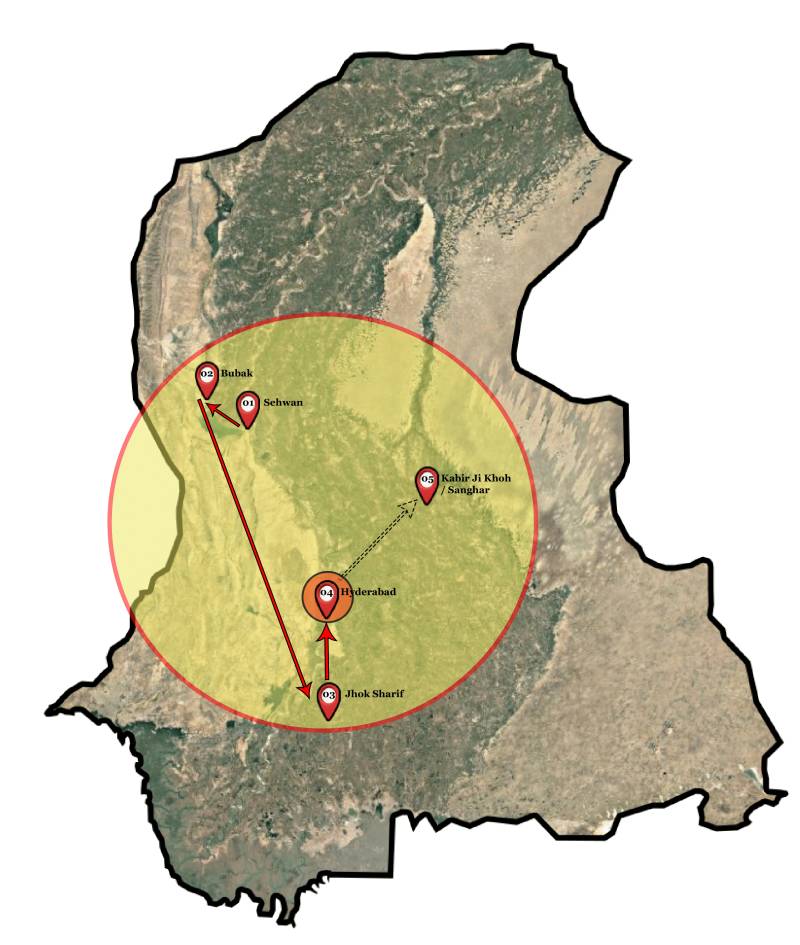
Bhai Dalpatram was born in Sehwan in 1769. He initially served as a Kardar (revenue collector) under the Talpur Amirs, a position of considerable responsibility during that era. A transformative moment occurred when Dalpatram learned of the arrival of Sant Bhai Asardas in Bubak, a revered disciple of Salamullah Shah of Jhok Sharif. This news prompted him to undertake a journey from Sehwan to Bubak to meet him. The encounter proved to be a pivotal turning point; immediately thereafter, he resigned from his post, dispatching his resignation to the Mir’s official without apparent concern for his future income or the practicalities of sustaining his life. This act underscored a remarkable commitment to his newfound spiritual path. For seven years following this decision, Dalpatram dedicated himself as a devoted disciple of Bhai Asardas. Subsequently, he married and had five children—one daughter and four sons. Later in his life, Dalpatram relocated to Hyderabad, where he established his asthan in the Sipahmalani Ghitee.
Every evening, he would instruct his disciples to empty all food vessels and ensure that all utensils were inverted. His rationale was encapsulated in the Sindhi maxim, "Subhani Jo Bhag Subhani Sa’n" (Tomorrow’s fortune is to be sought tomorrow)
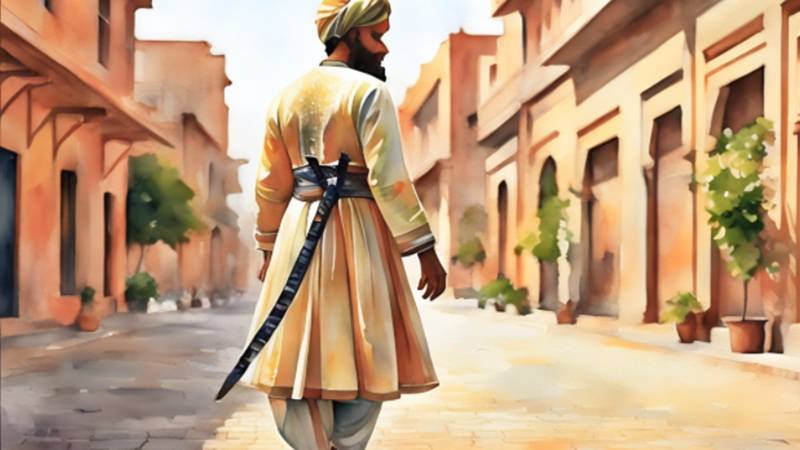
Bhai Dalpatram possessed a striking and robust personality. He was described as a man of imposing height, with luminous, shining eyes. His customary posture involved sitting on a traditional Sindhi cot, and he consistently carried a sword, an object that perhaps symbolised his unwavering resolve and principled stance. His commanding presence and dominating personality effectively discouraged individuals from posing irrelevant or trivial questions, reflecting an expectation of seriousness in interactions. His philosophical approach to daily sustenance was distinctive and deeply ingrained in his spiritual convictions.
Dalpatram firmly believed that with the close of each day, that day’s "rozi roti" (daily bread and butter) should be considered fully consumed and accounted for. This belief manifested in a peculiar practice: every evening, he would instruct his disciples to empty all food vessels and ensure that all utensils were inverted. His rationale was encapsulated in the Sindhi maxim, "Subhani Jo Bhag Subhani Sa’n" (Tomorrow’s fortune is to be sought tomorrow). This concept aligns remarkably with the Persian phrase, "Youm Jadeed, Riziq Jadeed" (New day, new provision), emphasising a complete reliance on divine providence for each new day. Beyond his primary residence, Dalpatram also spent considerable time at Jhok Sharif and frequently embarked on journeys to Kabir Ji Koh in Sanghar. He undertook numerous spiritual pilgrimages, visiting various teeraths, asthans, and dargahs in the company of Bavo Shankar of Shikarpur, further illustrating his engagement with the spiritual landscape of his time.
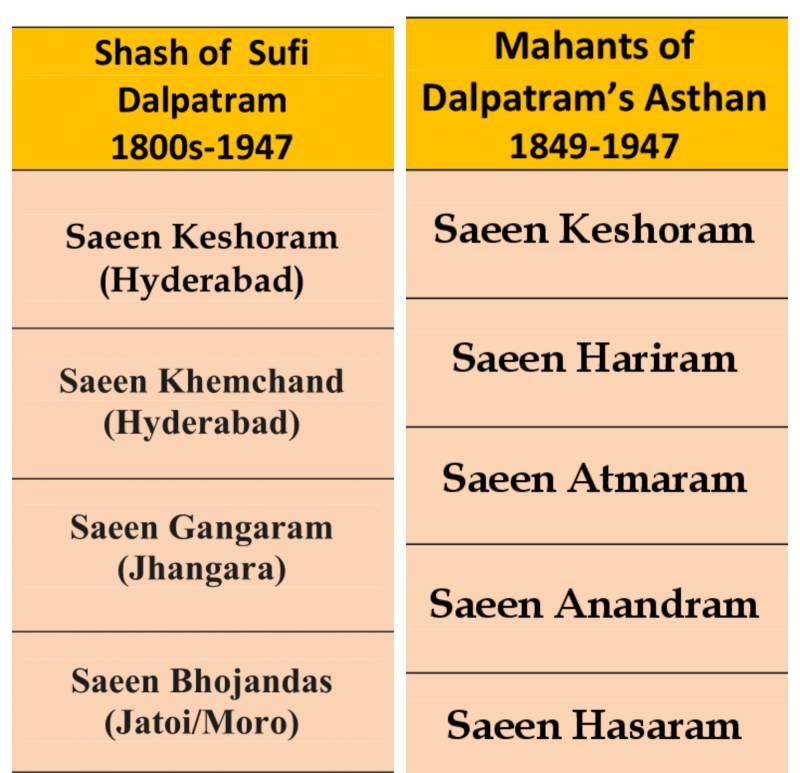
Dalpatram’s spirituality, tapasya, unwavering bravery, and insightful wisdom drew a significant following, leading many to desire to become his disciples. However, he was selective in his acceptance, formally recognising only a few as his closest followers: Saeen Keshoram Hotchand Sipahmalani, Saeen Khemchand Kirpalani, Saeen Gangaram Jhangarn Waro, and Saeen Bhojandas Jatoin Waro.
Bhai Dalpatram was renowned for being a man of unyielding principles. A notable anecdote recounts an instance when an attendant from the Talpur Amirs delivered a message that an Amir wished to meet him. Dalpatram’s response was direct and indicative. He instructed the messenger: “Chal, me’n na chalsa’n, Mir no’n gharaz hovseen, ta aphe;n aa veseen” (No, I will not come. If the Mir has a matter to discuss, he will come himself.). This demonstrated a remarkable assertion of personal dignity and spiritual authority. It should also be noted that no forceful action occurred; this suggests the Talpurs were more considerate towards sants and dervishes.
Bhai Dalpatram passed away in 1849. Following his demise, Saeen Keshoram succeeded him on the gaddi (spiritual seat), ensuring the continuation of Dalpatram’s spiritual lineage and teachings. The Asthan’s spiritual lineage continued till 1947. The subsequent mahants were: Saeen Keshoram, Saeen Hariram, Saeen Atmaram, Saeen Anandram, and Saeen Hasaram. Until the Partition, the asthan meticulously preserved and displayed some of Dalpatram’s personal items. These relics included his gadi (sitting cushion) and his chakherio (rough wooden footwear). Over time, the chakherio of subsequent nahants were also added to this collection.
The asthan also showcased a manuscript of Bhai Dalpatram's wamni (spiritual poetry). Notably, this manuscript was incomplete, as Dalpatram never permitted his work to be fully copied, preserved, or printed. He was highly proficient in composing poetry across multiple languages, including Sindhi, Siraiki, Hindi, and Persian. His most celebrated work is the Jangnama (heroic ballads), a powerful epic that narrates the martyrdom of Shah Inayat Shaheed, an important event in Sindhi spiritual and historical consciousness.
Dalpatram expressed his Sufi thoughts through various traditional forms favoured by earlier poets like Sami, as well as his contemporaries. One of his frequently applied forms was the salook. The thematic content of his salooks can be broadly categorised, encompassing concepts such as muhabbat (divine love), the symbolism of the kalal (wine seller/server), the evocative imagery of malhar (cloudy season/rain), the devotion of the patang (lover), the deep yearning for beloved sik (longing), the spiritual state of porab (being united with the one), reflections on the kaljug (about those who indulged themselves in the material world), and the vibrant beauty of basant bahar (flowery season/nature), sasui and tales from Rumi. His poetry was versatile enough to seamlessly fit into various classical music systems, notably raag kalian, raag sham kalian, and raag talang. Scholars widely acknowledge him as the first Hindu poet to express spiritual insights through the classical Sindhi kafi form.
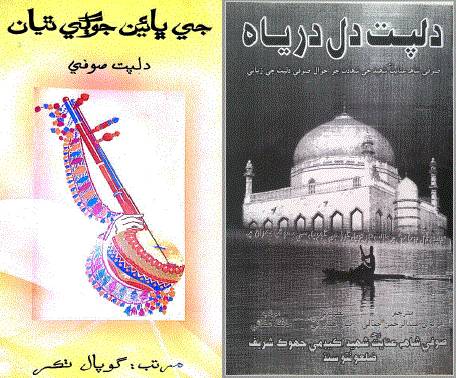
A survey of Dalpatram’s published anthologies provides valuable insight into his collected works and underscores the continued resonance of his poetry in contemporary times. These include Dalpat Jo Sufi Kalam (compiled by Kauromal Chandanmal Khilnani, year?), Sufi Dalpatram Ja Sindhi Salook (compiled by Moolchand Jhangaldas Thakur, 1938), Deewan Dalpat (compiled by Gidumal Khatanmal Harjani, 1965), Je Bhaeen Jogi Thiyan (compiled by Gopal Thakur, 2009), and Dalpat Dil Darya (compiled by Hafiz Atai, 2011). In addition to the dedicated anthologies of his work, Dalpatram's poetry has also been an inclusion in compilations by various scholars featuring diverse poets. Among these popular editions are Dr. Daudpota's Chond Sindhi Nasur Aen Nazam (1940), Naraindas Mevaram Bhambhani's Adabi Gulshan- bhango pahriyun/bhango biyo (both published in 1945), Lutufullah Badvi's Tazkirah Lutfi- bhango biyo (1963), and Ram Panjwani’s Sindhi Shair Jo Intakhab - 1947 taeen (1976).
Beyond his celebrated poetry, Dalpatram also themed ancient wisdom stories in his poetry. Lutufullah Badvi, in his aforementioned Tazkirah Lutfi-bhango biyo, notably quotes Dalpatram’s poem, "Hathi Aen Andha" (The Elephant and Blind Men). This poem serves as a powerful yet humble reminder of the limited scope of human understanding when confronting vast, sacred truths. It elegantly illustrates how each individual perceives only a fragment of the ultimate reality; while their unique perspective is authentic to them, it does not encompass the entirety of the picture. The narrative gently guides us towards humility and encourages an open-minded approach, fostering the realisation that diverse paths and interpretations can ultimately converge upon the same overarching truth.
Prior to concluding this discussion, it must be understood that the Partition considerably damaged the vibrant Sufi tradition in Sindh. However, it is now a prime time to trace tikanas, mandirs, darbars, and asthans that have re-established themselves in various Indian cities after the Partition. In this endeavour, Michel Boivin's work could prove particularly insightful. Boivin in his book, The Hindu Sufis of South Asia: Partition, Shrine Culture and the Sindhis of India, has meticulously traced various traditions of Sindhi saints, often with reference to the post-Partition period. Regarding Bhai Dalpatram, he notes that his samadhi is located in Colaba, Bombay (now Mumbai). At this site, he mentions the presence of five pairs of chakariyuns and other personal items such as bayragins (canes). He observes that there are no regular satsangs held at the samadhi. However, he adds that Dalpatram's versi is marked by the singing of Sufi songs in Sindhi.
It is an undeniable fact that the Partition of 1947 has considerably eroded the rich Sufi tradition of Sindh. But, old masters kalams are still relevant, and one of them is Dalpatram. This sentiment is powerfully articulated by Sufi Attaullah Satari gaddi nashen of Jhok Sharif. In his introduction to Hafiz Atai’s book, he categorically refers Dalpatram’s poetry and stated that it his poetry has supreme values of humanity and the overarching idea of divine oneness. He further emphasises that if these principles were truly embraced and practiced, enmity would be uprooted, and human beings would cease their outward search for the Divine "Being"—neither across physical lands nor in the vastness of space—but would instead discover "Him" within themselves.
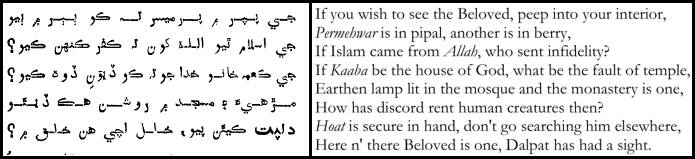
The Sufi scholars recognise Dalpatram as a grand master of wahdat al-wujud (the concept of 'Unity of Being,' a core tenet in Sufism) and Vedanta philosophy, particularly its non-dualistic aspects. His poem, "masjid aen mandar men bari hek diyio" (The same earthen lamp is lit in the mosque and the monastery) is praised and t almost all Sufi melas and secular assemblies in Sindh, this poem is frequently requested and sung repeatedly, serving as a powerful anthem for religious harmony and universal truth. Perhaps, alongside other classical Sufi poetry, Dalpatram’s kalam is considered a sublime and potent means to promote pluralism—an integral aspect of what might be termed Sindhi Sufiat or Sindhiyat, reflecting the syncretic spiritual identity of Sindh.