

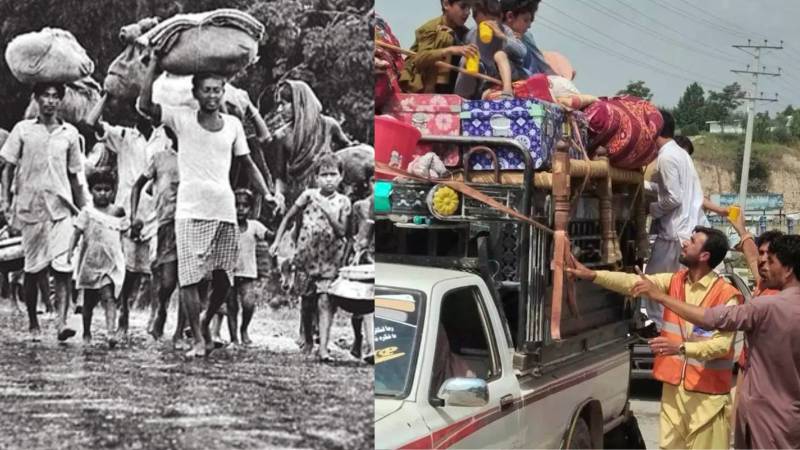
‘Dhaka Fall’ does not qualify as a national tragedy or as a moment for our honest collective reflection. This has been my conclusion after more than 15 years of lone advocacy on the plight and predicament of Pakistani citizens, also known as Biharis, those stranded in the squalid camps of Bangladesh following the ceremony of surrender on 16 December 1971. I insist on calling it a ceremony, as I have no reason to disbelieve that Pakistan was dismembered long before this terrible date, perhaps on 7 March 1971 or even somewhere in 1969. Authentic activism and journalism died long ago. What we mostly get is twisted truth or a bundle of lies embellished by powerful publishers, politicians, and power brokers.
I have little appetite or intention of walking through the corridors of biased history or the labyrinths of media blackouts. Without oversimplifying a complex chapter of Pakistan’s history, it can be safely said that 1971 shattered our national unity, identity, and cohesion—a fault line that still remains, largely unobserved. It was a traumatic tutorial on how unaddressed grievances and mistrust can collapse a national structure. Let us dare to look, without diplomacy or deception, at what is happening now and what present-day Pakistan can still do to prevent future setbacks. This reflection is personal.
In earlier writings, I have repeatedly documented the plight of loyal Pakistanis who have been left stateless for decades. That experience—seeing how popular, not necessarily correct or honest, narratives shape public sentiment and institutional memory, and how sidelined communities suffer silently—informs my urge to write about Bajaur and Balochistan. I do not write to criticise my country but because I believe silence, when lives are being lost and trust eroded, is a disservice to Pakistan itself.
Pakistan has been fighting the war on terror since 2001. Since then, more than 80,000 Pakistanis have lost their lives to terrorism, including 23,000 security personnel. In 2025 alone, militant attacks have claimed over 320 civilian and 150 military lives. A rapid review of the situation in two provinces (Khyber Pakhtunkhwa and Balochistan) and of recent events in some specific areas shows a worrying surge in terrorist and separatist activity. Before going further, I wonder how many among us—especially those in Pakistan’s urban centres or comfortably settled abroad, often speaking on high-level platforms or dominating media spaces—have ever actually visited these areas, let alone interacted with the common people who live there?
As Bajaur experiences renewed extremist attacks and Balochistan struggles with “alleged” enforced disappearances and insurgent offensives, we must ask many difficult questions: why is this happening?
Take the example of Bajaur, a small district in Khyber Pakhtunkhwa, with an estimated population of 1.3 million, youth unemployment above 40 percent, and female literacy rates below 40 percent. These are not abstract figures; they translate into frustration and vulnerability, easily exploited by militant recruiters. Bajaur is caught in a vicious cycle where militant incursions and insecurity meet rising civilian impatience. Locals demand not unmitigated operations but transparency, protection, and participation. Meanwhile, state agencies are under mounting pressure to restore law and order without fuelling further alienation.
Not overlooking the inadequacies within the civil-military bureaucracies, one should not discount the magnitude of sacrifices by our young soldiers and civil officials. A 22-year-old sepoy, Abdullah from Swabi, who embraced shahadat during the roadside bombing in Bajaur’s Mamond tehsil on 2 July, had joined the army only last year. He was a young man full of hopes who had promised his mother during his last call home that he would be back for Eid. That visit never came. His story, like thousands of others recorded in ISPR releases over the years, reminds us that each entry in a casualty chart is not just a number but a precious life cut short and a family left inconsolable. In the same terrorist attack, a bright young man from a middle-income family, the Assistant Commissioner of Bajaur, Faisal Sultan, was killed, along with five senior officials. Eleven others (we seldom bother to know who those other human beings with loved ones were, for sure) were injured.
Like Bajaur, the wrongs of Balochistan—Pakistan’s largest province, with a population of just 14 million scattered across vast, resource-rich but mostly underdeveloped terrain—are valid, but so are its hardships and fiascos caused by elite capture. Balochistan’s per capita income is nearly half the national average, literacy lags by 20 percentage points, and maternal and child health indicators are among the worst in South Asia. These troubling numbers are the catalysts for constructing the plots of discarding and mishandling. According to the South Asia Terrorism Portal, over 300 people were killed in insurgency-linked violence in 2024 alone. Locals, however, continue to demand genuine political autonomy, fair resource sharing, and an end to allegations of enforced disappearances.
Pakistan’s strength lies not only in defending borders but also in amplifying the support and love of all its people for the country and its institutions
The parallels with 1971 are hurtful. When communities feel unheard and unrepresented, separatist narratives thrive. My own community’s loyalty to Pakistan did not save it from abandonment; today, Bajaur and Balochistan face the opposite risk: what if communities choose not to side with the state? If they stand with Pakistan, demanding rights but rejecting insurgency, there is hope: insurgents lose any ethical position, peacebuilding gains ground, and socio-economic development becomes sustainable. If they turn away, either from fatigue or distrust, then every operation, every investment, and every “national interest” policy risks being dented by dissension.
Today, as Bajaur experiences renewed extremist attacks and Balochistan struggles with “alleged” enforced disappearances and insurgent offensives, we must ask many difficult questions: why is this happening? What is the truth? Where is the truth? How come some voices are muted while others are free to make noises? Who are the real champions of rights? Is this a puppet show? Is the state repeating the same mistakes, or is it learning and unlearning?
I leave it to experts on national security, geostrategic trends, or terrorism to interpret these snippets or draw conclusions. What I know as a member of a forsaken community that sided with soldiers, not separatists, is that in all such circumstances, the stories of agony of common people remain curbed. Nobody cares about pregnant women, lactating mothers, menstruating girls, babies requiring immunisation, or elderly and disabled people needing special care, who are not a priority even in so-called normal circumstances, and are further demoted to the status of nobodies, ineligible to be heard or seen. In all such crises, marginalised groups, especially women with overlapping vulnerabilities, suffer the most and are silenced as well. As a medical doctor and social development professional, I know how these populations are rarely even counted in “national security” planning. They are not even viewed as a component of national security and interest. This invisibility itself is a security hazard, because unaddressed social suffering feeds political dejection.
Is there any window of opportunity for us—as the state, society, and system—to learn from Bangladesh’s “tragedy” and to act on its lessons rather than endlessly lament it and use it as a threat, without even empathising with the pain of the ongoing devastation inflicted on the communities caught in conflict?
I wonder if concepts like remorse, recognition, and restitution can be effectively integrated into national security dialogues and popular glossaries not as weaknesses but as strategies for constant and unconditional unity. As someone who has seen loyal Pakistanis reduced to the wretched, forgotten, and stateless in the ghettos of Bangladesh, I urge my country not to “administer” Bajaur or Balochistan as a distant colonial ruler but to establish more sincere partnerships with the people, treat them with more dignity, and build the capital of trust. Then I see no barrier in winning the war against terrorism and anti-state propaganda, or digital dehshatgardi.
Pakistan’s strength lies not only in defending borders but also in amplifying the support and love of all its people for the country and its institutions. This is the true magic of the magical mantra: Pakistan, Hamesha Zindabaad.