

When David stood before Goliath—towering, armored, and supremely confident—he wasn’t overwhelmed by fear or blinded by size. While others warned him, "Don’t you see he’s too big to hit?” David calmly replied, “No, he’s not too big to hit—he’s too big to miss.” That wasn’t arrogance; it was clarity. In that moment, it wasn’t brute size that triumphed, but simple sense and unshaken vision.
I first read this retelling in Shiv Khera’s book—and it struck like truth often does: instantly and deeply. In today’s scenario, this story feels less like a tale and more like a warning.
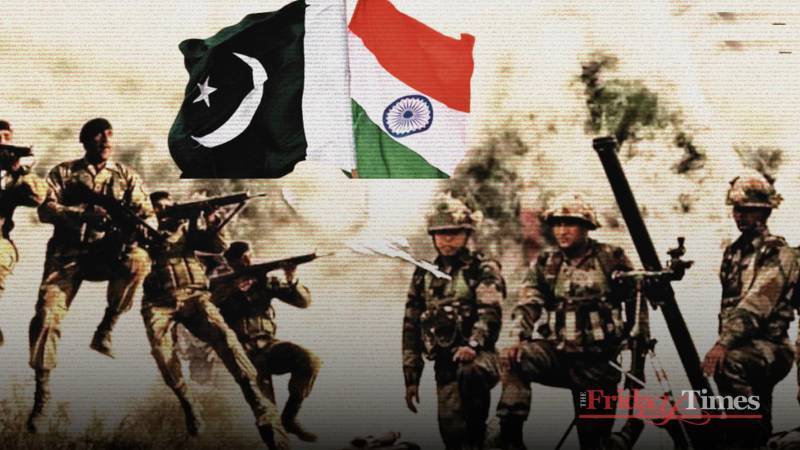
It began on May 7. Civilian areas across Pakistan were jolted awake—deadly missile attacks on residential homes, drone incursions, aerial violations, and the unmistakable scent of escalation in the air. Despite the recklessness of these provocations, Pakistan responded with notable restraint. According to Pakistani sources, 26 civilians were killed and 35 injured, including women and children. Such targeting of non-combatants is a war crime and a blatant breach of the sovereignty of the state.
Yet Pakistan did not jump into the abyss. Its response was calculated—not to provoke war, but to deter it. In one of the most sophisticated and advanced dogfights of this century, retaliation came precise and symbolic: a Rafale—one of the most intelligent and technologically advanced aircraft in India’s fleet— —a key symbol of India’s defense modernisation and pride—was downed, along with damage to several other strategic assets, in a display of technical and professional finesse that sent a clear signal: don’t mistake silence for surrender.
But what followed in India was not introspection. It was hysteria—unfortunately, mass hysteria. The Indian media, drunk on its own delusions, declared instant victory, praised mythical successes, and buried the real story under a landslide of dopamine-fueled nationalism. This is what happens in nations where noise is mistaken for strength, and drama for direction.
A joint investigation commission should be established, ensuring that every act of terror, on either side of the border, is investigated thoroughly, transparently, and dealt with through the rule of law
This wasn’t journalism—it was stand-up comedy in war paint.
But behind the farce, real fire was being lit. The media's war cries soon translated into actual acts of aggression. What followed was a red line no state could ignore. Indian forces launched direct attacks on Noor Khan Airbase in Rawalpindi and other Pakistan Air Force installations—a sheer act of aggression aimed at incapacitating Pakistan’s defense infrastructure. It was a deliberate provocation, one that left Pakistan with no choice but to retaliate—and to retaliate hard.
Then came Pakistan’s formal announcement of retaliation—swift, strategic, and unflinching. The world was shocked—and so were we—to witness one of the most technologically advanced, bewildering, and multidimensional displays of warfare in modern times. Whether one calls it a conflict or a calculated deterrence, it unfolded as a rare fusion of intellect, professionalism, technological prowess, strategy, timing, bravery, and precision—all converging in real time. This was not just a demonstration of military might, but of national preparedness and resolve.
Twenty-six Indian military installations reportedly hit. Electronic warfare jammers deployed. Coherent targeting across the LoC. This was not just retaliation; it was a statement. And it will likely be studied in military colleges for years to come.
As the dust settled, even a clip of the Deputy Air Chief Marshal candidly remarking “IAF vs PAF—6 nil” began making rounds on social media, becoming a symbol of both pride and pointed commentary.
But all this muscle-flexing misses the larger truth: there is no such thing as a “small war” between two nuclear states. There is only a storm followed by silence—and the haunting realisation of how close we came.
Instead of reflection, India institutionalised it under the banner of a ‘new normal’, a new narrative peddled by its policymakers— the idea that India can strike, escalate, and set the rules of engagement unilaterally.
Let’s be clear, Pakistan does not accept doctrines dictated by fantasies of dominance. If the new normal includes attacking sovereign nations, then retaliation becomes the 'newest normal'—a path that leads straight to mutually assured destruction. In a nuclear neighbourhood, there are no winners—only survivors, if lucky.
Gone is Gandhi’s India. In its place stands a nation where the father of nonviolence would now be labeled “anti-national.” In his time, he fasted to end riots. Today’s India feeds riots with primetime debates.
This is not a media gone rogue; this is a media turned weapon. And in the process, it has transformed itself into a global joke—more meme than mouthpiece.
But India’s intoxication with hatred is not just embarrassing—it’s dangerous, very dangerous for the whole world. Meanwhile, as Indian leaders fuel hatred, their people are left to bury bodies and fear tomorrow. Rather than pursue real justice for the victims of Pehalgam, the state chose theatrics over investigation, missiles over evidence. But the world is not blind. The world sees the designs behind India’s neo-expansionist appetite.
May 10 , The United States stepped in after getting some intelligence reports and announced a ceasefire upon India’s request. India followed, and Pakistan accepted. Kashmir, long suppressed in regional conversations, is now explicitly on the table again as per President Trump. And in this pause—this breathless silence—lies a rare opportunity to rethink, reimagine, and reclaim the sanity Indian Policy makers nearly lost.
This is not a call to appease—it is a plea to envision. To replace impulse with insight, and fear with foresight.
So what now? Perhaps a roadmap—one grounded in sanity, not spectacle. Diplomatic ties must be restored, not for ceremony, but for clarity. Human contact across borders—students, artists, grandparents—must resume, for these are the threads that stitch peace. Hate speech must be outlawed, and truth must be shielded from the blizzard of fake news. And above all, Kashmir—no longer a footnote—must return to the conversation, not as a land to be owned, but as a people to be heard. Trade must follow, art must speak, and culture must reconnect what barbed wires have tried to sever.
But for any of that to happen, both sides must choose interdependence over hostility. The region cannot afford to let terrorism—regardless of where it strikes—dictate its future. It’s time to bring back confidence-building measures, to replace blame with inquiry, and impulse with institutions. A joint investigation commission should be established, ensuring that every act of terror, on either side of the border, is investigated thoroughly, transparently, and dealt with through the rule of law. Without justice, there is no trust; without trust, no peace.
David didn’t prevail because he was stronger—he prevailed because he refused to see through the eyes of fear. It’s time to shun fears. South Asia’s real test is no longer military—it is moral. Not about firepower, but foresight. Not about dominance, but dignity.
The world has seen enough fire. It waits now, perhaps for the last time, for light. Not from missiles—but from minds.