

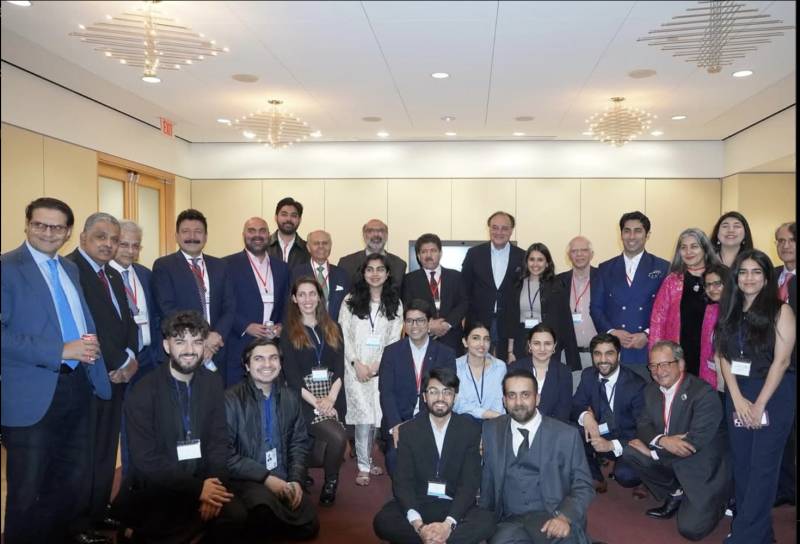
On April 27th, I attended the Pakistan Conference 2025 at Harvard University. Pakistani government representatives, opposition leaders, scholars, public intellectuals, and journalists all converged to address two questions that have haunted Pakistan since its founding: How can Pakistan's political and economic challenges be addressed? Can it achieve stability without betraying its democratic promise?
Three interesting and, to some extent, competing narratives emerged. The pro-government side argued that Pakistan is stabilising and poised for growth. They pointed to new investments, mining projects, and macroeconomic indicators trending upward. The message was clear: Pakistan is resilient, reforming, and ready to reclaim a place among emerging economies. It was an optimistic vision, aimed perhaps particularly at younger Pakistanis who have grown up with more cynicism than hope.
There was also a broad scholarly and diplomatic consensus on two key points: first, that Pakistan is a country of significant consequence, though it is currently not a priority for the United States; and second, that despite its many challenges, Pakistan holds immense potential. Historically, a crossroads of civilizations and a bastion of mystical Islam, it still has much to offer the world. A few independent scholars also acknowledged that Pakistan is currently experiencing one of its worst periods in terms of human rights and the rule of law.
Contrary to what the government side suggested, Salman Akram Raja, PTI's General Secretary, however, offered a starkly different assessment. Raja described a country where constitutional norms are routinely violated, where politicians are abducted to force constitutional amendments, where judges operate under threat, and where the true center of power remains not with elected representatives but with the military establishment. His intervention was a reminder that economic growth figures mean little when the rule of law itself is hollowed out.
The path forward for Pakistan, then, is not to choose between democracy and governance, but to recognise that real governance requires real democracy
Yet, beyond these perspectives, a third, more insidious idea surfaced—one that I believe poses the greatest long-term threat to Pakistan's future. It is what I call the technocratic shortcut: the belief that Pakistan's governance problems can be solved by sidelining politics altogether and entrusting decision-making to "experts" who can "just get things done."
At first glance, this approach seems rational. In moments of crisis—economic collapses, pandemics, energy shortages—technocratic efficiency feels like a lifeline. It promises action where politics seems to produce only gridlock, and expertise over ideology, reason over passion. In a country exhausted by political dysfunction, the appeal of this vision is undeniable.
The important point to remember is that the seduction of autocratic rule masquerading as technocratic governance is neither novel nor exclusively learned from East Asian development models (as some panelists tried to suggest). Rather, it represents a fundamental impulse toward total control that is inherently totalitarian. By replacing genuine political deliberation with the rule of "experts," technocracy attempts to eliminate, as philosopher Hannah Arendt would argue, the unpredictability of democratic politics in favor of "scientifically controlled conditions" where human spontaneity itself becomes the target of elimination. What begins as an apparently pragmatic desire to "get things done" without messy democratic contestation ultimately seeks to transform governance into a laboratory experiment, potentially reducing citizens to bundles of reactions, whose dissent is interpreted not as legitimate political expression but as obstacles to efficient management. The technocratic promise of simplified development conceals its true nature—an avoidance of democratic accountability and the suppression of disagreement under the guise of necessity.
From a more practical and policy standpoint, the technocratic temptation reflects a grave misunderstanding of both Pakistan's crisis and the nature of democracy itself. Pakistan's governance failures are not merely the result of technical incompetence. They are the outcome of deeply entrenched structures of unaccountable power, where elites—whether military, bureaucratic, or economic—operate above public scrutiny. Insulating policy from politics does not cure this disease; it entrenches it. It transforms visible political failures into quieter, less detectable ones—failures that fester because the democratic mechanisms meant to detect and correct them have been neutralised.
The impulse toward technocracy also reveals another deeper anxiety: a loss of faith in the people themselves. It rests on a dangerous belief that Pakistanis are somehow incapable of choosing competent leaders, that democracy is a luxury Pakistan cannot afford. This mindset does not merely open the door to authoritarianism; it actively seeks it, under the guise of efficiency.
The political economists Gabriele Gratton and Jacob Edenhofer recently warned about the dangers of technocratic democracies. Their research shows how societies that insulate key areas of governance from democratic control may achieve short-term stability but ultimately become vulnerable to waves of backlash, institutional reform, and even autocratization. Their insights are illuminating, but Pakistan's dilemma goes even deeper. In Pakistan, democratic legitimacy is already fragile. A technocratic turn would not just provoke future instability; it would further erode the already tenuous trust between the state and its citizens.
Consider the darker possibilities that technocratic governance opens. Imagine a future public health crisis where policies are enacted without public debate: mass quarantines that cause starvation, medical interventions imposed without consent, surveillance systems that erode civil liberties in the name of efficiency. Without democratic institutions—free media, independent courts, competitive elections—there are no mechanisms to halt, correct, or even expose such abuses. The efficiency gained would come at the cost of catastrophic errors without recourse.
Moreover, the belief that politics itself is the problem ignores what politics actually provides: not merely decision-making, but legitimacy. Democracy is not the fastest way to solve problems; it is the way to solve them while ensuring that those solutions are rooted in the consent of the governed. In a country like Pakistan, where questions of legitimacy, representation, and accountability remain unresolved, bypassing democracy is not a solution—it is an invitation to deeper crises.
The path forward for Pakistan, then, is not to choose between democracy and governance, but to recognise that real governance requires real democracy. Not democracy as an event—occasional elections—but democracy as a daily practice of accountability, transparency, and responsiveness. This means strengthening courts, protecting the independence of the media, curbing the military's political role, and creating genuine avenues for citizen participation beyond the ballot box.
The hardest truth the conference revealed is this: there are no shortcuts. Pakistan cannot leapfrog the difficult, frustrating, and necessary work of democratic consolidation by outsourcing its future to technocrats. The promise of efficiency is alluring, but without legitimacy, even the best policies will wither under popular distrust.
Kudos to the organisers for this great success!