

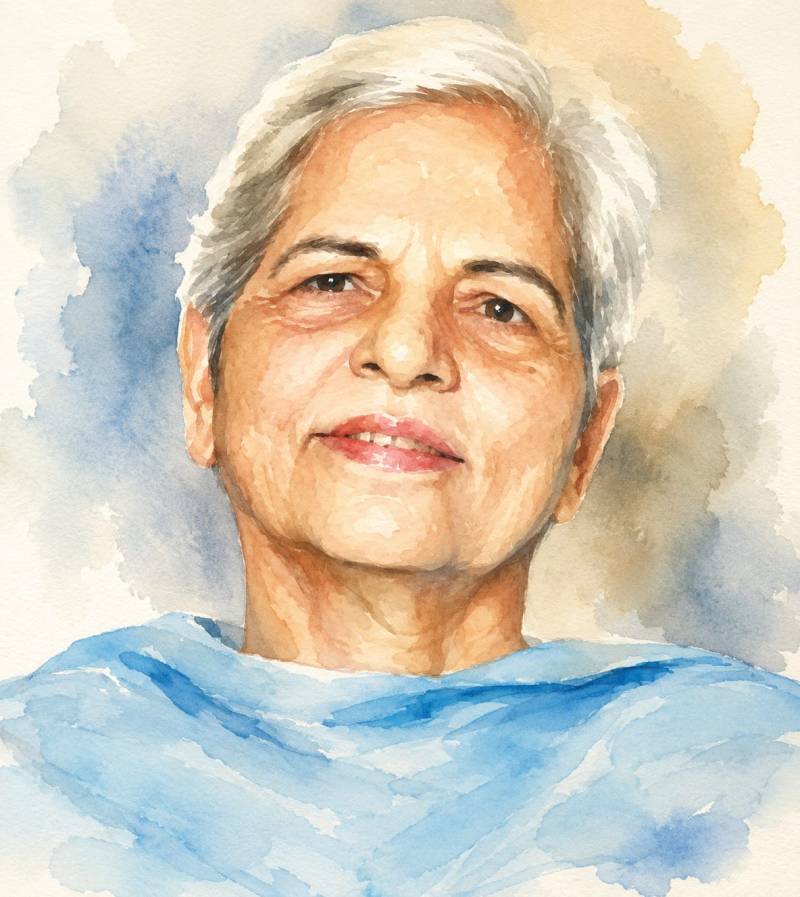
The month of July brings back the memory of my dear friend and mentor, Zubeida Mustafa. It was in July last year that she left us forever, and I have spent the year since trying to find the right way to write about her. I am still not sure I have.
I came to know Zubeida Mustafa in 2000, when I moved from Karachi to Lahore to take on the task of building a Faculty of Social Sciences in a private university. It was from there that I sent a piece on education to Dawn. Zubeida wrote back a long email, first introducing herself and then appreciating the piece and asking me to write for Dawn on a regular basis. That encouragement turned into my first writing in Dawn, on a page she edited for education, and from there into the Books and Authors page, and eventually the Op-Ed pages. Nine years of writing for Dawn followed, before I moved on to The News. None of it would have started without her.
By the time I met her, she had already spent a quarter century at Dawn, having joined in 1975 as one of the first women in Pakistan's mainstream media. She stayed 33 years in all, retiring in 2008 as the paper's assistant editor, and in that time, she built pages that don't really exist in that form anymore: The Health Page, the Education Page, Career Wise, Encounter, Karachi Notebook, and Books and Authors, which she started as the first book magazine any Pakistani newspaper had run. Every one of those pages carried the same conviction, that journalism should do more than describe the world. It should try to change it.
She was, by any measure, a polished journalist and a serious thinker, someone who read widely and wrote with the kind of clarity that comes from actually understanding a subject rather than performing expertise on it. But she never treated ideas as an end in themselves. She did not in the kind of journalism that stopped at diagnosis. If a child couldn't learn because the school taught in a language the child didn't speak at home, that wasn't a topic for an essay and nothing else. It was a problem you worked on, and fixed if you could.
That discomfort is what drove her decades-long advocacy for mother tongue education, the cause she's probably best remembered for outside the newsroom. She argued, consistently and with evidence, that children taught in Urdu or English before they had mastered their first language were being set up to struggle, not because they lacked ability but because the system had put an unnecessary obstacle in front of them. She wrote a book on it, Tyranny of Language in Education, and she kept making the argument in her columns long after most people would have considered the point made. I remember her saying, more than once, that advocating an obvious truth doesn't make it heard. You keep saying it. That was very much how she operated, not just on language but on women's rights and public health as well.
What I valued most, though, had less to do with any of her causes and more to do with how she worked with the people writing for her. She read what you sent her closely, not as a formality before publishing it, but because she actually wanted to know what you thought and whether you'd thought about it carefully enough. She'd push back, sometimes hard, but never in a way that made you want to stop writing. If anything, being edited by her made you want to write more, and better. That's a rare quality in an editor, and I didn't fully appreciate it until years later, after I'd worked under editors who saw their job as gatekeeping rather than developing writers.
Writing is not there to reassure people. It’s there to make them think again about things they thought were settled.
She was also, without any theatrics about it, kind. I remember her more for her warmth than for her achievements, which is unusual, because her achievements were considerable: a Global Media Award for Excellence in 1986 and again in 2004, a Lifetime Achievement Award from the International Women's Media Foundation in 2012, and the Women Leaders Award from the President of Pakistan in 2020. But what stays with me is smaller than any of that. It's her face, which seemed to default to a smile even when the conversation had turned serious, and the sense she gave you that she was genuinely glad you'd come to write, and to argue with her if you had reason to.
That combination, I think, is what made her a mentor rather than just an editor. She didn't hand down a formula for good writing. She modelled a way of thinking about why you write at all. Journalism, as she practiced it, existed to unsettle comfortable assumptions, particularly the ones nobody bothered to question because everybody already agreed on them. Why should children be taught in a language they don't understand, just because that's how it's always been done? Why should half the population be written about as a special interest rather than as the population? She didn't ask these questions to be provocative. She asked them because she'd looked closely enough at how things actually worked to see that the answers people gave didn't hold up.
I've thought about that a great deal since hearing of her death. It would be easy to write a tribute that stays at the level of gratitude, and I am grateful, more than I can easily put into words, for a career that started because one editor thought a page on education needed a new voice and decided mine might do. But I think she'd have found a purely sentimental tribute a bit beside the point. She'd have wanted to know what I was doing with the encouragement she gave me. Was I still asking the uncomfortable questions, or had I settled into the easier habit of writing what readers already wanted to hear?
That's the standard I'll try to hold myself to, going forward, in her memory. Not just to write, which she pushed me to do for nine years at Dawn and which I've kept doing since, but to write in a way that challenges the taboos we've stopped noticing because we've stopped looking at them, and to look, seriously, for alternatives rather than settling for the complaint. That was her real lesson, more than any single article or page she edited. Writing is not there to reassure people. It's there to make them think again about things they thought were settled.
I'll remember her affection, her patience with a young and uncertain writer, and that face that always seemed ready to break into a smile, however heavy the conversation had turned. She died in Karachi on 9th July 2025, at 84, after months of illness she bore the way she bore most things, quietly, without asking anyone to make a fuss. I got the news in Riyadh, KSA and found I had nothing to say for most of that day, which felt strange for someone who has spent a career finding words for other people's silences.