

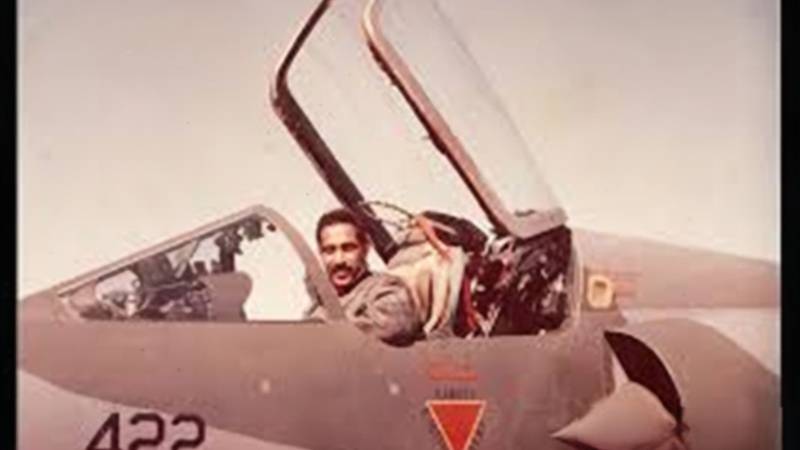
Anyone who went to school in Pakistan before the year 2000 is likely to have come across a name that evokes pride, not just for the Christian community, but for the entire nation.
Some names in Pakistan’s history will always stand as enduring symbols of bravery, determination, and selfless service. One such name is Group Captain (Retd) Cecil Chaudhry, a war hero, educationist, and passionate advocate for the rights of religious minorities.
His life journey from fighter jets to schools and human rights activism is an extraordinary story that brings pride to every Pakistani. While the new generation may not be familiar with Cecil Chaudhry's name or achievements, he remains etched in golden letters in the annals of Pakistani history. This article is not only a tribute to him, but also an effort to introduce this great war hero, educator and defender of human rights.
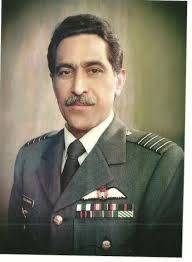
Cecil Chaudhry was born into a well-known Pakistani Catholic Christian family. His father, Faustin Elmer Chaudhry, widely known as “Chacha Chaudhry,” was a familiar name in Pakistan. Cecil was the fourth among five siblings. According to renowned researcher Azam Maharaj in his book Shaan-e-Sabz-o-Safeed, Cecil was born on 27 August 1941 in the village of Dhalwal, located in the Salt Range. His family had migrated from East Punjab after Partition.
A few years later, the family moved to Lahore, where his parents became affiliated with St Anthony’s School. Cecil received his early education there and went on to complete his FSc from FC College, Lahore. Driven by his passion for flying, he joined the Air Scouts during his studies and earned his glider pilot wings in 1956. He was selected for the Pakistan Air Force (PAF) through the 23rd GDP course and entered the Risalpur Academy on 12 March 1958. He graduated on 26 June 1960, and was posted to the 12 Squadron for fighter conversion. He considered himself fortunate to have received his first posting to the 5 Squadron under the inspiring leadership of Squadron Leader Sarfraz Rafiqui Shaheed.
During the 1965 Indo-Pak war, Cecil Chaudhry displayed remarkable courage by targeting enemy bases and installations while piloting the F-86 Sabre jet. He flew several dangerous missions, including in Operation Grand Slam. His bravery earned him a place among Pakistan’s most distinguished combat pilots, and he was awarded the Sitara-e-Jurat (Star of Courage). He also participated fearlessly in the 1971 war, defending Pakistan’s airspace with distinction.
He is the only Pakistani Christian after whom a church has been named by the Pakistan Air Force – the Cecil Chaudhry Church at PAF Base Sakesar, a unique honour
In recognition of his service during the 1971 war, he was awarded the Sitara-e-Basalat (Star of Good Conduct). Over the course of his career, he held several key positions, including commander of the 9 Squadron, Deputy Director of Air Operations, and Commanding Officer of the Combat Commanders' School. From 1979 to 1983, he was also on deputation in Iraq. His illustrious technical career concluded on 2 July 1986. In 2013, he was posthumously awarded the Tamgha-e-Husn-e-Karkardagi (Medal of Excellence) by the President of Pakistan, received by his son.
Personal Life and Educational Contributions
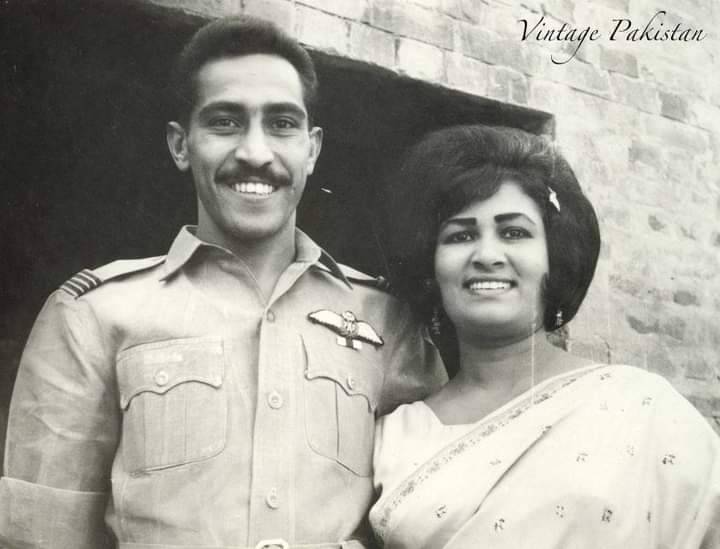
He married Iris Chaudhry in 1964, and they had four children: three daughters, Michelle Chaudhry, Carol Haye, Merlyn Khan and a son, Cecil Shane Chaudhry. Michelle Chaudhry later established The Cecil & Iris Chaudhry Foundation, an NGO advocating for human rights in Pakistan, in her father’s memory.
After retiring from the Air Force, Cecil Chaudhry shifted to the field of education and worked with the Punjab Education Foundation. Before becoming the principal of St Mary’s Academy in Rawalpindi, he served for several years as principal of St Anthony’s College, Lahore, retiring in July 2011.
He was also an influential human rights activist, especially focused on children with disabilities and educational reform. Since the early 1990s, he served as the Executive Secretary of the All Pakistan Minorities Alliance (APMA) alongside Shahbaz Bhatti. He was involved with the National Commission for Justice and Peace and played a vital role in a 14-year campaign that led to the restoration of Pakistan’s joint electoral system in 2002.
Cecil Chaudhry was not only a successful professional but also a remarkable father. His son Cecil Shane Chaudhry shared.
“My father lived a life of integrity, always respecting principles and laws. As a father, he was kind and loving, but he never compromised on values, even at home. From his life, we learned and saw in practice that whatever you do, do it with full honesty and dedication. Only then can you truly do justice to your work. He always said, ‘Set your goals high so that you strive your best to achieve them and get the best outcomes.’”
His daughter Michelle Chaudhry said.
“We are proud to be the children of a patriotic warrior who is still remembered and honoured by not just Christians, but all Pakistanis even internationally. As the eldest child, his values still guide me in dark times like a light.
To fulfil his vision, I established The Cecil & Iris Chaudhry Foundation to advocate for the underprivileged and ensure they get justice and their rightful place. I’m proud that he protected the country’s borders during his military service and, even after retirement, defended its ideological frontiers.
His words ‘By faith I am a Christian, but my religion is humanity’ are a truth no less than scripture.”
Cecil Chaudhry was a symbol of humanity and interfaith harmony. His service extended beyond the military into education, where he influenced the lives of thousands of students as principal of St Anthony’s High School, Lahore. He was a staunch supporter of providing quality education to underprivileged children. After his educational career, he focused his energy on minority rights. A close associate of Shahbaz Bhatti, he worked for religious tolerance and equal rights in Pakistan, consistently opposing discriminatory laws.
An Enduring Legacy
Cecil Chaudhry’s life is a shining example of courage, honesty, and service. He proved that a true hero succeeds not only on the battlefield but also brings positive change to people’s lives.
He passed away on 13 April 2012, but his services and sacrifices are still remembered. His contributions to Pakistan’s defence, education and human rights sectors have made him immortal in the country’s history. Pakistan salutes this great son of the soil, a noble soldier, a compassionate teacher, and a tireless defender of justice. Someone once beautifully described his life:
“He spent the first 27 years of his life protecting Pakistan’s geographical boundaries, and the next 27 years safeguarding its ideological boundaries.”
He is the only Pakistani Christian after whom a church has been named by the Pakistan Air Force – the Cecil Chaudhry Church at PAF Base Sakesar, a unique honour. Additionally, a square on University Road in Sargodha was named after him on 6 September 2016.
His legacy remains a beacon for the nation. Recently, in recognition of his extraordinary services, the Cecil Chaudhry Complex was established at PAF Hospital in Islamabad a modern facility symbolising his dedication to humanity and service.
Cecil Chaudhry’s life was a dazzling example of courage, sacrifice, and compassion. Truly, “legends never die they live forever.” Though he is no longer physically with us, his struggle, service, and impact are still felt. His name is not only recorded in history books, but lives on through institutions and initiatives that continue his mission of courage, sacrifice, and public service.
In recognition of his services in education, the road leading to St Anthony’s School, Lahore has been named Cecil Chaudhry Road.
A few months ago, while passing through that road, I reflected on how this great man of our time passed away on April 13, 2012, and was laid to rest in Lahore’s Christian cemetery (Gora Qabristan). Yet, through his achievements, he still lives on inspiring us to live better lives. He used to say:
“By faith I am a Christian, but my religion is humanity.”
His life and service proved that Pakistani religious minorities remain committed to the development, survival, and stability of their homeland, and will continue to light their share of the flame for the glory of the green and white crescent flag.