

The Baisaran attack has happened. Blood brothers India and Pakistan are once again at each other’s throats. Fratricide is in our blood. Even Emperor Ashoka, who later in his life was instrumental in spreading Buddhism, had 99 of his brothers and half-brothers murdered to claim the throne of Magadha (his father had 16 wives). And Aurangzeb, the last Mughal emperor of consequence, killed his three brothers to wrest the reins of empire. Aurangzeb went further; he executed anyone influential who was close to his brothers. This included Sarmad Kashani, the murshid of his eldest brother Dara Shikoh.
Sarmad’s life trajectory is unique; an Armenian Jewish merchant from Kashan, in what was then Persia, he was drawn to Islam. While traveling on the Silk Road through Thatta in Sindh on business, he met a Hindu scholar, Abhay Chand. The encounter transformed him; they became inseparable companions. The two itinerants finally came to settle in Delhi on Dara Shikoh’s invitation. Sarmad was an authentic seeker, and it became known that he refused to recite the kalima in its entirety. Aurangzeb used this as a ploy to execute him. When the Qazi asked Sarmad to recite the Kalima-i-Tayiba, he recited only La ilaha- there is no god. To the question of why he couldn’t recite the rest of the kalima, he replied that he couldn’t do it because he hadn’t personally experienced the truth of the other lines. This refusal made Sarmad a kafir, a nonbeliever. He was beheaded at the steps of the Jama Masjid. His dargah is not far from where he became shaheed. Sufis, Muslims, Hindus, and Jews all visit it to pay their respects to this eccentric saint.
Had fratricide not claimed the life of the Din-i-llahi founder Akbar’s spiritually like-minded grandson Dara Shikoh; had Dara succeeded Shah Jahan as the Badshah, and had the syncretic philosophy of his spiritual guide Sarmad prevailed, the history of the subcontinent would perhaps have not been stuck in reenacting variations on Sarmad’s murder scene over and over again. The most recent gruesome variation was staged at the picturesque Baisaran meadow, Pahalgam, where the attackers shot those among the tourists who couldn’t recite the kalima. Tragically, we appear to be captives of history, unable to break our destructive patterns to forge more wholesome destinies.
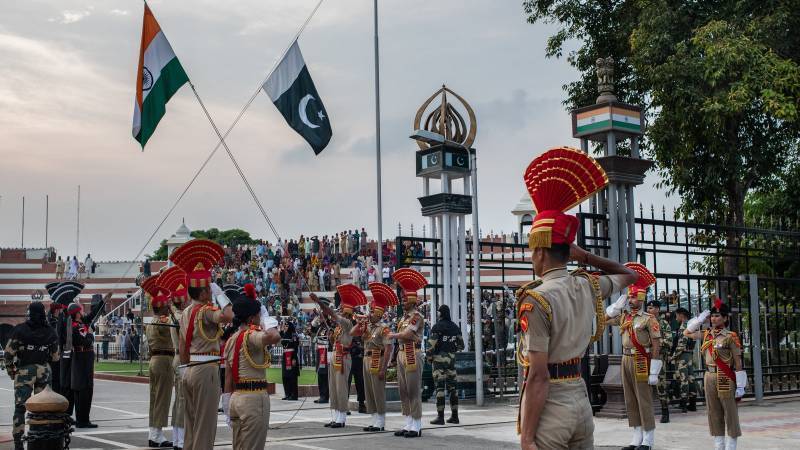
Just imagine for a moment that you were born on the other side of the border. And it was Independence Day in Pakistan. And you had in your hand the Pakistani green flag with the star and the crescent moon. What slogans would you be chanting?
The other day, I was photographing some wind-blown flowers floating in a water tank. They looked so delicate and lovely. But even as I photographed them, other pictures drifted into my mind- pictures of bloated bodies of migrants, whose flimsy boats had capsized, and the desperate escapees had drowned. These involuntarily recollected images clouded the beautiful scene of floating flowers that was presently before me. I inferred: clarity is not an option; there is no escape from the tyranny of tragic images that muddy the mind.
Yet, isn’t that terribly pessimistic? Is there any way to clean our slate, stop seeing through the glass darkly, and adopt a clearer worldview? Hannah Arendt gave us the concept of Natality- birth as new beginning. The continuous influx of newcomers, with their unique perspectives and experiences, offers the ever-present potential of refreshing the political screen. In the case of Indo-Pak relationship this would translate to debugging our code to rescue us from the costly ‘do loop’ of conflict without resolution.
So, who has the audacity to imagine radically distinct futures? Critical thinkers who have a relatively low burden of tragic historic memory, perhaps? In the year 2019, the year of the Pulwama attack, I witnessed an effort in this direction in a small primary school in a Himachali village. A veteran social activist was conducting an activity with some children of 7-8 years on the occasion of Independence Day. He had brought taklis (portable hand spindles) to spin yarn. Through learning this skill, Gandhi wanted every child to appreciate the value of self-reliance. The social activist patiently taught the children how to spin the takli and pull out the yarn from a cotton ball. He then got the children to draw the Indian flag. He discussed the meaning of the symbols of the three colors and that of the central Ashoka Chakra, the 24-spoked Dharma Wheel.
Since he knew the children of the village personally, the activist then went on to remark that he had spotted many of the kids marching through the village lanes waving the Indian Tiranga and shouting “India, zindabad! Pakistan, murdabad!” To my surprise, he then launched, with mock casualness, into a provocative thought experiment, taking his time to let each question be absorbed by the children: “What if you were not born here, in this village, but in some village in Pakistan? Just imagine for a moment that you were born on the other side of the border. And it was Independence Day in Pakistan. And you had in your hand the Pakistani green flag with the star and the crescent moon. What slogans would you be chanting?” Children being children, Pat came with their response without any hesitation: “Pakistan, zindabad! India, murdabad!” Maybe, such critical thinking exercises that foster insight into how our national identities get constructed, and how we unquestioningly vow allegiance to them, could be one place to invest our energies.
The renowned Spanish cellist, composer, and conductor Pablo Casals, who went into self-imposed exile from his native country unwilling to accept the Franco dictatorship, maintained: “The love of one’s country is a splendid thing. But why should love stop at the border?” Indeed, why should it?
It shouldn’t, except that here in our sub-continent, there is Kashmir, that paradise on earth caught between borders, and now fragmented into three territories, each under the independent administration of Pakistan/India/ and China. Each of these three nations, including the Kashmiris as a people- the Muslims and the Hindu pandits- has woven their own dream around this coveted land. It’s 78 long years since the Partition of British India, and the thornily protracted dispute continues with regard to the fate of Kashmir. “What happens to a dream deferred?” asks Langston Hughes, referring to the African-American experience in his poem ‘Harlem. The same question haunts Kashmir:
What happens to a dream deferred?
Does it dry up
like a raisin in the sun?
Or fester like a sore-
And then run?
Does it smell like rotten meat?
Or crust and sugar over-
like a syrupy sweet?
Maybe it just sags
like a heavy load.
Or does it explode?