

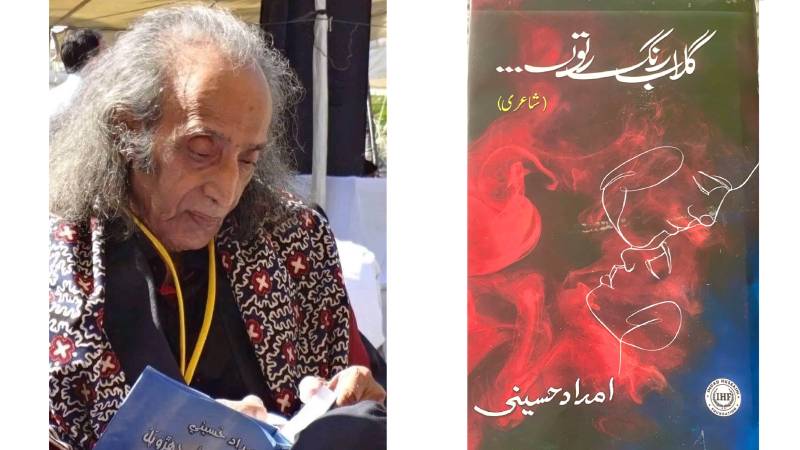
Imdad Hussaini, a distinguished poet, short story writer, researcher, translator, and editor, was born on 10 March 1940, in Tikhurh, a village celebrated as a historic hub of Sindhi poetry and culture. His lineage traces back to the venerable Sufi saints and poets Shah Abdul Karim and Shah Abdul Latif Bhittai.
Reflecting on his heritage, Hussaini noted: “Our family belongs to the Jararpotas, the same lineage as Shah Karim and Shah Latif. Ours was a scholarly and literary household.” This intellectual environment was shaped by generations of writers. His grandfather, Qazi Asadullah Shah ‘Fida’, was a multilingual poet of Sindhi, Persian, and Arabic who edited and published the periodical Bahar-ul-Ikhlaaq. His great-grandfather, Meeran Muhammad Shah (I), was among the pioneers of Sindhi prose.
Hussaini’s early literary sensibilities were deeply influenced by the women in his family. His grandmother, Bibi Sheher Bano, was not only a traditional healer but also a repository of folklore and the poetry of Shah Latif. “I could not go to sleep without hearing a tale from her,” he recalled, noting that it was from her that he first heard the sacred baits (verses) of Latif.
Poetry was a constant presence in his youth. His paternal cousins—Hafiz Shah ‘Natif’, Asadullah Shah ‘Bekhud’, and Shabeer ‘Hatif’—as well as his maternal cousin Saeed Tikhrai, were all established poets. ‘Bekhud’ notably documented this legacy by compiling the biographies of local poets in Tazkira Shuera-e-Tikhur.
Hussaini’s own poetic inclination was sparked by the sounds of his childhood home, where Sheedi women and members of the local singer tribe, the Maghnhaars, would perform the kafis composed by his elders. He often recalled a childhood longing: “I yearned for them to one day sing my poetry too.” This passion eventually led to his literary debut when his first poem was published in the children’s magazine Gulistan, edited by Murtaza Bhatti.
By skillfully weaving modern themes into traditional folk formats, he boldly reimagined the haiku for Sindhi literature, famously naming his version "terhoo"
He received his primary education at the village kuthab (maktab). Later, he pursued higher education at the University of Sindh, where he obtained an M.A. in Sindhi.
During his student years, Hussaini was already associated with literary and research activities. He worked part-time at the Sindhi Dictionary Office and the Sindhi Folk Literature Project. Later, he was appointed Librarian at the Sindhi Adabi Board. In 1970, he was appointed Research Fellow at the Institute of Sindhology, and in 1973 he joined the Sindh Textbook Board as a Subject Specialist in Sindhi.
While serving at the Sindh Textbook Board, he also contributed to literary journalism. From 1977 to 1979, he served as the editor of the quarterly literary journal Mehrān. In 1992, he also served as Secretary of the Sindhi Adabi Board.
Hussaini grew up in the culturally vibrant city of Hyderabad and spent more than three decades in Jamshoro, an important academic centre of Sindh.
His first Sindhi poetry collection, Imdad Aahey Rol (Imdad is a Vagabond), was published in 1976 by the Sindhi Academy Hyderabad. His long poem Shehar (City)—a shehr-ashob written in 1988—was published in March 2000. In the same year, his third poetry collection Hawa je Samhoon (Facing the Wind) was published by Roshni Publications, Kandiaro.
Later, his fourth collection Karni Jehro Pal (A Moment Like a Ray) was published by the Sindhi Adabi Board in 2012. His fifth collection, Hooa (She), was published in 2016 by Naoon Niyapo Publishers. The Sindhi Adabi Board also published his sixth poetry anthology Zard Mithi (Yellow Dust) in 2022, and his seventh and most recent Sindhi poetry collection, Suraj Lai Ko Pathar Naahey (No Stone for the Sun), appeared in 2023.
His first Urdu poetry anthology, Dhoop Kiran, was published by Scherzade Publications in 2014.
Hussaini was a bold experimentalist in poetic form, often pushing the boundaries of traditional structures. Notably, he composed dohas without the conventional qafia (rhyme), and he reimagined the three-line poem—popularly known as the haiku—by naming his version Terhoo (Orion’s Belt).
His versatility was further reflected in his ghazals, where he shifted effortlessly between minimalist short-form compositions and those featuring exceptionally long radifs (refrains). By skillfully weaving modern themes into traditional folk formats, he bridged the gap between Sindhi classical heritage and contemporary literary expression.
Apart from poetry, Hussaini made significant contributions in editing, translation, and compilation. Together with Sehar Imdad, he compiled the book Muel Maanho, Jeeri Peera. He translated the famous Sindhi folk epic Dodo Chanesar into Urdu, which was published by Lok Virsa, Islamabad. He also translated Mirza Qaleech Baig’s novel Zeenat into Urdu, published by the Pakistan Academy of Letters, Islamabad.
Hussaini also edited important literary works. He edited Barana Bool (six volumes), a collection of children’s verses by Ahmad Khan Asif. For the Urdu Academy, he translated four books of children’s Urdu poems into Sindhi. His compiled Catalogue of Religious Literature of Sindh was published by the Institute of Sindhology in 1971.
He also translated the Punjabi poetry of Baba Farid and Madho Lal Hussain into Sindhi. In addition, he translated the Urdu poetry of Faiz Ahmed Faiz into Sindhi, which was published by the Culture Department in 2013 as Tunhje Saagar Nainan Mein.
Hussaini remained actively involved in literary organizations and movements. He served as Secretary of Bazm-e-Talib-ul-Mola (Hyderabad branch) and Sindhi Adabi Sangat (Hyderabad branch). He also participated actively in movements for the restoration of Sindhi language rights, the movement for printing voter lists in Sindhi, and the anti–One Unit movement.
Writing under the pen name “Sanwal,” Hussaini also wrote short stories, which were later published in a collection titled Wanjaro in 2024. He wrote plays, song-stories, and songs for Radio Pakistan, and many scripts for the popular radio program Jhara Gul Gulab Ja were written by him. He also wrote songs and dramas for television.
Hussaini contributed lyrics for Sindhi films as well. Among the films for which he wrote songs are Dharti Lal Kunwar, Sajan Sain, Hazar Sain, and Janiyara.
In 2000, he retired from the Sindh Textbook Board, though he continued to work there for some time on contract as a Subject Specialist. From 2004 to 2006, he served as Chief Editor of three Sindhi Adabi Board journals: the quarterly Mehrān, the monthly Surtioon, and the children’s magazine Gul Phul. Later, he also served as Chief Publication Officer.
In literary journalism, he also worked as editor of Ibrat Magazine, associate editor of Koonj, and compiled the section for new poets in Suhni. Hussaini was also a member of the Board of Governors of the Sindhi Adabi Board and the Sindhi Language Authority. He was part of the editorial team of major scholarly projects such as the Encyclopedia Sindhiana (Sindhi Language Authority) and the Encyclopedia Shah Abdul Latif Bhittai produced by the Shah Abdul Latif Bhittai Chair at the University of Karachi.
For his outstanding literary services, Imdad Hussaini received several awards, including the Tulu Prize, Talib-ul-Mola Award, Narayan Shyam Award, Tamgha-e-Imtiaz (2003), and the Josh Malihabadi Award (2007).
In the final years of his life, he lived in Karachi with his family. He passed away on 27 August 2022 in Karachi and was laid to rest in the cemetery of Wasi Malook Shah, near his ancestral village.