

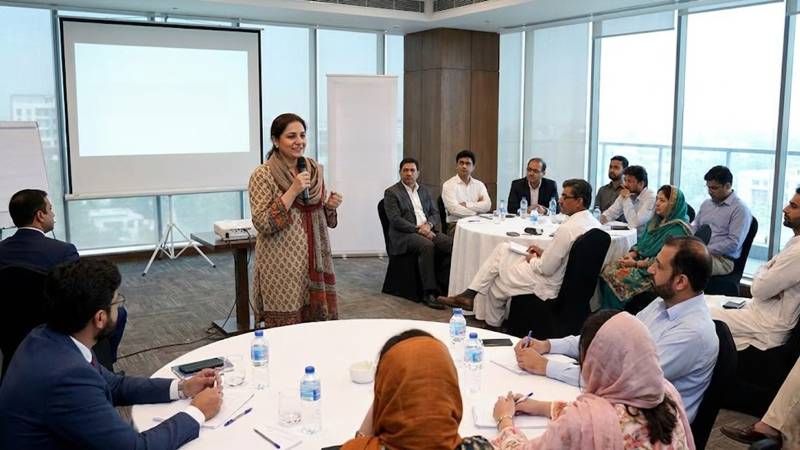
Though it was not my first time attending a UN-organised training workshop, participating in one during these fragmented and ‘disordered’ times was reassuring and thought-provoking, at the same time.
It seemed like the training event acted as a trigger, bringing home more of the reality that the United Nations, despite its many limitations to effect peace and world order, represents, perhaps, the strongest semblance of principled orderliness today, the unflinching call of collective conscious, in a world gone amiss, unprincipled and disruptive.
And though, perpetual peace and reconciliation might have mostly been elusive for the world’s primary multilateral organisation to ensure, it has been doing a lot of remarkably praiseworthy work in the field of education, health, human rights and migration the world over, Pakistan being no exception.
So, as a part of the two-day workshop, organised by UN’s International Organisation for Migration (IOM) in collaboration with the FIA in Lahore, it was agonising to harbour thoughts about the multifarious challenges encountering the equalising force, a global promoter of human rights and equality, that is the UN.
As the United States, previously the global organisation’s number 1 financier quit at least 31 UN agencies lately and intensively cut funding for others, the UN Secretary General António Guterres warned that the UN is facing an “imminent financial collapse” as unpaid annual dues and shrinking liquidity push the organisation towards “a moment of truth.” US withdrawal from the WHO and subsequent aid cuts could lead to 23 million deaths by 2030, according to an estimate.
In a stark letter, dated Jan 28, addressed to all permanent representatives, the secretary general revealed that UN’s current financial trajectory is “untenable,” leaving the organisation “exposed to structural risk and forcing a stark choice between reform and collapse.”
The UN is facing an 'imminent financial collapse' as unpaid annual dues and shrinking liquidity push the organisation towards a moment of truth
From peace and security to human rights, to humanitarian aid, to upholding international law, to sustainable development goals, the UN stands for so much, not forgetting climate change, gender equality, agriculture, finance, telecommunications also falling within its expansive ambit.
At the grassroots level, through trainings, tutorials and courses the UN agencies aim at sensitising, educating and equipping stakeholders with the right knowledge and practices leading up to implementation and execution, as it brings together scholars and practitioners to address critical global issues and promote dialogue to develop actionable solutions.
Focussed on the mechanisms of victim identification, screening and referral, the recently held IOM Pakistan workshop highlighted the various vulnerabilities of the victims of human trafficking and human smuggling in Pakistan. The workshop was conducted by Deputy Director FIA and Incharge Immigration, Multan Airport, Shafqat Jamal Durrani, whose persona goes a long way reinforcing the doctrines that he dictates through his trainings. Workshop participants included officials of the FIA and Punjab Police, besides NGO officials, journalists and social sector stakeholders.
Human trafficking and smuggling has grown into an alarming menace in Pakistan, more so, in the current socio-politico-economic environment, with victims often losing their mental stability, lives or limbs to frequent migrant boat capsizes or exploitation and abuse.
Adding insult to injury is the fact that those lucky enough to return home battered and broken in the aftermath of being trafficked or smuggled, are not always greeted by a shielding or sheltering framework, as victims of human trafficking and smuggling are often not looked upon as victims, especially if they give their consent to leave the country through illegal channels.
In UN’s more equitable and humane terminology however, illegal migrants are referred to as ‘irregular migrants’, and victims of smuggling as ‘vulnerable smuggled migrants’, lending perspective to the victim narrative and broadening the definition of their act to include their own vulnerability.
Legal frameworks like Protocol against the Smuggling of Migrants and the Protocol against Trafficking in Persons, Prevention of Smuggling of Migrants’ Act 2018, do exist, and yet, sensitising stakeholders regarding how human smuggling become cases of human trafficking when victims are scammed, exploited, abused confined, coerced or tortured is imperative. When victims of human smuggling or trafficking, are deported and return home to Pakistan, the first responders are the immigration officers/FIA officials at the airports or other ports of entry. The victims, after having been defrauded with fake promises of lucrative jobs abroad, or scammed into prostitution, bonded labour, carrying drugs or organ trafficking, are often treated as criminals themselves by the first responders.
How important it is to not victim-blame and adopt trauma-informed behaviour by giving dignity, respect, security, privacy and ensuring the well-being of the victim constituted the crux of the IOM workshop. Immigration officers/referral mechanism should not treat victims as offenders, re-traumatize or stigmatize them, or resort to unnecessary detention, encompassed the main message of the two-day training.
Relying on victim-centric approach while offering Trauma-informed Care (TIC), immigration officers must prioritize the victim’s physical safety, as returning home may pose risks of retaliation from traffickers too. Most initial support should include access to food, clothing, shelter, and medical/psychological care. Confidentiality of victim’s information is key, while referral and reintegration support should include medical care, counselling and vocational training.
Officials should use empathetic, non-judgmental, and trauma-informed techniques, not penalize or charge victims for immigration offences or illegal acts committed as a direct result of being trafficked. Information regarding rights, legal aid, and services must be provided too.
The empathy and understanding diffused during the IOM workshop and thousands of others conducted around the globe by the IOM, set the perfect pace for adoption and implementation of viable victim-centric approaches across the various departments that might provide relief and rehabilitation as they hail the trafficked and the smuggled back home in their respective countries.
The UN, through its various agencies, has shaped practices and trends, since its inception in 1945, in almost all areas of human rights and needs; a world without its reassuring presence might be a much scarier world. While the thought of the UN ever being replaced by a controversial ‘Board of Peace’ is not only inconceivable but very unnerving.
The UN has weathered periods of unpaid financial contributions in the past, but its present situation “is categorically different,” as around 132 countries out of its 193 member states do not pay their dues in full, failing to support its regular budget. The crisis has continued into 2026, with the UN chief warning of "imminent financial collapse.” But the UN must continue to exist and deliver, however little, unless we want to take away a plausible mechanism of rectification and redressal from our wayward world.