

Education in Pakistan has always been an area of concern for policymakers, educators, and communities. Despite being recognised as a basic human right, access to quality education remains a challenge for millions of children and young people across the country. The disparities in education are not just about who goes to school and who does not, but also about the quality of education, the resources available, and the future opportunities students can access. These disparities are influenced by factors such as geography, gender, economic conditions, and cultural traditions, making it a complex issue that affects the country’s social and economic growth.
One of the most visible disparities in education in Pakistan is between rural and urban areas. In urban centres, schools are more likely to be equipped with trained teachers, better facilities, and modern learning resources. Children in cities have greater access to private schools and tuition centres that can help them perform better in exams and compete for higher education opportunities. In contrast, rural schools often lack basic infrastructure such as proper classrooms, furniture, clean drinking water, and electricity. Many rural schools operate with a single teacher managing multiple grades, and sometimes children have to walk long distances to reach the nearest school. This gap in infrastructure and teachers’ availability means that rural students are often left behind in terms of learning outcomes.
Economic inequality plays a significant role in widening the education gap. Families with higher incomes can afford to send their children to private schools that offer English-medium instruction, smaller class sizes, and better academic results, while children from poorer families usually attend government schools, where resources are scarce, and the quality of teaching can be inconsistent. In many cases, these children also face pressure to work and contribute to the household income, which can lead to dropping out of school altogether. This creates a cycle where poverty leads to limited education, which, in turn, limits future earning opportunities, keeping families trapped in difficult conditions.
Gender disparity is another challenge. While progress has been made in increasing girls’ enrolment in schools, there are still significant barriers preventing them from receiving an education, especially in rural and tribal areas. Cultural traditions, early marriages, and concerns about safety can prevent families from sending their daughters to school. In some areas, schools for girls do not exist at all, or they are located far from communities, making attendance difficult. Even when girls do attend school, they may face discrimination or lack of encouragement compared to boys, which can affect their performance and confidence.
Digital learning platforms, online classes, and mobile applications can help provide educational resources to areas where trained teachers or proper schools are unavailable
Quality of education is another dimension of disparity that affects all regions of Pakistan. Even when children are enrolled in schools, the actual learning they receive can be very limited. Studies and assessments have shown that many students are unable to read or do basic arithmetic at the expected level for their age. This problem is linked to outdated teaching methods, the lack of training for teachers, and insufficient teaching materials. The emphasis on rote learning rather than critical thinking and problem-solving also limits students’ ability to apply knowledge in real-life situations.
Language of instruction is another factor that influences education outcomes. In Pakistan, there is a divide between English-medium and Urdu- or regional language-medium schools. English-medium education is often associated with better career prospects and access to higher education, but it is mostly available in private schools that charge higher fees. This creates an imbalance, where children from wealthier families have an advantage in learning the language that is often required for better jobs, while those from poorer backgrounds struggle to compete.
The government has made various attempts to reduce these disparities through policies, education reforms, and development projects. Efforts have included increasing the education budget, building more schools, providing free textbooks, and offering stipends to encourage parents to send their children to school. In the federal budget for 2024/25, education has been allocated around PKR 97 billion, which is still considered insufficient compared with the country’s needs and the UNESCO-recommended target of at least 4 per cent of GDP. Provinces, which are primarily responsible for education after the 18th Amendment, have also allocated separate funds in their budgets, with Punjab setting aside over PKR 485 billion, Sindh over PKR 326 billion, Khyber Pakhtunkhwa around PKR 291 billion, and Balochistan around PKR 88 billion. While these figures show a commitment to funding education, experts believe that effective utilisation of these funds and improved transparency are just as important as the size of the allocation. However, challenges remain in implementing these policies effectively, ensuring accountability, and maintaining quality standards. Corruption, the lack of political will, and inadequate monitoring often prevent these initiatives from achieving their full impact.
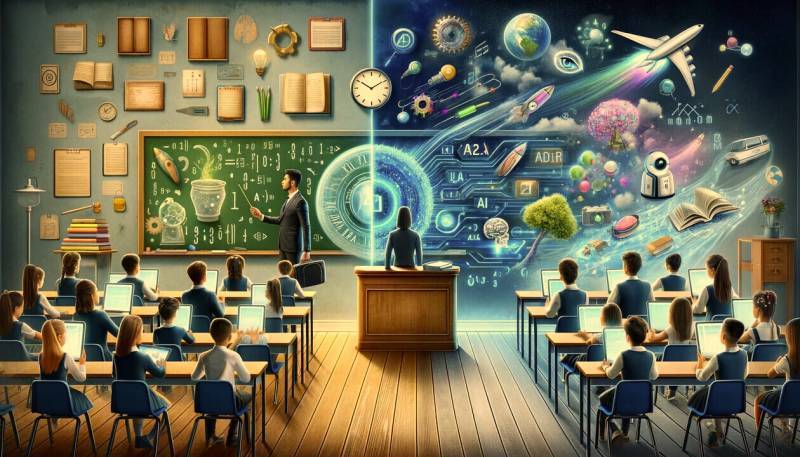
In recent years, technology has been seen as a possible way to bridge some of the education gaps in Pakistan. Digital learning platforms, online classes, and mobile applications can help provide educational resources to areas where trained teachers or proper schools are unavailable. However, the use of technology in education faces its challenges, such as the lack of internet access in remote areas, limited availability of devices, and low digital literacy among students and teachers.
Tackling education inequality is not an easy task, and promoting AI in a country with deep-rooted disparities presents additional difficulties
When it comes to Artificial Intelligence (AI), Pakistan faces even greater challenges in promoting its use in education. AI has the potential to personalise learning, assess student performance in real time, and provide targeted support to those who need it most. It can also assist teachers in managing workloads, identifying learning gaps, and designing customised lesson plans. However, the successful use of AI in education depends on several conditions that are currently lacking in many parts of Pakistan.
Firstly, there is the issue of digital infrastructure. Many schools, especially in rural areas, do not have reliable electricity, let alone internet connectivity. Without a stable digital network, AI tools cannot be deployed effectively. Even in urban areas where internet access is available, the speed and stability may not be sufficient for running AI-powered applications.
Secondly, there is a shortage of trained professionals who can develop, maintain, and operate AI systems. Teachers and school administrators would need training to understand how to use AI tools effectively. At present, many educators are not familiar with basic computer skills, which means introducing AI without proper training could widen rather than close the education gap.
Thirdly, there is the problem of affordability. AI technology requires investment in software, hardware, and maintenance. For schools already struggling to provide basic facilities, these costs can be prohibitive. Without government subsidies or public-private partnerships, it will be difficult to make AI accessible to the majority of schools in the country.
Another challenge is the lack of awareness and trust in AI. Many people are unfamiliar with how AI works, and there can be resistance to using technology in education, especially if it is seen as replacing teachers rather than supporting them. Building awareness about the benefits of AI and demonstrating its positive impact on learning will be important in gaining public acceptance.
Further, there are policies and ethical concerns related to AI in education. Issues such as data privacy, algorithm bias, and misuse of information need to be addressed before AI can be widely adopted. Pakistan currently lacks comprehensive policies or regulations in this area, which could create risks for students and educators.
Despite these challenges, AI could play a role in reducing education disparities in Pakistan if introduced thoughtfully and gradually. Pilot projects could be launched in selected schools to demonstrate how AI can improve learning outcomes, and these projects could then be expanded based on results. Teacher training should be a priority, along with investment in digital infrastructure to ensure that AI tools are accessible to both urban and rural schools.
In the long term, bridging education disparities in Pakistan will require a combination of strategies. Improving physical infrastructure, ensuring equal access for boys and girls, enhancing the quality of teaching, and making education more relevant to modern needs are all essential. Technology, including AI, can support these efforts, but it cannot replace the fundamental need for strong policies, adequate funding, and a commitment to equal opportunities for all students.
Pakistan’s future depends on how effectively it can address these education disparities. A well-educated population is necessary for economic growth, social harmony, and innovation. If large segments of the population continue to be denied quality education, the country risks falling further behind in a world where knowledge and technology are the driving forces. By investing in education and embracing technology in a careful and inclusive way, Pakistan can move towards a future where every child has the opportunity to reach their full potential, regardless of their background or where they live.
Tackling education inequality is not an easy task, and promoting AI in a country with deep-rooted disparities presents additional difficulties. Yet with coordinated efforts from the government, private sector, civil society, and the international community, it is possible to create an education system that is both fair and forward-looking. The goal should not only be to bring every child into a classroom but to ensure that every classroom offers a learning experience that prepares students for the challenges and opportunities of the modern world. This includes preparing them to understand and use AI responsibly, making it a tool for empowerment rather than division. By doing so, Pakistan can take important steps towards building a more equal and prosperous society for generations to come.