

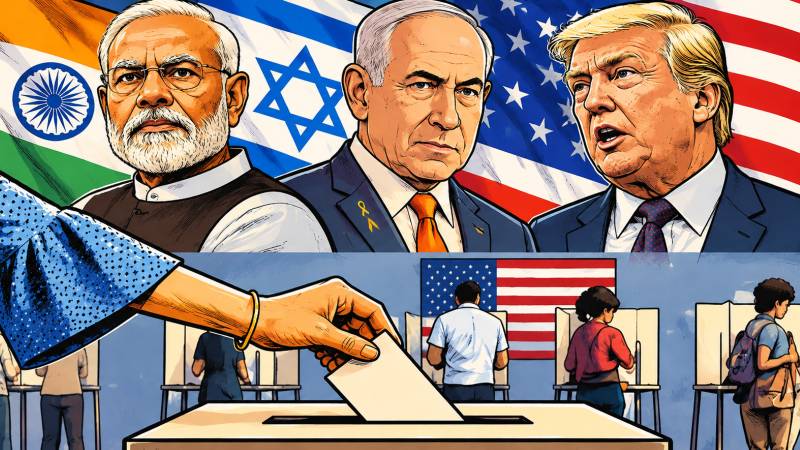
A few weeks ago I argued in these pages that we have become a nation on probation, a country where every thought must clear a loyalty inspection before it is allowed out of the mouth. A couple of readers wrote to ask what the opposite condition looks like. I had planned to answer with theory. Then I spent Wednesday morning between two hearings, scrolling election results on my phone, and the theory wrote itself.
Donald Trump is, by common consent, the most powerful man alive, and nobody would call him gentle with it. He has leaned on institutions, bullied universities, menaced broadcasters, insulted judges by name. And on Tuesday the voters of his country took both houses of Congress away from his party anyway. No soldier moved. No count stopped at midnight and read differently by morning. Abdul El-Sayed, a Muslim son of Egyptian immigrants whom the President abused by name and whose opponents outspent him by tens of millions of dollars, is now a United States Senator from Michigan. The first Muslim ever elected to that chamber, as it happens. Ilhan Omar has had more official hostility directed at her than any legislator I can think of; her neighbours in Minnesota keep sending her back. And it is only a year since New York, of all cities, handed its mayoralty to Zohran Mamdani, a young Muslim of our own subcontinental stock, against the full weight of money and insinuation. The system let its fiercest critics win. That, I have come to think, is the whole test of a country. Not whether power is kind. Whether power can lose.
Look next door, if America feels too far away. I carry no brief for Prime Minister Modi, and his government leans on newsrooms and universities in ways I would not defend for a minute. And yet. In 2024 Indian voters quietly stripped his party of its single-party majority, and he took the number as he found it and formed a coalition like anybody else. His party keeps losing states it fully expected to win. Students march against him in broad daylight, loudly, rudely, through parties and unions of every description, and the people who answer them are politicians. Nobody in Delhi telephones a general to ask who should govern India. No general sits by the phone waiting.
Even Israel, in the middle of a war whose conduct I have not spared in these pages, went to the polls late last month. Netanyahu, the great survivor, fell short of a majority. The Arab parties, the most distrusted minority in that country, nearly doubled their seats and woke up holding the balance of the next government. His party cried fraud, as such parties do. The election authority looked at the claim, threw it out, and the ballots of Arab citizens stood. A state at war counted the votes of the very minority the war is about, and the count was final. I read that twice to make sure I had it right. Now set all of this beside us.
I am not going to relitigate any particular election of ours. I have spent enough of my life in courtrooms to know when a pattern does the work of evidence. Counts that slow down at midnight. Mandates trimmed and transferred like plots in a housing scheme. Winners settled before the polling, losers manufactured after it, by people whose names appear on no ballot. You know this. Everyone knows this; that is rather the point. And when a verdict does not count, something quieter dies than the losing candidate's career. The voter's reason to think dies. Why study a choice that was never yours to make?
This is the same disease I wrote about last time, seen from its other side. Fear kills thought by punishing it. A managed election kills thought by wasting it. Because a vote, when you stop and look at it, is a thought completed: a citizen's reasoning carried to a conclusion and written down. An election honestly held is a whole nation thinking out loud. Steal one and you have not merely wronged a politician. You have told twenty-four crore people that their thinking was decorative all along.
I can hear the objection, and it is a fair one. Democracy is slow, noisy, frequently mediocre. It elected Mr Trump, twice. It has just produced an Israeli parliament that may take months to form a government, or fail to form one at all. Churchill's old crack about the worst system apart from all the others has survived because both halves of it are true. But democracy has the one property nothing else has ever managed. It corrects. It lets a country be wrong in safety and change its mind lawfully. The Americans just did it. The Indians did it in 2024. The strongman cannot, because the one thing a strongman cannot do is lose, and a system that cannot lose cannot learn.
And correction is how minds grow; I really do believe it is that simple. Where losing is safe, questioning is safe. Where questioning is safe, people think, and thinking compounds the way capital compounds. That is the quiet engine under every country now pulling away from us. Not their rivers or their minerals. Their citizens' conclusions are allowed to matter. We console ourselves that we are at least standing still. There is no standing still. Fall out of the compounding and you drop behind every month by the width of everyone else's progress. That is what moving backwards actually means, and we are doing it in every direction at once.
So when I am asked, as lawyers of a certain age are asked, what reform I would put first, before the economy, before the courts, before the tax machinery I have spent half a working life inside, my answer has grown shorter with every passing year. Count the votes. All of them, as cast, loser conceding, winner sworn in, and not one uninvited hand on the scale. Let people speak within the law and question without permission. Everything else is furniture. A nation comes off probation the day its people's verdict is final. The world spent the past two weeks showing us how it is done. We watched, as we always watch, and took notes.