

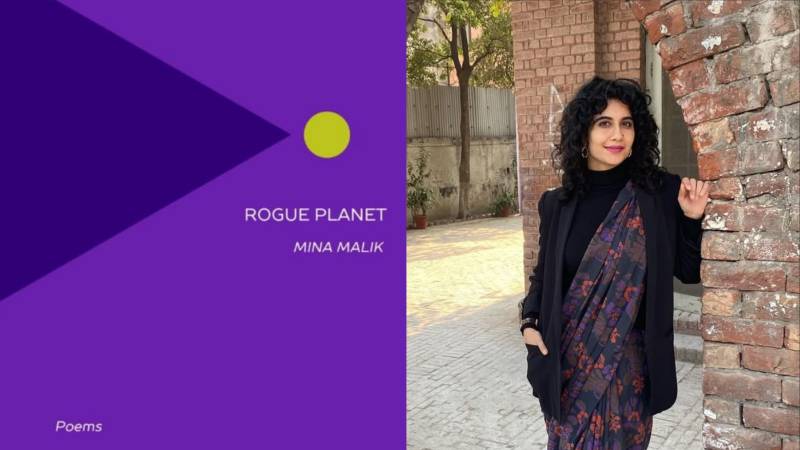
“The End of Love walks in silently,
stands in the corner. There is plenty of time.
The end of love knows it is here for a while.”
Rogue Planet is a small book. Only a few pages. But it leaves a bruise. The kind of bruise you notice later, when you are doing something ordinary: folding a shirt, opening a cupboard, hearing an old song somewhere in the background. It is a book about love, but love after the pretty part has thinned out. Love after the room has changed temperature. Love after desire has become memory, irritation, hunger, betrayal, silence. Love after the glow has gone, and the objects are still there.
That is where Mina Malik is strongest. She keeps going back to things. Laundry. Cupboards. Shirts. Cigarettes. Beds. Doors. The stuff that remains after feeling has shifted. There is no grand stage here. No clean heartbreak. The poems know that grief sits in fabric. It gathers in corners. It makes evidence out of the room. A washing machine, a shirt, a bed, a cupboard — these things become part of the record. Malik seems to know that the most devastating memories are often attached to the most practical things, to the remnants of material memory.
There is sadness in the collection, of course, but it has teeth. It has humour too, the dry kind. The kind that comes after a person has exhausted the softer versions of themselves. The speaker often seems tired of her own tenderness, almost amused by the absurdity of having loved this much, waited this much, felt this much. The poems move between ache and irritation, sensuality and fatigue, intimacy and judgement. The voice feels human because it is allowed to be uneven. Hurt, sharp, observant, sometimes cruel, often tender when it least wants to be.
At times, the book feels crowded. Myth, domestic objects, space, bodies, memory, betrayal, grief — all pressing into a small chapbook. Some images jostle against each other. Some lines feel as though they are trying to hold too much at once. But that may also be the point. Loss is rarely tidy. Desire is rarely well arranged. Memory does not enter politely, one object at a time. It comes in heaps. It spills. It repeats itself. Malik’s best lines cut through that clutter with force because they sound lived rather than arranged.
The title works because it understands the book before the reader does. A rogue planet is a body thrown out of orbit. No fixed sun. No familiar centre. Just movement through the dark, carrying its own gravity. That is the emotional condition of these poems. The speaker feels untethered, as though love was once the thing that organised the sky, and now that sky has gone strange. But there is strength in the drifting too. These poems are lonely, but they are alive. They have heat. They keep moving.
Mina Malik has written a collection about love in its more difficult forms: love as shelter, love as weather, love as memory, love as injury
Malik’s use of myth and literary reference could easily have become decorative, but mostly it does not. Andromeda, Juliet, Circe and Galileo Galilei do not appear as ornaments. They arrive like old witnesses. Or accomplices. Or people the poet wants to argue with. Juliet carries the old danger of romance, the lie that ruin can be beautiful if it is narrated prettily enough.
Circe brings exile, power, punishment, and transformation. Andromeda opens the poems towards distance and cosmic loneliness. Malik takes private hurt and places it inside older stories about women who have been watched, desired, abandoned, punished, worshipped, and misunderstood. It gives the book scale without taking it away from the room.
The strongest poems are the ones where private feeling begins to touch something larger. After Juliet looks beyond the glamour of doomed love and asks what is actually left afterwards. The theatre ends. The body remains. The laundry remains. The consequences remain. There is a tired wisdom there, the wisdom of someone who has outgrown the performance and is left with the domestic wreckage.
Sabr, shukar cuts even deeper. These are words many of us know too well. Patience. Gratitude. Endure. Be thankful. Make peace. Swallow it. Survive beautifully. Malik understands how words meant to comfort can also be disciplinary. They can ask a person to turn pain into grace before the wound has even had time to speak. That is where the collection moves beyond a private account of heartbreak. It begins to speak about how women are trained to absorb, soften, forgive, and continue. Anger comes later, if it is allowed to come at all.
The poems resist that neatness. They do not give us a clean survivor. The speaker remains complicated: loving and resentful, desiring and accusing, able to remember warmth while also recognising damage. This matters. There is no tidy resilience here. No moral lesson wrapped around pain. Malik lets the wound stay awkward. She lets it speak in fragments. She lets it contradict itself.
There is also the body. The body as memory. Appetite. Evidence. A place where love has left its marks. Malik understands intimacy as physical, spatial, and atmospheric. The weight of someone in a room. Smell. Touch. Heat. Distance. And then betrayal enters. Infidelity. She knows. The body one trusted has become familiar somewhere else. There is a particular humiliation in that. That love can leave through the body before it leaves through words. This is one of the more painful currents in the book because it is so bodily. So embarrassing. So human.
The brevity of Rogue Planet helps it. The book does not explain itself to death. It gives fragments. Flashes. Rooms half-lit. Feelings caught mid-breath. Some poems feel like confessions. Others like notes written after an argument. Others like the thoughts that come when sleep refuses to arrive, and the mind starts touching old bruises. At times, the collection reads less like a finished monument and more like a wound speaking before it has decided what shape to take. That rawness is part of its force.
Rogue Planet is small, intense and emotionally generous. It carries hurt with dignity and thinks deeply without losing warmth. There is intimacy here, but it never begs. Mina Malik has written a collection about love in its more difficult forms: love as shelter, love as weather, love as memory, love as injury. Sometimes all of them at once. One reads it quickly, then finds it returning later in small ways, like a lover’s perfume still caught in your clothes, or a song you once associated with someone suddenly playing in a café, dragging you back to a version of yourself you thought you had outgrown.
Perhaps this is where the book finally leaves us. No consolation. No neat clearing of the sky. Just the voice, still there, still speaking.
“My heart is a wasteland where nothing grows;
We don’t believe in miracles here.”