

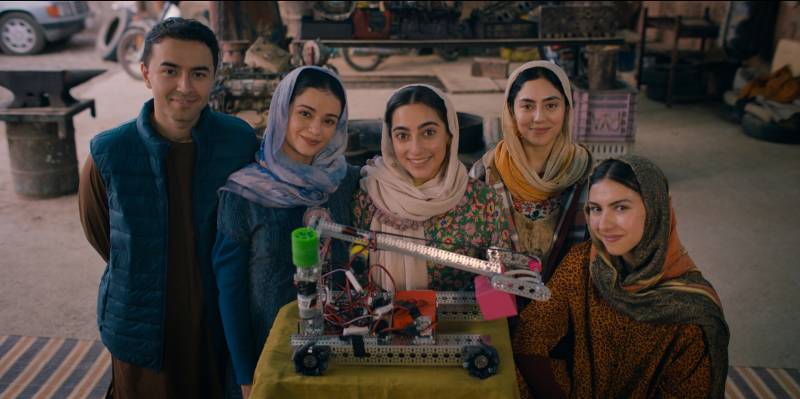
International Women’s Day is celebrated on March 8th. It is perhaps with this day in mind that the movie Rule Breakers hit theaters across the U.S. on March 7, 2025, to coincide with the celebration of the female spirit. This timing connection is not confirmed and may be a coincidence, but the storyline of this movie happens to be a clear reflection of girl power. What is remarkable about all this is that the film is about the emergence of a group of young ladies engaged in robotics from Afghanistan, and it is based on a true story.

A two-hour journey, this film from Angel Studios starts off in the year 2017 in Herat Province, Afghanistan, at a school. Roya Mahboob (Nikohl Boosheri), aided by her sister Elaha and a laptop, shares her first encounter with a computer with the students, which later leads to the opening of the whole world to her. The classroom full of girls is impressed and appears eager to learn what men have prevented them from learning. “This is the language of the 21st century. Knowledge is power,” says Roya. Afghanistan has changed. But sadly, it is no longer the country of their parents or grandparents. “This is our Afghanistan too,” she adds.
With their brother Ali (Noorin Gulamgaus), the two sisters of the Mahboob family drive out on a dirt road playing some Dari-language rap, which is not Elaha’s favorite. She hands Ali a CD and pleads with him to put it on instead, to which he agrees—until their vehicle is pursued by another occupied by masked Taliban. A window rolls down, and an automatic weapon is aimed at the trio. Roya yells. To keep the suspense going, we are suddenly switched to a time 18 years earlier, in 1999, when little Roya is dropped off at her coeducational school by her supportive father. “If boys can use the computers, so can the girls,” says her father. But the reality inside the school is different, as only the boys have access to the desktops, and the girls are asked to leave the room. But Roya is not one to give up.
There is also the underlying theme of some male family members having a soft corner and taking pride in the accomplishments of their girls but still somehow unable to express their true emotions in public since they cannot openly go against established customs
Thirteen years later, Roya makes a deal with a local shopkeeper who has computers in his shop but doesn’t himself know how to use them. She asks him if she can come an hour before he opens every morning to set up the computers and entices him with promises that it will enhance business. She makes the pitch that having working computers will generate much more income for his shop. The shopkeeper reluctantly agrees. Roya adds that she will teach him how to use computers too. The two Mahboob sisters, self-learners, become computer savvy in the process! Two years later, they can be considered experts relative to their environment.
But Roya has bigger plans. She wants a girls' computer class to be added to the local higher education college curriculum. She gets her way despite the odds against her. In the process, on campus, she is introduced to an Indian American tech executive, Samir Sinha (Ali Fazal), who is very impressed. Others may have had Roya becoming a professor in mind, but Samir gives her another idea. “If you really want to help your country, you have to be entrepreneurial,” he says. So, Roya listens and opens her very own Afghan software company, spreading computer literacy in the country, especially for girls. But she is still not satisfied. She wants even greater visibility. The idea of girls building robots and entering international team competitions comes to her mind. No one from Afghanistan has done something like this before. But the environment is not conducive, and she must overcome significant odds. Even Ali is skeptical in the beginning.
We now return to the scene where the Taliban attack them. Their car is shot up, but by some miracle, the gunman’s weapon jams. He cannot finish the job, and the trio survive the attack. From that point onwards, the movie turns to robotics and the building of an Afghan girls’ team. As they spread the word, looking for potential recruits, they are in for a surprise. A computer literacy test is prepared and given out. Their first recruit is Taara (Nina Hosseinzadeh), followed by Haadiya (Sara Malal Rowe), Arezo (Mariam Saraj), and Esin (Amber Afzali). The team is formed, but everyone remains skeptical. “Do you think that girls from Herat are going to win an international competition? That is insanity,” says one Afghan uncle.
This is where the rubber meets the road. While joining the team, each chosen finalist has her own social challenges to face. But they exhibit talent that just cannot be suppressed. Then there are some logistical problems too, with robot kits stuck at customs, getting a visa for the team from the U.S. Embassy in Kabul, and even while trying to board a flight. Even the American media steps in to help this Afghan Dreamers team. With a little help from some sympathetic Afghans, they make it out of the country and travel to Washington, D.C., for their first robotics competition. They do not win but place in the top three and are subsequently honored at the Afghan Embassy.
The rest of the film is enjoyable viewing. The trials and tribulations of this group of girls from conservative Afghanistan interacting with Western society are both moving and, at times, humorous. There is also the underlying theme of some male family members having a soft corner and taking pride in the accomplishments of their girls but still somehow unable to express their true emotions in public since they cannot openly go against established customs. The dark side of tradition and tribal law is somewhat soft-pedaled in this film, possibly to make it more palatable to Western viewers. Afghanistan remains a very tough country but is one with some very beautiful people.
Rule Breakers is certainly a feel-good movie. If there were an Oscar for cuteness, it could be a contender. Viewers may also want to see this film because the real Roya Mahboob’s story is also the story of Afghanistan that once was and may return in the future.