

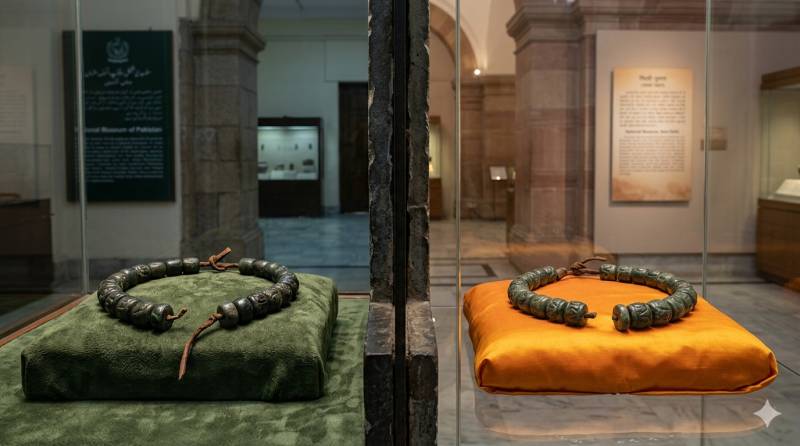
In the blood-stained summer of 1947, as the subcontinent was hacked into two, a storied jade necklace from Mohenjo-Daro was split down the middle. One-half migrated to the nascent Dominion of Pakistan; the other remained within the borders of a newly independent India. Today, those two halves sit in separate vaults as silent, shimmering casualties that left a masterpiece incomplete.
This severed heirloom is more than a tragedy; it is a visceral metaphor for the fragmentation of heritage. While the necklace was divided by the internal trauma of Partition, countless other treasures of our soil were not merely split; they were removed. From the Benin Bronzes of Nigeria to the Rosetta Stone of Egypt, and the Koh-i-Noor that once graced the Mughal throne, the museums of the Global North remain the world’s largest repositories of “legalised” plunder.
The discourse surrounding the repatriation of cultural artefacts has, for decades, been dismissed by Western curators as an exercise in “identity politics” or “sentimental nationalism.” Yet, as the sun sets on the era of unchallenged Eurocentrism, the demand for the return of stolen heritage has evolved into a sophisticated legal and ethical imperative. It is no longer enough to view repatriation as a mere logistical transfer of goods; it is a fundamental requirement of restorative justice, a process that demands an admission of colonial guilt and a dismantling of the “universal museum” myth.
The Legal Architecture of Restitution
The moral argument for repatriation is often framed through the lens of common-sense property law: if an object is stolen, it must be returned. However, the international community has fortified this sentiment with robust legal frameworks. The 1970 UNESCO Convention on the Means of Prohibiting and Preventing the Illicit Import, Export, and Transfer of Ownership of Cultural Property, followed by the 1995 UNIDROIT Convention, established a global standard for the protection of cultural heritage. These instruments acknowledge that the displacement of cultural property is not just a loss of “art,” but a violation of a nation’s sovereign right to its history.
Restorative justice, the bedrock of this movement, requires more than a simple handover. It requires not just dialogue, but a broad range of methods, including provenance research and transparency, agreements, capacity building, shared stewardship options, loan programmes, and digitisation. Repatriation is the process of restoring valuable items to the nations or indigenous communities where they originated. This necessitates a collaborative admission of wrongdoing, a hurdle that many former colonial powers loathe to jump. To admit that a museum’s centrepiece was obtained through extractive colonialism is to admit that the institution itself is a monument to a crime.
The concentration of global heritage in the Global North is not a result of “universal” interest; it is the result of centuries of cultural theft, plundering, and coerced acquisition
Heritage as Spirit
Why does a statue or a shard of pottery matter so much to a modern state?
The answer lies in the intrinsic link between heritage and identity. Artefacts are not merely aesthetic objects; they are material reminders of a collective consciousness. When French researchers Sarr and Savoy authored their landmark report on African artefacts, they described the absence of these objects as a deprivation of “spiritual nourishment.” Without their ancestral treasures, formerly colonised peoples find themselves “struggling to recover the thread of an interrupted memory.”
Holding these objects in London, Paris, or Berlin perpetuates a form of “vestigial colonialism.” It suggests that source communities are either too unstable, too poor, or too backward to care for their own history. This paternalistic narrative is a relic of white supremacist ideology that seeks to maintain a monopoly on the interpretation of human civilisation. By refusing to return these objects, museums impose their own curated, often sterilised, interpretations of “The Orient” or “The Dark Continent” onto the public, effectively silencing the voices of the people who created them.
The era of cultural dispossession is far from a closed chapter of history. Following the U.S. invasion of Iraq, the National Museum in Baghdad, the guardian of the “cradle of civilisation”, was systematically dismantled. Despite frantic pre-war warnings from archaeologists, coalition forces failed to secure the site, allowing a vacuum that birthed a national disaster beyond imagination.
Approximately 15,000 artefacts vanished in a matter of days, including 5,000 priceless cylinder seals. This was not merely the chaotic looting of a desperate populace; the scale and precision suggested organised networks. Most disturbingly, the “War on Terror” era saw reports of Western soldiers and contractors participating in the illicit traffic of antiquities, treating Iraqi history as a battlefield souvenir. While recent years have seen the celebratory return of items like the 3,500-year-old “Dream Tablet” of the Epic of Gilgamesh, these successes represent less than half of what was stolen. This modern catastrophe exposes the lie that the West is the only “safe” custodian of heritage; in reality, Western intervention and the subsequent demand in the global black market are often the primary drivers of cultural destruction.
The Myth of the Universal Museum
The most frequent defence against repatriation is the concept of the “Universal Museum.” Proponents argue that institutions like the British Museum serve all of humanity by housing artefacts in a single, accessible location. However, this “accessibility” is a fallacy. For a student in Karachi, a craftsman in Lagos, or a historian in Athens, the cost of a visa and a flight to London makes their own heritage effectively unreachable.
The concentration of global heritage in the Global North is not a result of “universal” interest; it is the result of centuries of cultural theft, plundering, and coerced acquisition. The British Museum’s staggering collection, including 700 Benin Bronzes and the Elgin Marbles, is a ledger of imperial expansion.
The “politicisation of culture” is a bogeyman frequently raised by those who fear the emptying of Western galleries
This ledger is illustrated through the story of the Caryatids, the sculpted maidens who for two millennia held the roof of the Erechtheion temple on their heads. Today, five of these sisters stand in the Acropolis Museum in Athens, their faces turned towards an empty, hollow plinth. That space is reserved for the “Lost Sister”, the sixth Caryatid, who was sawed off her base by Lord Elgin’s workmen in 1801 and now stands in solitary confinement in the British Museum.
The Greek government’s call for her return is less a request and more an appeal to end a two-hundred-year-old kidnapping. The British Museum’s steadfast refusal is often shielded by the 1963 British Museum Act, which legally prohibits the “deaccessioning” of its collection, and this stance has become a primary flashpoint of friction. By keeping the maiden, the museum is not just protecting an artefact; it is preserving the very act of vandalous extraction that defined the nineteenth-century imperial project.
The argument that culture is geographically unbound is often used to decouple artefacts from their modern descendants. Critics suggest that because borders have shifted, no modern state can claim provenance. While the history of movement is complex, it does not negate the primary right of the source community. Complex provenance should be a reason for deeper research and shared stewardship, not a pretext for permanent retention by the last colonial power to hold the loot.
Yet any intellectually honest debate on repatriation must grapple with the visceral counter-argument of “security in active conflict.” Critics of restitution often point to the harrowing fate of Palmyra as a cautionary tale for what happens when history remains in the crosshairs of modern instability. In 2015, the world watched in horror as ISIS forces overran the ancient Syrian site, systematically demolishing the Temple of Bel and the Arch of Triumph. The tragedy was punctuated by the death of Khaled al-Asaad, the 83-year-old retired head of antiquities who was publicly beheaded by militants after he refused to reveal the location of hidden artefacts he had helped spirit away for safekeeping.
This grim episode, much like the Buddhas of Bamiyan before it, is often weaponised by Western institutions to argue that “safe” storage in London or Berlin is a moral necessity. They argue that until a source nation can guarantee a shield against ideological threats or the chaos of failed states, repatriation is effectively a death sentence for the object.
However, the case of Palmyra also offers a counter-narrative of local devotion that Western logic often overlooks. Using the tragedy of a conflict zone as a blanket justification for permanent retention ignores the role that foreign interventions, like the very one that destabilised Iraq and led to the Baghdad looting, often play in creating that instability in the first place. The answer to “active conflict” should be international protection and temporary sanctuary, not a permanent transfer of ownership that profits from a nation’s most vulnerable moments.
Breaking the Colonial Narrative
The “politicisation of culture” is a bogeyman frequently raised by those who fear the emptying of Western galleries. They argue that artefacts become pawns in modern power plays. Yet what could be more political than the original act of seizing an object during a punitive expedition or a colonial war?
The very act of displaying a stolen artefact in a Western museum is a political statement of dominance. Repatriation offers a path towards deconstructing these colonial narratives. It allows nations that have been historically sidelined to establish their own museums, tell their own stories, and exercise their own sovereignty. It is a way of acknowledging that the era of the explorer-thief is over. Even in cases where objects were “legally” obtained under the laws of the time, the ethical standards of the twenty-first century have evolved. We no longer accept that the victor is entitled to the soul of the vanquished.
The arguments against repatriation, while academically intricate, pale in comparison to the moral and legal weight of the pro-restitution movement. As Dr Shashi Tharoor and other post-colonial thinkers have argued, colonial powers cannot be held accountable for the crimes of their ancestors today, but they must not continue to profit from the spoils of those crimes.
The path forward requires us to view museums not as static warehouses of “things,” but as dynamic spaces of reconciliation. Only when the cleaved pendants of the world are allowed to return to their origins can we begin to speak of a truly post-colonial world. The artefacts of our ancestors are the anchors of our future; it is time they came home.