

This author had been to Quetta a few times during his service days in the dying years of the previous century, but only for three to four days at a time; not enough to understand the mood of the city. Travel by air, a stay within the airbase and a dinner at Serena is the epitome of exclusivity, that doesn’t allow one to take in the vibes and aura of this ancient town. Now that he decided to go there for a three months long visit, his old colleagues, who had lived in the city for longer periods, gave a few suggestions for sightseeing and shopping. A Hazara-origin friend in Australia asked him to pay salutations to the Quetta Queen.
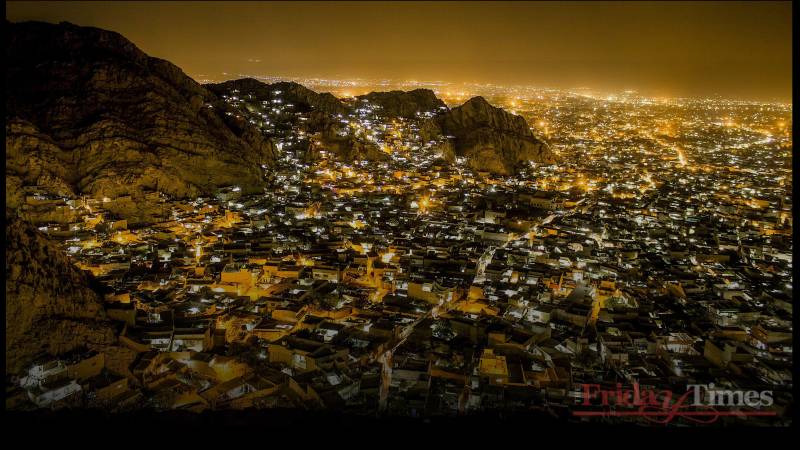
The first few days of late April being dusty, the Queen couldn't be sighted, but as the horizon to the northeast cleared up, she became visible lying on her back on an isolated hilltop. Her graceful facial features and her long amber tresses were clearly discernible on the hill top. The famed Queen, depicted on Google Maps as well, is a ridge in Koh-e-Murdar, whose top has been chiselled by natural elements into a human female face. I, therefore, inform my friends, in particular the three helicopter flying colleagues who had flown over the royal ridge a number of times, that the Queen has been saluted and curtsied. I also captured her through my low-resolution cell-phone camera and applied a bit of make up in evening colours. The image is placed in these columns.
Quetta is a historic town and the only major city of the country at a height of 5,500 feet. It derives its name from the Persian word ‘Kota,’ meaning fort. Its original name was Shalkot but got anglicized to Quetta. This author was reminded of the old name as he saw a hotel named ‘Shalkot’ near the intersection of Sabzal and Spinny roads. It is one of the three regional roundabouts in Pakistan, the other being Peshawar and Gilgit. According to historian Arnold Toynbee, roundabouts are “regions on which routes converge from all quarters of the compass and from which routes radiate out to all quarters of the compass again.” Quetta has been the gateway from Kandahar, Kabul, Herat and beyond to Central Asia and Iran, to Arabian Sea coastline, to Sindh via Shikarpur-Sukker, to Punjab via Dera Ghazi Khan-Multan, to Khyber-Pakhtunkhwa (KP) via Zhob-Dera Ismail Khan and to Ghazni via Zhob-Angor Adda.
To the north of the city, the Pashtun belt of Balochistan, extending to Sibi, Killa Saifullah, Pishin, Zhob and Chaman, is roughly divided from the southern Baloch-Brahui half by hills and mountains. Quetta is part of the Pashtun belt and connected to Sibi via Bolan Pass and to Chaman vis Kojak Pass. The Iran highway (now RCD highway), connecting Quetta with Karachi in the south, Taftan-Zahedan in the east and the coastal areas to the south through the Lakpass Tunnel, was constructed in 1905 by the British as an accompaniment to the strategic railway line connecting rest of India with Iran.
The Quetta-Shikarpur trade-cum-invasion route connects the South Asian Subcontinent with Afghanistan as well as Iran via the Bolan Pass, and has been of immense importance. The oldest known human settlements here are located in Mehergarh near Dhadhar in Kacchi district. Dhadhar is 25 kilometers west of Sibi and is the southern end of the treacherous Bolan Pass. The northern end of the narrow Pass is Kolpur, a few kilometres southeast of Quetta where the road branches off north to Quetta and west to Mastung. There are many important events linked to the Bolan Pass and Quetta, even if traced no earlier than the Mughal period.
In 1540, Sher Shah Suri finally defeated Emperor Humayun at Kannauj to wrest control of north Indian empire. Humayun fled to Lahore where his brother Kamran, the governor of Lahore and Kabul, rebuffed him. The dethroned Emperor escaped south to Multan and was given refuge by the Rajput prince of Amerkot, Rana Paratp Singh. It was here that the future emperor Akbar was born. Humayun then decided to proceed to Iran via Sehwan, Shikarpur, Sibi and Bolan Pass. He stopped briefly at Mastung before restings in Quetta.
This route from Sehwan to Quetta is through a very dry land with no vegetation in sight. The weather is extremely hot in summers and extremely cold in winter. In this year, the feel-like maximum temperature in Jacobabad touched 60˚ C, and Dadu, Sibi and Dhadhar 59˚ C, whereas in winters, the night time temperature falls below zero.
In his era, Humayun undertook his journey here in winter months and had to share his tunic with his servants to protect them against freezing cold. He reached Quetta and left his one-year-old son here before proceeding to Kandahar and on to Iran to take refuge with the Safavid Shah Tahmasp.
The fugitive Humayun and his son would certainly have lived in the Quetta Fort as it is the oldest structure in the city, though rebuilt by the British after the 1935 earthquake. The first Britishers to arrive in the town in 1828 described it as nothing more than a mud fort surrounded by three hundred mud houses. Akbar remained in Quetta for two years before Humayun came back with Persian soldiers to collect him on his way to retake Kabul from his estranged brother.
The next famous episode in the history of the town is the intended visit of another fugitive Mughal prince on his way from India to Kabul but whose incomplete journey ended in tragedy in the Bolan Pass before he reached Quetta.
Dara Shikoh, the heir-apparent to his father Shahjahan lost his bid to take the throne to his younger brother Aurangzeb in 1658 in the battle of Samugarh near Agra. He fled to Delhi, then to Lahore and finally through Sindh to Gujarat whose ruler was his ally. However, the unfortunate prince again lost to his brother’s forces in battle of Deorai (near Ajmer) in March 1659. Dara fled with his family and a few supporters and attempted to follow the route through Bolan Pass that was taken more than a century earlier by his great great-grandfather Emperor Humayun.
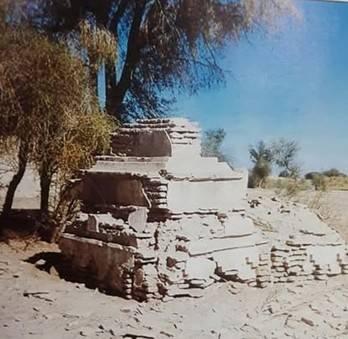
He took refuge with Malik Jeevan Khan, the chief of Dadhar, the gateway to Bolan Pass. The weather had turned hot and dry. Dara’s wife, the unfortunate princess Nadira Begum, could not tolerate the rigours of travel and died in a makeshift tent. One account, by a French doctor named Bernier who accompanied the prince through his misfortunes, says that she died of dysentery. Another account, by the Italian adventurer, Manucci, who remained loyal to the princess till the end, wrote that she took poison. Her body was brought back to Lahore where she is buried in the centre of a char-bagh next to the mausoleum of Mian Mir.
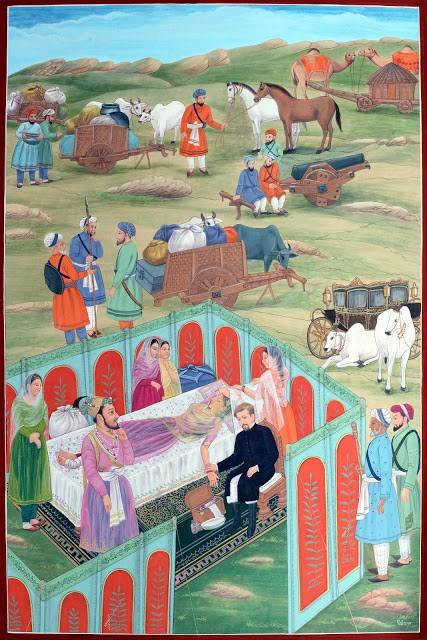
The Afghan chief had initially received the prince with respect, but later was overcome with greed and decided to arrest him in return for a reward from Aurangzeb. Somewhere near Dadhar, at the entrance of the Bolan Pass, Jeevan Khan betrayed his guest. As narrated in the authoritative History of Aurangzeb, vol ii by Jadunath Sarkar, he was mistreated by Jeevan and handed over to the troops of Aurangzeb, who first paraded him through the streets of Delhi and then executed him.
While declining to offer any help, Mehrab Khan, head of a Brahui confederacy, famously asked Alexander Burns: “You have brought an army into the country but how do you propose to take it out again?”
The third important episode about Quetta, and most elaborately documented, occurred at the start of the first Anglo-Afghan war in 1839 when the ill-fated forces of the British and Shah Shuja marched from Shikarpur to Quetta through a bone-dry and treeless country. Dalrymple writes in Return of a King of the difficulties faced by the invading army, which consisted of a thousand Europeans, 14,000 East India Company sepoys and 6,000 irregulars hired by Shuja and accompanied by no fewer than 38,000 Indian camp followers and 30,000 baggage camels.
A vivid description of the Pass has been given by Major Rawlinson of the British Army, who led his men and baggage camels through the pass in eleven days between 16 and 27 November 1841, during the second Anglo-Afghan war. In 1839, however, the force reached Shikarpur in March, when the hot season had already started and the journey could only be undertaken at nights. From Shikarpur, the march of 240 km was through salty marshes. The marauding Baluchis and Sindhis, who, in the absence of any pacts for the peaceful passage of troops, considered the invaders a fair game, attacking and robbing them. Many soldiers and followers and baggage camels were killed and looted even before the army reached Dadhar, the gateway to the Bolan Pass. All along, there was no tree, no shade and, ominously, no water. Very few of the wells dug on the route yielded water, and it was too brackish to be of any use – as continues to be the case to date. Hot and fierce winds carried scorching particles of dust, creating intolerable thirst, causing many deaths.
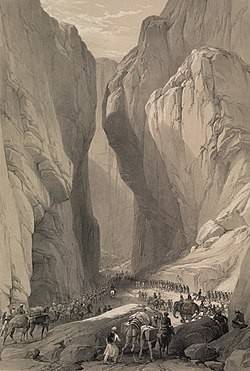
Before the force entered the Bolan Pass, the British sent their cunning and deceptive political officer Sir Alexander Burns to Mehrab Khan, the Khan of Kalat, to ask for supplies, especially 10,000 sheep. While declining to offer any help, Mehrab Khan, head of a Brahui confederacy, famously asked Burns:
“You have brought an army into the country but how do you propose to take it out again?”
This ominous question was raised again of USSR and NATO during their respective occupation of Afghanistan. The question “How to take the Army out?” continues to vex Pakistan since the departure of the NATO troops, as the insurgency in Baluchistan and erstwhile FATA continues to take its human toll.
In 1839, however, the British thought that the khan was disloyal and hostile to them. They would raid Kalat a few months later in the same year and kill Mehrab Khan. The Khans that followed were installed with British approval and remained their loyal allies.
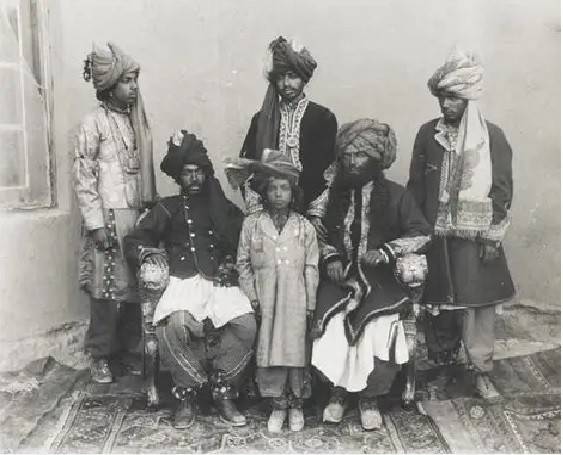
The British journey through the steeply rising 113-km-long Bolan Pass that, for most of time, was extremely narrow with overlapping escarpments from both sides, was extremely strenuous and forbidding. The Baloch frequently indulged in murdering stragglers, looting grain and killing animals. At one stage, guns had to be dismantled for ease of carriage. At places, no one could take more than three steps in the camp without seeing a dead human or animal (as per Dalrymple). It was a difficult passage.
Finally, the British forces and Shah Shuja’s armies passed through Quetta, “a miserable village of 500 houses,” where they found water, supplies and respite from weather and marauders. Ahead of Qila Abdullah, they would have to take the path through the arid and waterless Kojak Pass, before reaching the mild weather, rolling pasturelands and fresh water of Chaman, with Kandahar a few easy marches away.
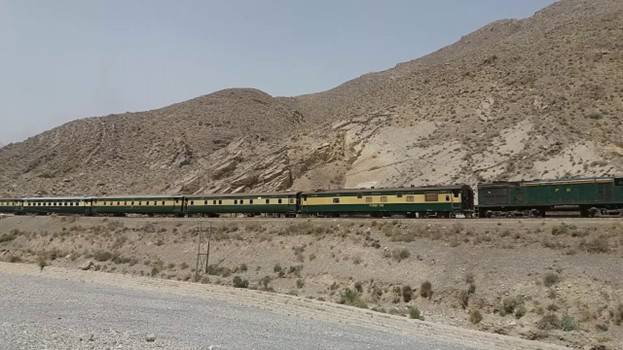
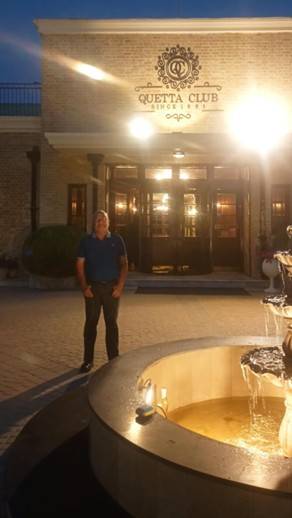
The British formally annexed Balochistan in 1876 and established Quetta as their headquarter. They have left a deep and rich legacy in the shape of the wide-boulevard cantonment, fabulous Quetta Club (1891) and the pleasant Hanna Lake. Their technical expertise and political tenaciousness is visible in the extremely difficult-to-build Sibi-Quetta railway line with all its tunnels, hairbreadth tracks and impossible curves. The British went on to take the railway line to Iran via Luckpass tunnel, and to Chaman through the Kojak Pass; a strategic infrastructural move to counter the Russians. These railway lines are engineering marvels by any standard.
The British also established the city’s identity as a military town by creating Army’s Command and Staff College in 1907. Other professional military schools were also established, ensuring that each army officer of our nation, including two younger brothers of this author, has at least one – but possibly more – stays in this town. From one or two educational institutions before independence, the city has a number of universities, engineering and medical colleges, geological museum, archaeology museum, arts council, hospitals and other professional institutions whose alumni have served in top tier of civil and military positions, including a Prime Minister, two Army Chiefs and two Chief Justices. The president, though a Sindhi, is also a descendant of a Baloch tribe. Hopefully, the city would also find the peace, stability and infrastructure that it deserves and badly needs.
Author’s note: The previous article was a study of deep neglect in the city. The next piece will be a reflection on the city as found by this author.