

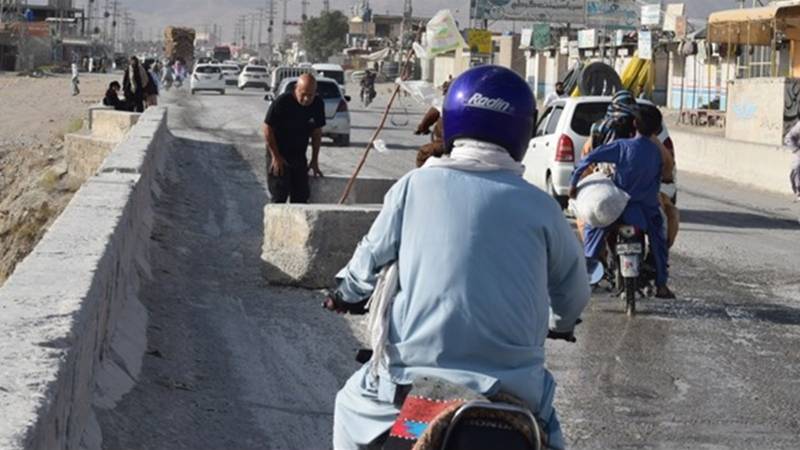
Khaizi Chowk in Quetta is the intersection of Quetta-Chaman highway (N-25) and Samungli Road. All buses, trucks and trailers to and from north of Quetta and beyond pass through this narrow crossing. The entire two-way traffic from Quetta to Kandahar, DI Khan and DG Khan passes through the Khaizi Chowk. The N-25 is also one of the two roads, the other being from the cantonment, that leads to the airport from the city. As the north-bound traffic on N-25 lumbers through this crossing, it passes through a bridge over the combined bed of the Houri and Lohra Nullahs, with the airport boundary to the left at a short distance and the heavily populated middle-class township of Khaizi Killi in between.
The bridge is narrower than the road and two large trucks can barely cross each other without causing an accident. In addition, a portion of the bridge is broken – with a pothole through which mangled steel bars and the bed of the nullah is visible. A few weeks ago, some locals rolled two large RCC blocks from the edge of the road and placed them around this hole to avoid vehicles getting stuck. The blocks are still there because the relevant department has taken no notice of the damaged bridge. With this obstacle, only one truck can pass over the bridge at one time at that point, causing hours-long traffic jams in the evening.
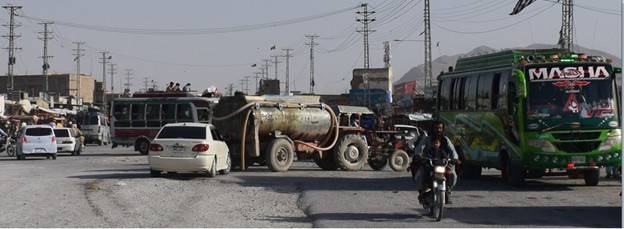
The entire section of this road is broken and gives the feel of a dirt track, where drivers swerve from left to right and back to avoid bumps on the fractured road, often coming head-on to each other. This author has driven between Karachi and Islamabad on the national highway in the 1980s, as well as on the motorway recently – Lahore and Islamabad via GT Road and M-2, Sahiwal and Islamabad via Samundri and Faisalabad, Islamabad and Peshawar via M-1 and GT Road, Karachi and Hyderabad, Islamabad and Gilgit via Babusar Top and on many other routes within the country – but cannot recall any major road that is in as bad a shape as this.
That speaks volumes, and raises questions, about the billions and billions spent on road infrastructure in this unfortunate province.
If an official or a member of the public in the rest of the country criticizes Baloch voices that voice rightful grievances, let them once pass through the Khaizi Chowk and the Houri nullah bridge to realize the extent of neglect
As one of the national highways, maintenance and widening of N-25 should be under National Highway Authority (NHA). While crossing this chowk and the stretch of road to the airport, it is hard to imagine that no responsible official of this esteemed organization has ever passed through this area and felt the daily torment that the public has to go through.
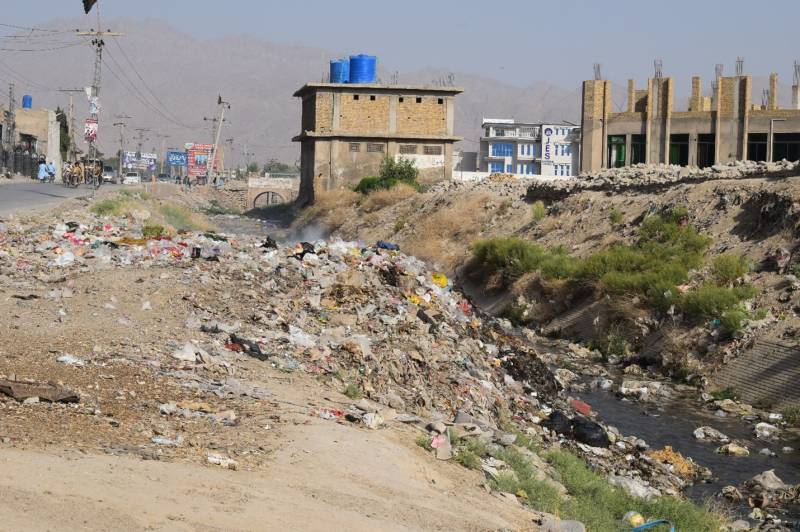
A complete lack of interest from the provincial government in the welfare of its people is evident from the condition of civic development and maintenance in the city of Quetta. Solid waste removal is infrequent and inefficient. Plastic bags litter the city and are dumped in the seasonal nullahs that now carry the city sewerage. Roads and sidewalks are dirty. There is hardly any effort for cleanliness of the city streets. Traffic jams on the city roads are common, with little effort by traffic police to unlock the gridlock. A Google search on “traffic jams in Quetta” lists scores of newspaper reports and images covering this aspect. This is the only provincial capital without a decent public transport system.
Nevertheless, the worst case is of the Khaizi Chowk because the road and traffic conditions here are a national shame. To give an idea of the load of traffic at this juncture, consider that the Gwadar-Ratodero highway/motorway, passing through Turbat and Panjgur, branches off at Surab, a little north of Khuzdar, to merge with the Karachi-Khuzdar-Quetta-Chaman road (N-25). N-25 continues north to merge with the Zahedan-Quetta highway at Mastung, south of Luckpass tunnel. Then, the road from Sukkur-Jacobabad-Sibi, via Bolan Pass to Quetta turns left at the southern entrance to the city at 13-Meel to merge with N-25 before it leads to Khaizi.
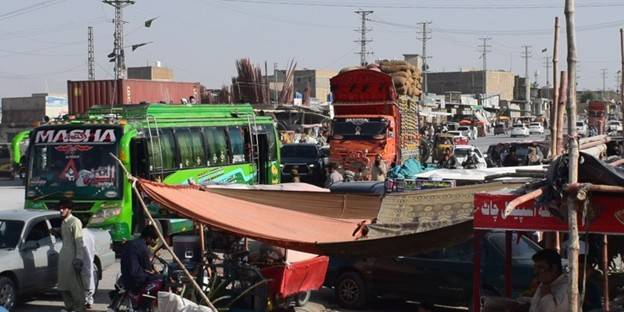
To sum up, the entire traffic from southern Balochistan, southern Sindh and Iran, proceeding to northern Balochistan, upper Sindh, Punjab, Khyber-Pakhtunkhwa (KP) and Afghanistan, and vice versa, passes through this pathetically narrow and broken patch of land. It defies logic that no responsible person notices the irony of the situation and hardship of the people who have to cross this damaged bridge, broken road and congested crossing on daily basis. Any traveller landing at Quetta airport, coming from the soccer-field wide roads of Islamabad, Karachi or Lahore and proceeding to the city over the bridge and through the Khaizi crossing, cannot help but feel anger and frustration; the two harbingers of alienation.
As can be judged, the Khaizi crossing and the nullah bridge is heavily busy. To circumvent the traffic jam, some vehicles take a wide hour-long loop round the airport to get to the other side. To give a perspective, this crossing is like the intersections of Rashid Minhas Road with Shahrah-e-Faisal in Karachi, GT Road with Ring Road in Peshawar, IJ Principal Road with Agha Shahi cum Stadium road in Rawalpindi and GT Road with Kashmir Highway in Islamabad. It is unthinkable to have traffic and road conditions like those of Khaizi Chowk anywhere in Lahore, Karachi, Peshawar or Islamabad. Such conditions cannot even be imagined to exist in Faisalabad, Multan or anywhere on the GT Road.
Every time one passes through this area, one wonders if any member of the provincial government or of the city administration has been through this part of the city. Those who are responsible for the maintenance and widening of this section of road, be they from the NHA or the provincial Road Authority, have to be completely irresponsible, callous and stone-hearted not to take cognizance of sufferings of the common public, including young children.
This is the heart of the city of Quetta and not some far-flung, sparsely-populated and isolated place in the province. To be honest, it is simply insulting not to have undertaken the repair and development work here.
This author recalls that in his childhood, his class fellows from East Pakistan used to look at the infrastructure in West Pakistan and lament the lack of it in their province. Similarly, if an official or a member of the public in the rest of the country criticizes Baloch voices that voice rightful grievances, let them once pass through the Khaizi Chowk and the Houri nullah bridge to realize the extent of neglect experienced by the people here. There has not been any period of two years when some underpass or overhead traffic bridge has not been constructed in any of the major cities of Pakistan. Unfortunately, it is not so in Quetta.
There is an immediate need to construct an overhead bridge at this place on the N-25 going over this chowk and the adjacent nullah bridge. The nullah bridge itself needs to be widened to at least two – if not three – lanes on each side, with the adjoining roads re-carpeted.
Let the civic issues of Balochistan be resolved, starting with the re-modelling of Khaizi Chowk in this capital and historic town. These would be the first steps in creating feelings of integration among the people of this troubled province.
The next article will be some reflections on a visit to Quetta.
Note: The pictures below were taken by the author during the Eid break when the heavy vehicular movement is lean