

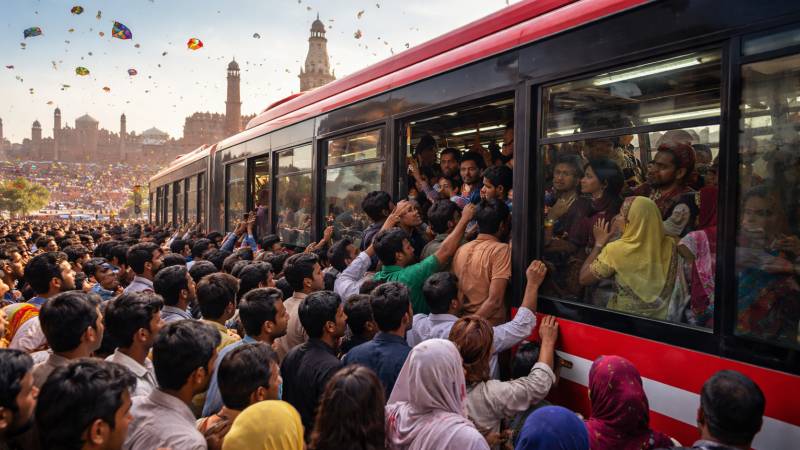
The revival of Basant in Lahore after nearly two decades was supposed to be a moment of collective joy, a return to colour, culture, and tradition. For many, it symbolised hope: kites in the sky, families on rooftops, and a city briefly reconnecting with its heritage. The Punjab government made visible efforts to ensure that this revival did not repeat the tragedies of the past.
Dangerous kite strings were banned, enforcement teams were deployed, and strict safety protocols were announced. Perhaps most notably, free public transport services were provided over the weekend to discourage motorcycle use and reduce accidents linked to kite strings. It was a rare attempt to balance cultural celebration with public safety.
Yet what unfolded across Lahore told a very different story. Free Metro Bus and Orange Line services were introduced specifically for safety reasons, urging citizens to avoid bikes and rely on public transport instead. The intention was clear: fewer motorcycles on the roads would mean fewer injuries and deaths.
But instead of treating this initiative responsibly, many commuters behaved as though free meant unlimited. Buses were packed far beyond capacity, passengers forced their way inside despite obvious overcrowding, and drivers were repeatedly compelled to stop because doors could not close properly.
Male passengers entered female-designated sections without hesitation. There was pushing, shouting, and complete disregard for elderly commuters and women. Drivers, overwhelmed and powerless, had to halt journeys again and again simply to clear doorways so buses could move. What should have been an organised public service became a chaotic struggle for space. This was not merely crowd pressure — it was a visible collapse of basic civic discipline.
To be fair, the government had played its role. After years of debate surrounding Basant’s safety, Punjab reintroduced the festival under controlled conditions, emphasising enforcement, surveillance, and public cooperation.
Chief Minister Maryam Nawaz Sharif publicly assured foolproof arrangements and appealed to citizens to celebrate responsibly. Public holidays were announced, emergency services were placed on alert, and extensive awareness campaigns were launched. This was governance attempting to meet cultural aspirations halfway.
But policies alone cannot create civic sense. What the Basant weekend revealed was a deeper social problem — one that cannot be fixed through regulations or free services. It exposed a mindset increasingly visible in everyday Pakistani life: rules are optional, public spaces are personal, and individual convenience outweighs collective comfort.
This behaviour is not limited to festivals. It appears in traffic violations, queue-jumping, misuse of public facilities, and casual disrespect for shared spaces. We often complain about broken systems, yet rarely reflect on how our own actions contribute to that breakdown. During Basant, instead of cooperation, many chose competition. Instead of patience, urgency. Instead of empathy, entitlement.
Civic sense is not a luxury reserved for developed countries. It is a basic requirement for survival in densely populated cities
There is also an uncomfortable generational aspect to this. Among segments of Gen Z and young adults, there seems to be a growing belief that discipline is outdated and boundaries are flexible. Confidence is mistaken for rudeness, and assertiveness becomes aggression. Standing in line feels unnecessary. Respecting capacity limits feels optional.
Yet these small behaviours form the foundation of any functioning society. Basant itself is deeply rooted in Punjab’s cultural history, representing spring, renewal, and communal harmony. Its revival should have been an opportunity to demonstrate social maturity — to show that we can celebrate while remaining responsible. Instead, the festival became a mirror reflecting how fragile our civic fabric has become.
People celebrated emotionally but failed socially. Buses meant for safety turned into overcrowded pressure chambers. Female sections meant for protection were violated. Drivers became unwilling referees in a daily struggle between rules and resistance. Everyone seemed focused on securing their own place, with little regard for others. This is not merely poor behaviour; it is a symptom of a broader identity crisis as a society.
We often admire Western cities for their cleanliness, discipline, and orderly public life. But civic sense there does not come from fear of punishment alone — it begins at home. Children are taught early to respect public space, wait their turn, and think about how their actions affect others. Here, we frequently teach the opposite: take your chance first, worry about others later.
The Basant weekend also highlighted a dangerous pattern in our national mindset. Whenever something goes wrong, responsibility is quickly shifted entirely onto the government. Yet this time, the state provided free transport, clear guidelines, and extensive safety arrangements. Still, chaos prevailed. This raises an important question: if citizens themselves refuse to cooperate, how far can governance really go?
Civic sense is not a luxury reserved for developed countries. It is a basic requirement for survival in densely populated cities. Without it, even the best policies fail. Free services turn into disorder. Safety measures become meaningless.
Cultural revivals lose their dignity. Basant brought colour back to Lahore’s skies, but it also exposed uncomfortable truths on the ground. It reminded us that reviving tradition is easier than reviving responsibility. Celebrating culture is simpler than practising courtesy. And that while governments can provide frameworks, only citizens can give them meaning.
As a nation, we must recognise that progress is not built solely through infrastructure or policy reforms. It is built through everyday choices — how we behave on buses, how we respect boundaries, how we treat strangers, and how willing we are to prioritise collective well-being over personal convenience. Until we internalise these basics, no festival, no free service, and no reform will ever fully succeed.
Basant may have returned after twenty years, but it left behind a pressing question for all of us: if we cannot demonstrate discipline and empathy during a simple cultural celebration designed for shared joy and safety, then how prepared are we to act like responsible citizens in more serious national matters?